Zara Anishanslin
Now ensconced in the American Wing of the Metropolitan Museum of Art, John Trumbull’s double portrait George Washington and William Lee has been reproduced time and again to illustrate both men (Fig. 1).[1] When Trumbull painted his now iconic piece in 1780, its subjects were already famous for their visibility in the American war for independence (1775-1783): Washington, of course, as Commander-in-Chief of the Continental Army, and Lee as his enslaved body servant. Lee was constantly at Washington’s side during the war, tending to his personal needs, caring for his uniforms, serving when Washington entertained, safeguarding his papers, and perhaps even sleeping in a small antechamber of the commander’s multi-chambered muslin tent. But Lee was more than a valet. He was renowned for his remarkable equestrian skills, honed before the war in Virginia fox hunts.[2] And he was a well-known figure to British, French, and American soldiers for riding by Washington’s side, holding his spyglass, and appearing on battlefields. Lee was an integral part of Washington’s wartime mythology.[3]

Trumbull’s portrait memorialized the men’s interwoven wartime history, foreshadowing his future skills as a history painter.[4] His inclusion of Lee made aesthetic as well as historical sense. By 1780 there was a long tradition in European and American art of including Black figures alongside white subjects. Such pairings often did precisely what Trumbull’s painting does: highlight the white subject’s wealth, power, and race while perpetuating racialized stereotypes of Black people.[5] In Trumbull’s portrait, the Black figure famously identified as William Lee almost certainly looks nothing like Lee himself.
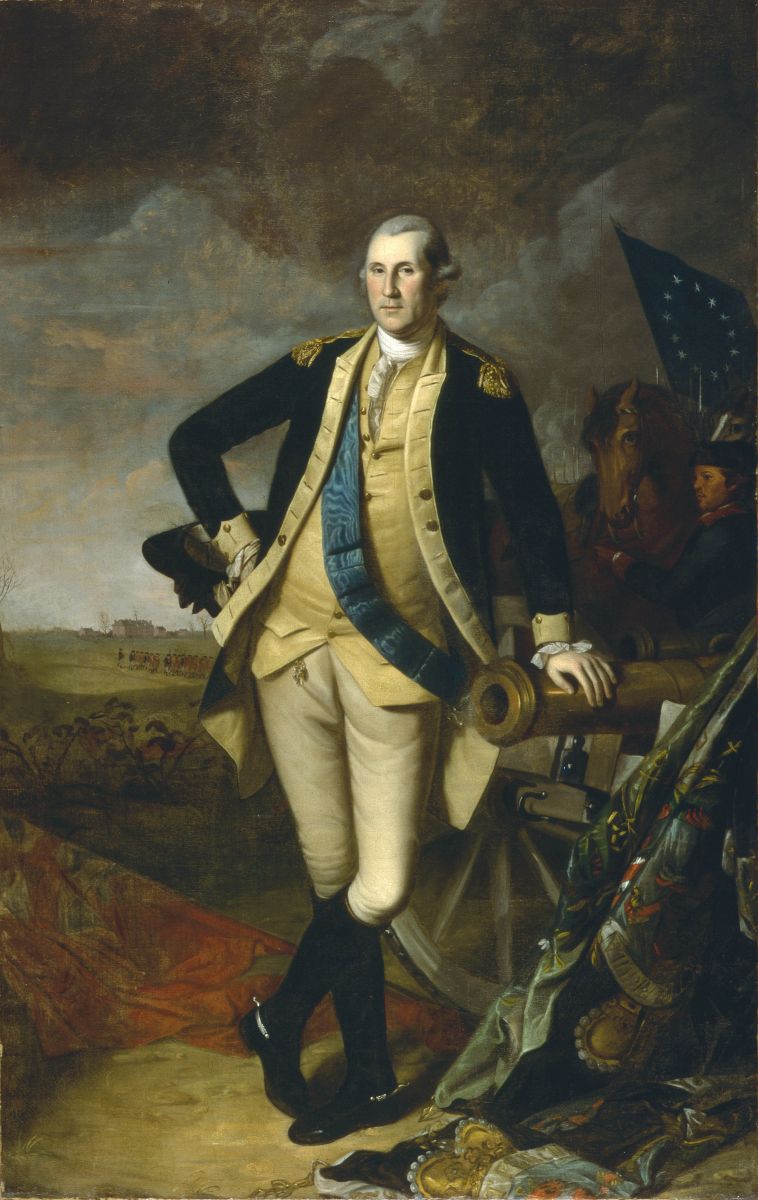
Although an accurate likeness is not necessarily the most important element of an eighteenth-century portrait, in this case it matters. Trumbull’s visual misrepresentation of Lee reflects both a long artistic tradition of racialized stereotyping and a long history of dismissing Black contributions to the founding of the United States. If we look for William Lee the historical actor, we recognize Lee as one of many Black Founders who helped fight the American Revolution and build the United States of America.[6] We can find that William Lee in a portrait by Charles Willson Peale painted the year before Trumbull’s image—a portrait not commonly acknowledged to include Lee at all (Fig. 2).
Trumbull served as one of Washington’s aides-de-camp in the Continental Army, where he would have seen Lee daily. Lee’s dress accurately reflects the blue and red coat he wore as a wartime uniform in place of the red and white livery he wore at Mount Vernon.[7] Lee did not, however, wear a turban as part of either his uniform or his livery. That addition was pure fiction on Trumbull’s part, and a symbolic fiction at that. The artist chose to paint Washington’s valet in the form of an “orientalized” stock figure used repeatedly in eighteenth-century art to symbolize “Blackness”—the image of a person with very dark skin and exaggerated facial features, wearing accessories that marked the figure as African, such as a silver collar, pearl earring, or, as in this painting, a turban.[8]
Trumbull painted the double portrait in London, completing it before his arrest and imprisonment on a treason charge.[9] Once freed, he left England to avoid further prosecution. But his double portrait of Washington and Lee left a lasting impression in Europe. Engraved as a mezzotint by Valentine Green, it enhanced Washington’s heroic image and made his enslaved companion an important part of his iconography (Fig. 3).
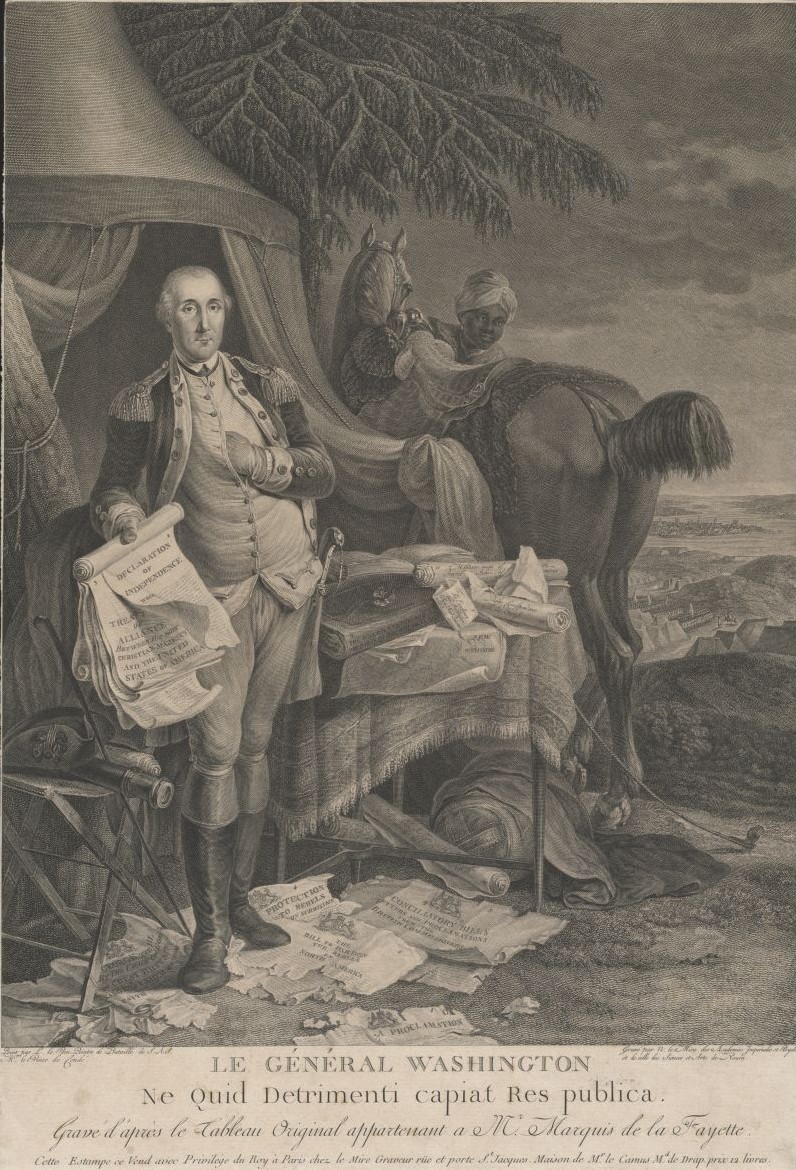
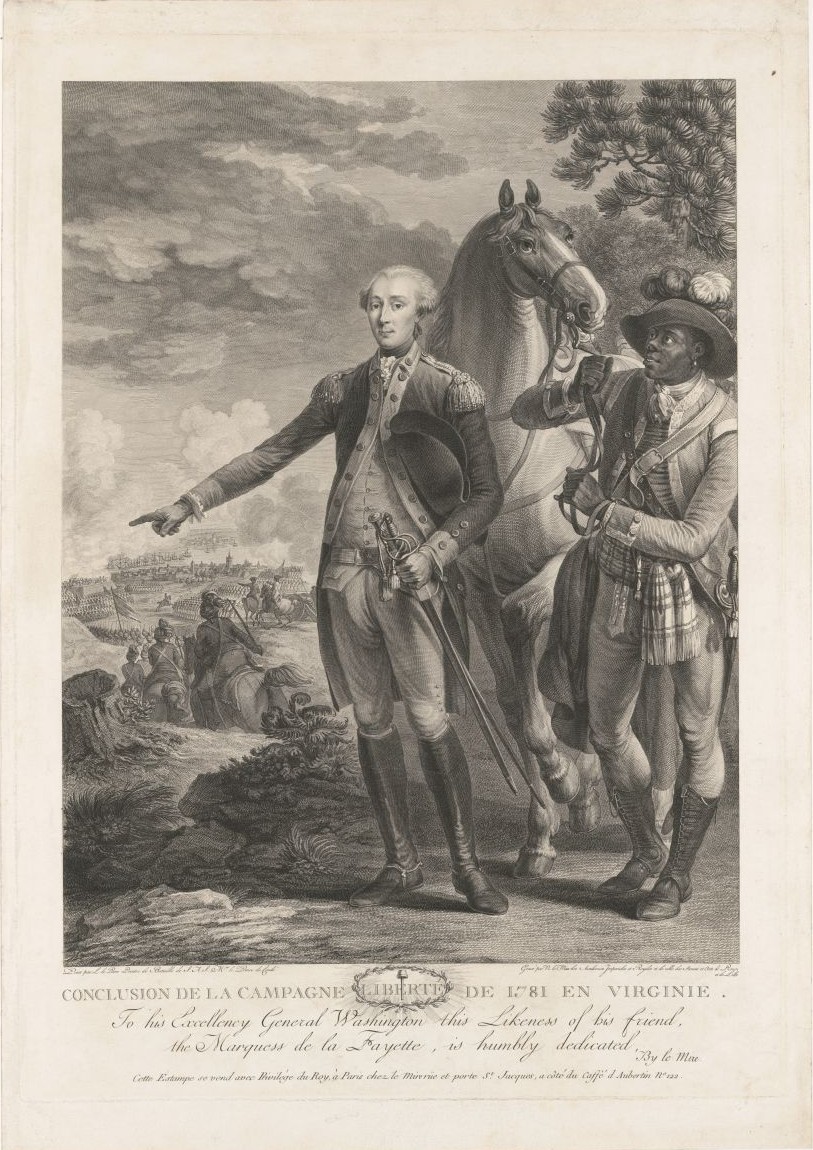
In 1783, French engraver Noël Le Mire published a print after a portrait by French painter Jean-Baptiste Le Paon—originally created for the Marquis de LaFayette—that further spread images of a paired Washington and Lee around Europe (Fig. 4). The French painting and engraving differed from Trumbull’s original and Green’s mezzotint: Le Paon modelled his figure of Washington on Peale’s 1776 portrait commissioned by Continental Congress President John Hancock, a copy of which LaFayette possessed; he also substituted a military camp for West Point and added a tent as well as political symbols, including copies of the Franco-American Alliance agreement.[10] Like Trumbull and Green, however, the French artist included a turbaned Black figure and a horse. So did Le Mire’s print, marking the start of centuries in which the Trumbull painting shaped public perception of Lee as a racially stereotyped, “orientalized” figure.
By contrast, Peale’s painting likely does show the real Lee (Fig. 2).[11] In 1779, Pennsylvania’s Supreme Executive Council commissioned Peale to render a grand painting of Washington to hang in the council chamber of the State House in Philadelphia (now Independence Hall). Peale later made multiple copies of the painting with slight variations.

In the original, Washington wears his buff-and-blue Continental army uniform, a blue silk sash marking his general’s rank. He leans confidently on a cannon with seized Hessian flags strewn at his feet and his personal headquarters flag of thirteen white stars on a field of dark blue waving triumphantly aloft. Behind Washington, a man holds the reins of a horse, probably Washington’s favored chestnut, Nelson, and wears a dark blue coat with red facings (Fig. 5). His skin is closer to the brown of the horse than the pale skin of Washington. In the background, a landscape marked by Nassau Hall at the College of New Jersey (now Princeton College) shows the site of the Battle of Princeton.
Peale took pains to accurately depict the battle site (in which he fought) as well as Washington, his flag, and his horse. Although the man in the background is not identified, there is good reason to think that he is Lee, and that Peale has provided an accurate representation of him, too.
Lee was certainly known to Peale, who served under Washington, just as he was to Trumbull. Indeed, both artists show him as a horseman, conveying one of Lee’s defining skills. They also depict him in the same coat and distinguish his skin as darker than that of Washington. But unlike Trumbull, Peale had the chance to paint William Lee from life. In 1779, Lee was with Washington in Philadelphia. Lee may have been keen to have his portrait painted in the city, as that was the year he married a free Black woman from Philadelphia who worked in Washington’s headquarters, Margaret Thomas.[12]
The physique of the man in the original painting resembles a description of Lee as “low, but sturdy, and of great bone and muscle.”[13] Moreover, Lee was a man of mixed race, as suggested in Peale’s depiction. Washington purchased William Lee (born c. 1750–52) in 1767 from Mary Smith Ball Lee, the recently widowed wife of John Lee. William and his brother Frank kept the surname Lee despite the purchase.[14] The Lees might have been John Lee’s children: John and Mary had no children of their own, and her sale might have reflected her discomfort with her husband’s enslaved offspring.
Washington alternated how he referred to Lee, calling him Billy, William, and Will. Lee himself preferred the more dignified William. But despite changing Lee’s first name, Washington never changed his description of him as a “mulatto,” a term used in eighteenth-century America to indicate that a person was of mixed race, with one white parent and one Black parent. At the time, such terms were meant as much to maintain a racist distinction between whites and others as to categorize someone’s parentage in service of race-based chattel slavery.[15]
Like many other Virginia planters, the Washingtons preferred to employ enslaved workers with lighter complexions in their personal domestic spaces. Enslaved, mixed race household workers often worked as valets, like Lee. William Lee undoubtedly looked more like the brown man in Peale’s portrait than the stereotyped stock figure of enslaved Black servants used by Trumbull.[16]
Although there is no archival evidence that Peale painted Lee from life in 1779, he later observed changes to Lee’s physique during an 1804 trip to Mount Vernon. Lee suffered crippling knee injuries in the 1780s that caused “both of his knee pans” to be “moved from their places…some Inches higher up.”[17] Lee was one of thousands of Black men who helped win the war, but he was among the most famous, with an unusually individual role.[18] Peale’s visit to Lee was in keeping with practice by other revolutionary war soldiers who made the pilgrimage to Mount Vernon. Lee reminisced with these veterans about fighting together for independence.[19] And “all of them bestowed a token of remembrance upon the old body-servant of the Revolution.”[20]
Unlike some other Black soldiers who enlisted, Lee most likely had no choice about his service. He did claim pride in it, however. And for reasons that remain opaque to us today, unlike other people enslaved by the Washingtons, he never sought self-emancipation during or after the war.
But Lee did end his life as a free man. Washington made a special exception for Lee in his will, granting him “immediate freedom” in testimony of “his faithful services during the Revolutionary War.”[21] Lee survived for years after Washington’s death, working as a shoemaker at Mount Vernon and increasingly turning to alcohol (to soothe his knee pain and also, perhaps, the trauma of war). He died sometime between 1810 and 1828 and was buried in Mount Vernon’s enslaved people’s cemetery. There is no marker on his grave.
Finding the historical William Lee—rather than racialized stereotypes, as in Trumbull’s painting—is more than an exercise in recapturing a likeness. It is also reparative work. Celebrating Lee as a Black Founder encourages us to consider other Black people’s histories hidden within iconic paintings. Peale’s depiction takes a step towards humanizing Lee’s image and giving him his historical due, and it invites us to celebrate the important contributions Black Founders made to the creation of the United States.
Zara Anishanslin, Associate Professor of History and Art History at the University of Delaware, is the author of The Painter’s Fire: A Forgotten History of the Artists who Championed the American Revolution (2025)
[1] It was used, for example, in the PBS documentary, “The American Revolution,” (2025) directed by Ken Burns, Sarah Botstein, and David Schmidt.
[2] On William Lee at Mount Vernon and during the war, see George Washington Parke Custis and Mary Custis Lee, Recollections and Private Memoirs of Washington (J. W. Bradley, 1861); Mary V. Thompson, “The Only Unavoidable Subject of Regret”: George Washington, Slavery, and the Enslaved Community at Mount Vernon (University of Virginia Press, 2019); Susan Schoelwer, ed., Lives Bound Together: Slavery at George Washington’s Mount Vernon (Mount Vernon Ladies’ Association, 2016); Philip J. Schwarz, ed., Slavery at the Home of George Washington (Mount Vernon Ladies’ Association, 2001).
[3] See James Thacher, Military Journal of the American Revolution (1823).
[4] On Trumbull, see Richard Brookhiser, Glorious Lessons: John Trumbull, Painter of the American Revolution (Yale University Press, 2024); Paul Staiti, Of Arms and Artists: The American Revolution Through Painters’ Eyes (Bloomsbury, 2016); John Trumbull, Autobiography, Reminiscences, and Letters of John Trumbull, from 1756 to 1843 (Wiley and Putnam, 1841).
[5] On this tradition, see Catherine Molineux, Faces of Perfect Ebony: Encountering Atlantic Slavery in Imperial Britain (Harvard University Press, 2012); David Dabydeen, Hogarth’s Blacks: Images of Blacks in English Art (Manchester University Press, 1987); Jennifer Van Horn, Portraits of Resistance: Activating Art During Slavery (Yale University Press, 2022); Gwendolyn DuBois Shaw, “On Seeing the Stain of Slavery: An Art History of Titian’s Poesie (1550) and the Maryland Portraits of Justus Engelhardt Kühn (1710),” second annual Benjamin Franklin Distinguished Lectures, University of Pennsylvania, October 20-23, 2025.
[6] The term “Founder” references people engaged in establishing the United States of America, usually through political leadership or military service. Historically, it has almost exclusively referred to white men. I use it deliberately both to give William Lee his due and to disrupt its historically commonplace association.
[7] See “Clothing,” George Washington’s Mount Vernon (all web links accessed February 9, 2026).
[8] A well-known example of this type and its iconography is found in the print: Samuel Phillips, engraver after William Hogarth, “Taste in High Life” (London, 1798), Plate: 15 1/4 x 18 3/8 in. The Metropolitan Museum of Art, Gift of Sarah Lazarus, 1891, no. 91.1.80.
[9] Trumbull had the misfortune to be in London at a time when the British government looked with increasing suspicion upon Americans in Britain, and high-profile arrests were often made without benefit of due process after the Treason Act of 1777. For more on American artists in London during the Revolution, see Zara Anishanslin, The Painter’s Fire: A Forgotten History of the Artists Who Championed the American Revolution (Harvard University Press, 2025).
[10] The original Peale painting was commissioned as a pair with one of Martha Washington (now lost). Charles Willson Peale, George Washington (1776), Brooklyn Museum, Dick S. Ramsay Fund, 34.1178.
[11] Carol Eaton Soltis, The Art of the Peales in the Philadelphia Museum of Art: Adaptations and Innovations (Philadelphia Museum of Art, 2017).
[12] See “William (“Billy”) Lee,” at https://www.mountvernon.org/library/digitalhistory/digital-encyclopedia/article/william-billy-lee.
[13] Custis and Lee, Recollections, 387.
[14] The George Washington Financial Papers Project [Original source: The Papers of George Washington Digital Edition, ed. Theodore J. Crackel (University of Virginia Press, Rotunda, 2008), n2.]
[15] Jennifer Morgan, Reckoning with Slavery: Gender, Kinship, and Capitalism in the Early Black Atlantic (Duke University Press, 2021).
[16] Contrast the brown skin of the man holding the horse in the original version of the painting with renditions such as George Washington at the Battle of Princeton (1784) at the Princeton University Art Museum, which includes General Hugh Mercer and Dr. Benjamin Rush, who both have luminously pale skin.
[17] Quoted in Jessie MacLeod, “William Lee (fl. 1768–1810),” Encyclopedia Virginia, Virginia Humanities (07 Dec. 2020). Web.
[18] Despite Washington’s initial misgivings, the Continental Army became a largely integrated fighting force. Sylvia R. Frey, Water from the Rock: Black Resistance in a Revolutionary Age (Princeton University Press, 1991); Judith van Buskirk, Standing in Their Own Light: African American Patriots in the American Revolution (University of Oklahoma Press, 2017).
[19] Custis and Lee, Recollections, 451.
[20] Custis and Lee, Recollections, 450.
[21] George Washington, Founders Online, National Archives. [Original source: Papers of George Washington.] https://founders.archives.gov/documents/Washington/06-04-02-0404-0001
Cite this article as: Zara Anishanslin, “Finding William Lee: A Black Founder in Early American Portraiture,” Journal18, Issue 21 Revolutions (Spring 2026), https://www.journal18.org/8143.
License: CC BY-NC
Journal18 is published under a Creative Commons CC BY-NC International 4.0 license. Use of any content published in Journal18 must be for non-commercial purposes and appropriate credit must be given to the author of the content. Details for appropriate citation appear above.
