Matthew Gin
On 20 Brumaire Year II (November 10, 1793), the Convention Nationale met in the Salle des Machines in Paris. Once used for royal entertainments, the hall had recently been converted into a meeting chamber for the new revolutionary legislature. An otherwise ordinary session took a spectacular turn when a delegation from the city government of Paris was permitted to address the assembly.[1] The municipal prosecutor (procureur), Pierre-Gaspard Chaumette, spoke on the group’s behalf. Chaumette informed the Convention that the citizens of Paris had just inaugurated that day a new cult dedicated to Reason in Notre-Dame Cathedral. The people had enthroned a Goddess of Reason in the church and made a sacrifice to her. He declared: “the gothic vaults, long battered by the voice of error … resounded for the first time with the cries of truth.”[2] Chaumette urged that the cathedral now be given over to the Revolution in accordance with the people’s wishes: “Fanaticism has abandoned [Notre-Dame]; reasonable beings have seized it. Consecrate their ownership.”[3] In response to this petition, François Chabot, the deputy from Loir-et-Cher, moved that Notre-Dame Cathedral be henceforth the “Temple of Reason.” The Convention adopted the motion and granted the people’s request. As the chamber erupted in triumphant applause, city officials ushered in a woman dressed as the Goddess of Reason and installed her on the presiding officer’s tribune.
Notre-Dame’s conversion into a Temple of Reason triggered a wave of similar transformations across France as part of larger movements to supplant Christianity with a new atheistic religion called the Cult of Reason. Conversions occurred within a brief, turbulent moment that only lasted from 20 Brumaire Year II to 18 Floréal Year II (November 10, 1793, to May 7, 1794) when Maximilien Robespierre officially suppressed the atheistic religion and replaced it with a deistic belief system called the Cult of the Supreme Being.[4] During this period, hundreds of churches from great cathedrals to small parishes were rebaptized as centers of Republican instruction, devotion, and ceremony.[5]
Histories and myths of the French Revolution have long invoked Temples of Reason as symbols of cultural upheaval and iconoclastic excess.[6] Yet, as historian Nigel Aston observes, much has yet to be discovered about what happened in Temples of Reason with regard to their ritual usage.[7] Similarly, these temples remain largely unexamined as either distinct building types or architectural artifacts of the Revolution’s political and cultural ambitions.[8]
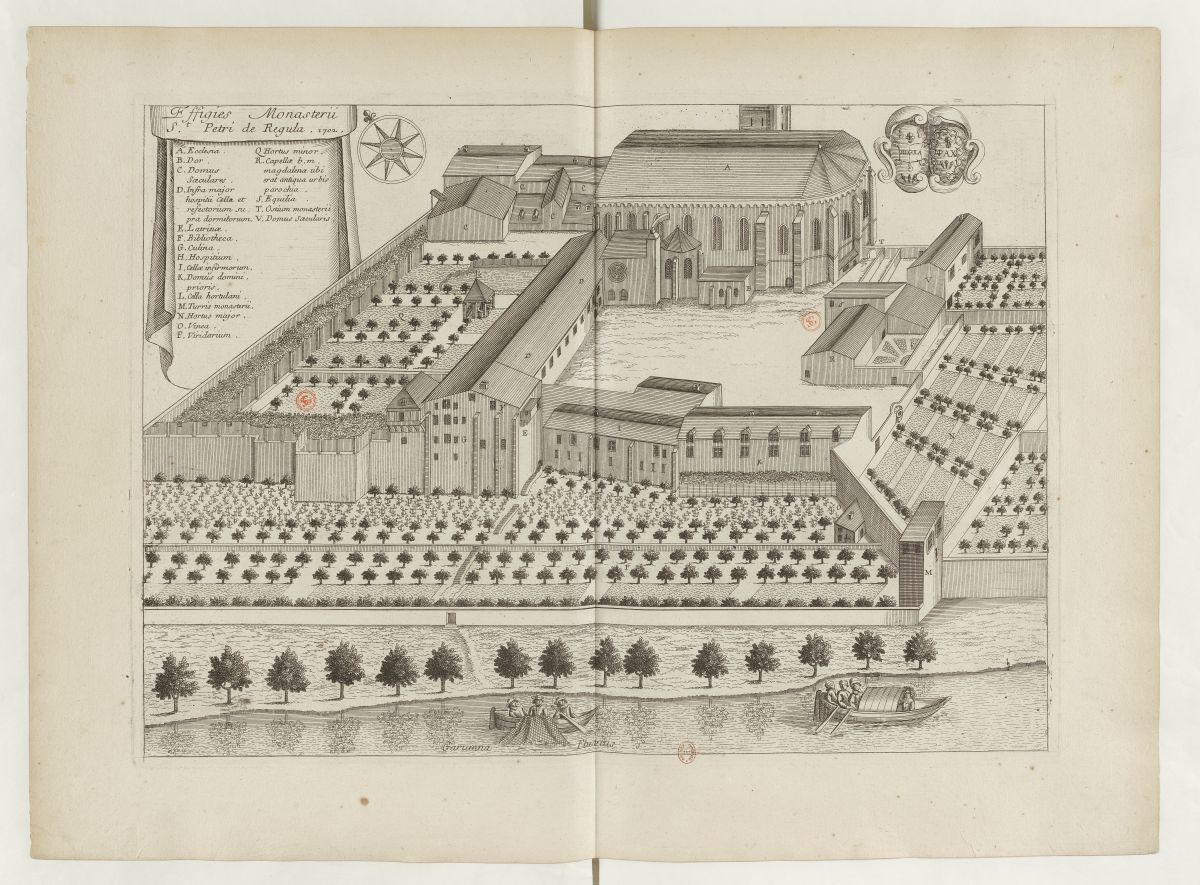
Several months after the events of 20 Brumaire, in La Réole, a small town of 5,000 people located 50 miles outside of Bordeaux, the architect Alexandre-Théodore Brongniart (1739–1813) undertook a project to convert the Church of Saint-Pierre into a Temple of Reason (Fig. 1). This study examines the design maneuvers that Brongniart deployed to remake this twelfth-century Benedictine priory church into a sanctuary for the Republic. As part of altering the building, the architect created new spatial effects that lent sacrality to an atheistic religion and enhanced the performance of revolutionary politics.
Central to this investigation are drawings by Brongniart from the Louvre Museum and the Archives Départementales de la Gironde in Bordeaux. These drawings reveal how the architect imagined ritual space for a new religion that had yet to develop regular patterns of worship or normative ideas about space that were free of Christian influence. While the designs were never fully realized, the architect developed them with the intention that they would be built. Brongniart’s project, as such, complicates conventional narratives of the Revolution as a time when architectural production was limited to visionary design experiments that were only ever supposed to exist on paper.[9]
The La Réole Temple of Reason captures Brongniart’s efforts to develop a novel building type by reworking Christian and revolutionary ritual-spatial practices. More broadly, the La Réole Temple of Reason directs attention to less familiar sites of revolution. By looking to a church in a small, seemingly out-of-the-way place, this investigation rescales ideas about where and how revolutionary culture was made.
The Cult of Reason: Belief, Ritual, and Space in Flux
As a new religion, the Cult of Reason offered Brongniart very little in the way of established ritual practices or spatial requirements that could inform the design of sacred space. The Cult of Reason emerged from the Revolution’s chaotic campaign of dechristianization. Efforts were made to extirpate Christianity (particularly Roman Catholicism) as the dominant cultural force in French society and replace it with new and secular Republican frames of reference.[10] The campaign against the church unfolded differently across France and was not always well received. In taking on the transformation of Saint-Pierre, Brongniart navigated a fraught political and religious landscape that differed from the one he knew from before the Revolution.
Actors from across society spread the Cult of Reason.[11] In towns of all sizes, municipal officials and local revolutionary clubs promoted the new religion by sponsoring the conversion of churches and organizing worship services. Administrative envoys from the national government also played a crucial role. Called representatives-on-mission (représentants en mission), these officers were stationed in towns across the country and were invested with exceptional levels of authority to maintain order and implement revolutionary policies. In the historical region of Aquitaine where La Réole is located, the représentant en mission Claude-Alexandre Ysabeau was the primary driver of the new religion, and it was under his authority and patronage that a Temple of Reason was erected in La Réole.[12]
The Cult of Reason was neither a unified institution nor a coherent system of belief.[13] Rather, it was a collection of atheistic ideas and practices centered on devotion to the Republic. In this way, the Cult’s primary motivation was not the cure of souls but the cultivation of virtuous patriotic citizens. The Cult of Reason did not worship Reason as a god.[14] Instead, it was the religion of Reason in the sense that it rejected superstitious ideas of the divine. The Cult of Reason rendered sacred Republican values like liberty and elevated a pantheon of martyrs that included assassinated politicians like Jean-Paul Marat and Louis-Michel le Peletier. Within Temples of Reason, statues of heroic figures and costumed actors personifying revolutionary virtues served not as objects of worship but as living examples of Republican ideals that were worthy of emulation and homage.
In towns across France, the Cult of Reason provided an opportunity for people to reimagine religion. Liturgical experimentation was widespread. In the absence of a central authority to oversee ritual practice, people in specific locales created new ceremonies by reworking familiar sacred and secular elements. As a result, devotional practices generally looked different from one place to another. Iconographic conventions and common types of furnishings, though, did emerge informally. Temples of Reason, for instance, frequently featured altars in the form of mountains that gave tangible expression to ideas of natural religion and notions of spiritual transcendence.[15]
Christianity’s influence endured despite official attempts to suppress it, and certain devotional practices retained the flavor of Roman Catholicism. Marat’s death, for instance, inspired a cult of bodily relics and a new Trinitarian formula that replaced “Father, Son, and Holy Spirit” with “Marat, Peletier, and Liberty or Death.”[16] People did not universally embrace revolutionary devotions. Marat’s cult proved controversial, and citizens in some places refused to participate on the grounds that such practices were blasphemous or excessively triumphalist.[17]
Published accounts from around France describe the temples as platforms for regular weekly services often called Festivals of Reason (Fêtes de la Raison) that were held on Décadi, the last day of the ten-day week in the new Republican calendar. The Cult’s ritual practice also included ceremonies for special events such as the inauguration of a new Temple of Reason and for occasions of national significance such as the abolition of slavery.[18] Services, which could last for several hours, varied in form but typically included processions, dramatic performances, the ritualized profaning of Christian liturgical objects, congregational singing, and patriotic speeches delivered by orators drawn from across society including, on one occasion, the female Creole abolitionist Marie-Thérèse Lucidor Corbin.[19] Participation was less than enthusiastic in some places, and authorities sought coercive measures to compel attendance in the Temple of Reason. In Floréal Year II (May 1794), the revolutionary club in the eastern French village of Turny petitioned the National Convention to punish nonattendance at Décadi services by depriving offenders of their rights as citizens.[20]
Buildings played an important role in the Cult of Reason given its emphasis on corporate devotion. Temples of Reason constituted revolutionary acts of repurposing. They were never built anew. Rather, temples were remade from existing church buildings through various kinds of cosmetic and structural interventions. Groups of citizens, revolutionary clubs, and government authorities across France most frequently targeted Roman Catholic churches, but a Jewish synagogue and a ruined Roman temple are also known to have been converted into Temples of Reason.[21]
In the absence of official doctrine or established tradition to guide the use of space, people developed different ideas about what a Temple of Reason was and the practices it would accommodate. For instance, in the Loire, the représentant en mission Claude Javogues issued a decree that established the Temple of Reason not as a ceremonial platform but as a space of civic self-edification more akin to a public library where individuals prepared themselves for the duties of citizenship by studying government papers and legal documents.[22]
Communities in Aquitaine generally embraced the Cult of Reason.[23] In La Réole, the Cult was active prior to Brongniart’s arrival. Limited accounts found in local government records speak to how people there negotiated a relationship to this new religion. In Ventôse Year II [March 1794], La Réole’s revolutionary club successfully lobbied municipal authorities to change the start time of the weekly Fête de la Raison from 10:00 a.m. to the more convenient hour of 2:00 p.m. so that citizens could attend free of concern for their morning chores.[24] Beyond capturing how the Cult of Reason figured into daily life in La Réole, this case underscores the important role that local authorities played in managing the exercise of religion.
In the absence of more robust evidence from La Réole, a pair of documents related to the conversion of the Church of Saint-Dominique in Bordeaux in 1793 offers a useful view into the practices and ideas that shaped Brongniart’s design for the conversion of Saint-Pierre. The architect was based in Bordeaux while working on the temple project, and the city’s experience with the Cult of Reason shaped his understanding of the religion’s ritual and spatial requirements. Bordeaux was also the region’s primary center of power, and authorities in La Réole looked to officials there for policies and resources.
An anonymous, undated speech offers a window into liturgical developments.[25] Likely addressed to municipal officials in Bordeaux, the speech calls for the transformation of the Church of Saint-Dominique into a Temple of Reason. The author proposes that the revolutionary faithful gather there at 10:00 a.m. on Décadi for a three-hour-long service that was to begin with an organ prelude followed by a procession of children and veterans to an altar in the form of a mountain where they were seated for the duration of the service. Then a designated orator would deliver an address on one of several subjects that was preapproved by a group of twelve commissioners who oversaw the temple. The service was to conclude with a period of joyful singing, lasting no more than fifteen minutes, and a reverse procession of the veterans and children.
The text describes a space that largely retained the form and character of a church. It specifies that the temple will have two banks of chairs separated by a three-foot-wide central aisle and that the congregation will be segregated by sex with men seated on the left and women on the right. To maintain an atmosphere of sacred reverence, the speech admonishes the commissioners to exclude prostitutes (femmes publiques) from the temple and instructs the orator to rebuke families whose children repeatedly disrupt services.
In Bordeaux, municipal authorities believed that the Temple of Reason fulfilled a larger spiritual civic mission. A broadsheet from 1793 announcing Saint-Dominique’s conversion describes the Temple of Reason as a vehicle of evangelism that was consecrated not to God but to a sacred humanity:
Citizens, it is in the Temple of Reason that your heart will be nourished and raised to the most sublime virtues; it is here that, by instructing yourselves in the precepts of sound morality, you will learn that the exercise of social virtues carries deep in the heart the love of humanity, and that if sacrifices to virtue are often difficult to make, it is always sweet to have made them; it is here, finally, where you will learn to bear, with pleasure, the gentle burden of a life useful to your fellow man, and that if the most wicked man could be someone other than himself, he would want to be good.[26]
As this text makes clear, the Temple of Reason was conceptualized as a place of special revolutionary purpose that elevated people both individually and collectively to a virtuous self-sacrificing citizenship. If the church prefigured heaven, the Temple of Reason anticipated a perfected Republican body politic. Transforming Saint-Pierre was thus no small order. Brongniart was not just remodeling a church. He was designing an entirely new kind of sacrality.
Brongniart and the Design of Sacred Space
Brongniart undertook the La Réole Temple of Reason project during a two-year stay in Bordeaux from 1793 to 1795. Long based in Paris, where he had designed aristocratic homes as well as major institutional projects such as the expansion of the royal military school, Brongniart left the capital and traveled south in search of work.[27] The Revolution ended crown patronage and created difficult conditions for architecture more generally as the volatile political and economic situation post-1789 drove elite clients into exile and made it difficult to secure credit for large building campaigns.[28] During his time in Bordeaux, Brongniart executed commissions for local authorities that included ephemeral decorations for revolutionary festivals as well as larger urban planning schemes.[29] An enthusiastic supporter of the Revolution, Brongniart undertook these commissions not just as sources of income but also as architectural expressions of support for the new regime.[30]
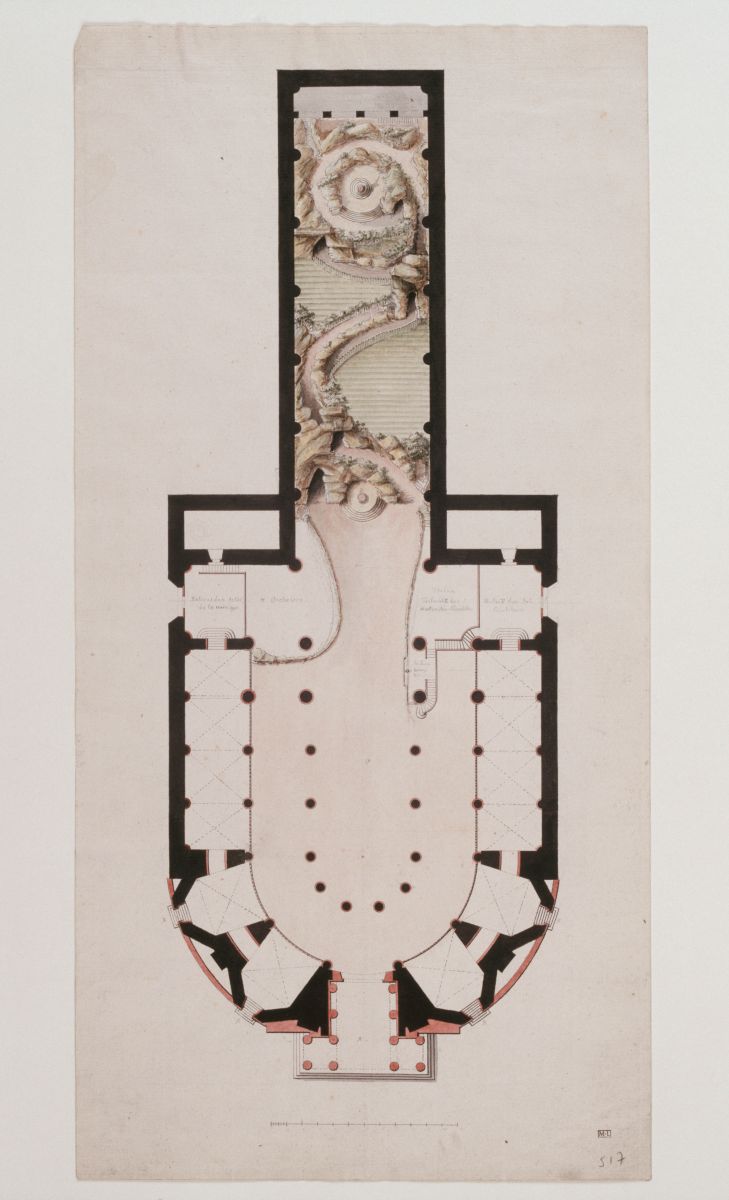
Prefiguring the project at La Réole, Brongniart remodeled, in 1793, the Cathedral of Saint-André in Bordeaux to serve as a Temple of Reason. He transformed the Gothic church by removing the Christian liturgical furnishings and inverting traditional spatial distinctions between sacred and profane within the Latin cross plan. In the vaulted nave, where the congregation normally assembled, Brongniart installed a mountain altar crowned by a statue of Liberty personified as a woman (Fig. 2). Around the mountain grew an artificial landscape with rocks, grottos, trees, and a circuitous path leading from the transept to its peak. Towards an upending of Christian usage, the mountain’s curved trail interrupted the traditional linear processional pathway down the nave. Brongniart’s designs further violated Christian sacred space by accommodating the public in the chancel, which was traditionally reserved only for the clergy and choir. The architect also created new sensorial effects that heightened the building’s drama. Recalling the Baroque’s theatrical staging of the divine, Brongniart artfully concealed the lights in the church such that the mountain appeared to be illuminated by an unseen supernatural presence.
Saint-Pierre was already being used as a Temple of Reason by the time Brongniart arrived in La Réole. In Pluviôse Year II (late January–early February 1794), Ysabeau designated the church as the site for the Fête de la Raison services held on Décadi and hastily adapted the building for revolutionary use.[31] Largely maintaining the church’s existing plan, he ordered chairs for the sanctuary and specified that they be arranged in segregated sections with men seated on the right and women on the left.[32] In place of the altar and pulpit, Ysabeau had a desk installed at the front of the assembly from which civil authorities would address the people. Municipal records note that these temporary measures were to suffice until a suitable architect was dispatched from Bordeaux.
It is not clear why Ysabeau chose to erect a temple in La Réole. It may have been an expression of personal favor as he had used the town as his headquarters while suppressing a revolt against the Convention Nationale in Bordeaux in 1793.[33] More practically, Ysabeau likely selected Saint-Pierre for conversion because it was substantially larger than the town’s other church. The transformation of Saint-Pierre into a Temple of Reason also provided revolutionary authorities with an important symbolic victory over the Benedictines who had established the priory in La Réole in 977.[34]
Brongniart began work on the Temple of Reason in La Réole as early as 29 Ventôse Year II (March 19, 1794), when Ysabeau dispatched him to the town for discussions with municipal officials about the project.[35] The next month, in Germinal Year II (April 1794), Ysabeau approved Brongniart’s plans and ordered the appropriation of funds for the project. Lacking more robust resources and labor, he decreed that women, children, and the elderly from the local workhouse (atelier de charité) be enlisted to aid in the construction.[36]
Brongniart’s designs for the La Réole Temple of Reason are known through a series of drawings executed in pen, wash, and watercolor with a high degree of finish. The sheets are exceptionally rare. They constitute one of only two known sets of fully developed designs for a Temple of Reason.[37] Individual drawings for other temple projects survive, but they are not as detailed or comprehensive. [38] The presence of a signature as well as an inscription, “bon pour l’éxecution” (fit for execution) dated Vendémiaire Year III (September-October 1794), on many of Brongniart’s sixteen drawings indicate that they were finalized designs used for official review and construction. The eight drawings from the Louvre Museum show the temple in plan, section, and elevation with detailed renderings of scale figures and liturgical furnishings. A shared scale bar links the drawings as a sequence of views. The eight drawings from the Archives Départementales de la Gironde are rendered at a larger scale and provide construction specifications for the remodeling of the church’s transept and apse, underscoring their technical function for builders.
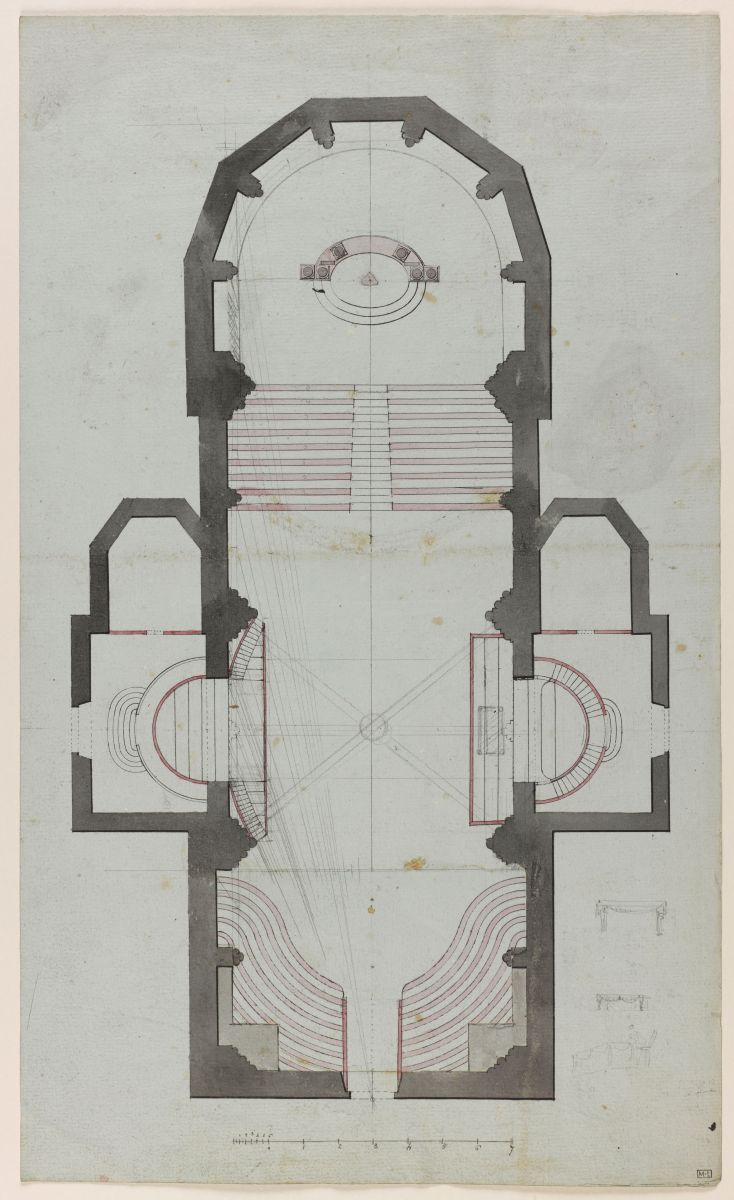
Brongniart embraced the opportunity to fully and permanently accommodate the Fête de la Raison in the former church. Transforming the building for revolutionary use required not just different liturgical furnishings but also entirely new sensorial activations that inspired reverence for the Republic. For the entrance at the temple’s west end, Brongniart marked a sacred threshold. The plan and section show that in the absence of a narthex, the architect planned a deep coffered portal (visible on the bottom of the plan and the left of the section views) to mediate the transition from the exterior into the sanctuary (Figs. 3 and 4).
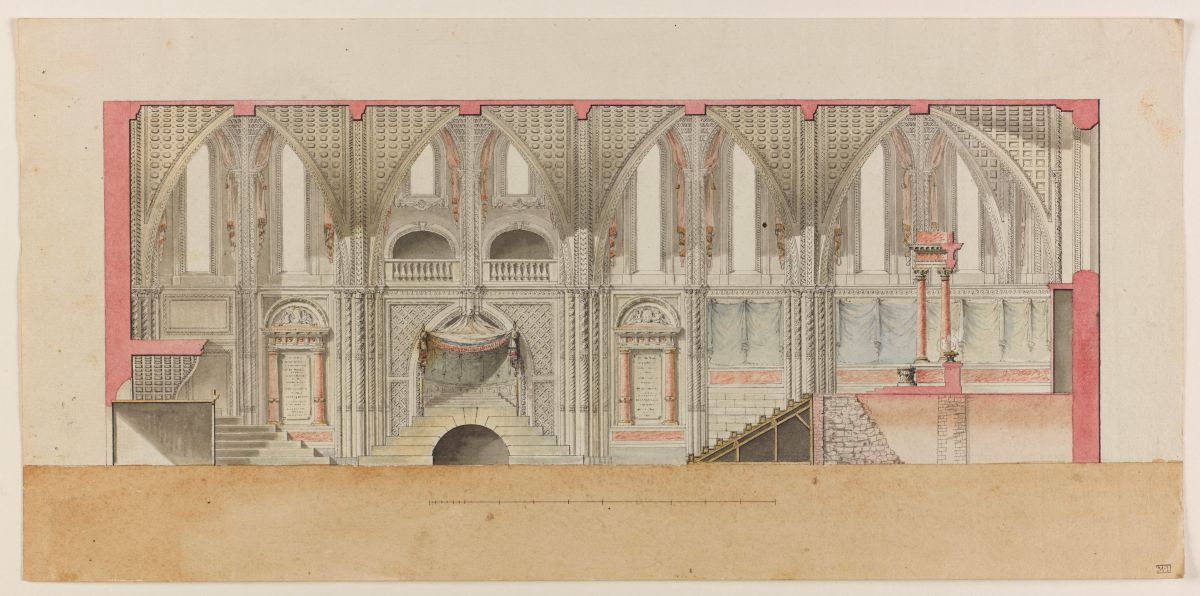
Moving through this narrow passage, the faithful would experience darkness and compression before passing into the bright openness of the Gothic nave. The portal also served as a framing device. In the plan, Brongniart calls out the dramatic uninterrupted views of the sanctuary that people would experience upon first entering the temple using a series of thin radiating lines that originate at the building’s entrance. Within the nave, the congregation sat in a pair of curved bleachers on the church’s west end that were separated by the entrance portal. This arrangement maintained the segregation of the faithful by sex that Ysabeau instituted in an earlier iteration of the temple.
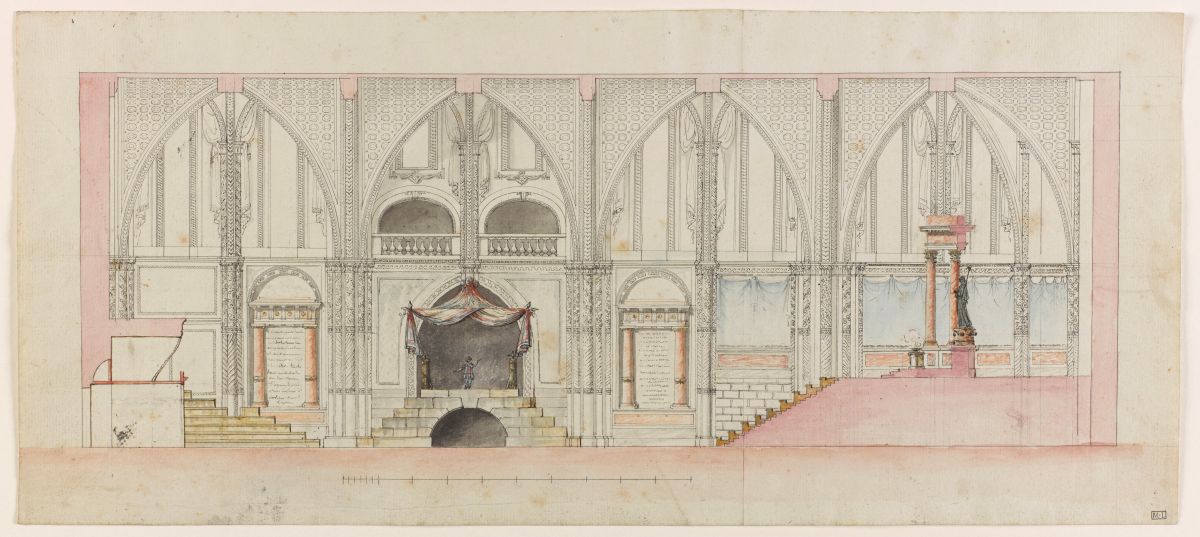
Brongniart devoted significant attention to remodeling the transept for new devotional practices. As detailed in the plans, the architect closed off the side chapels in order to install a pair of elevated platforms in the arches that open onto the crossing. The north transept, which is on the left of the plan, was to serve as the orator’s tribune. In the elevation view of the nave, Brongniart illustrates the platform occupied by a speaker in a blue and red coat dramatically framed by the pointed arch, fasces, and a tricolor canopy (Fig. 5). Drawings show that Brongniart planned to close the back of the tribune with a semi-dome, fashioned from wood and likely plaster, and decorated with trompe-l’oeil cloth hangings.
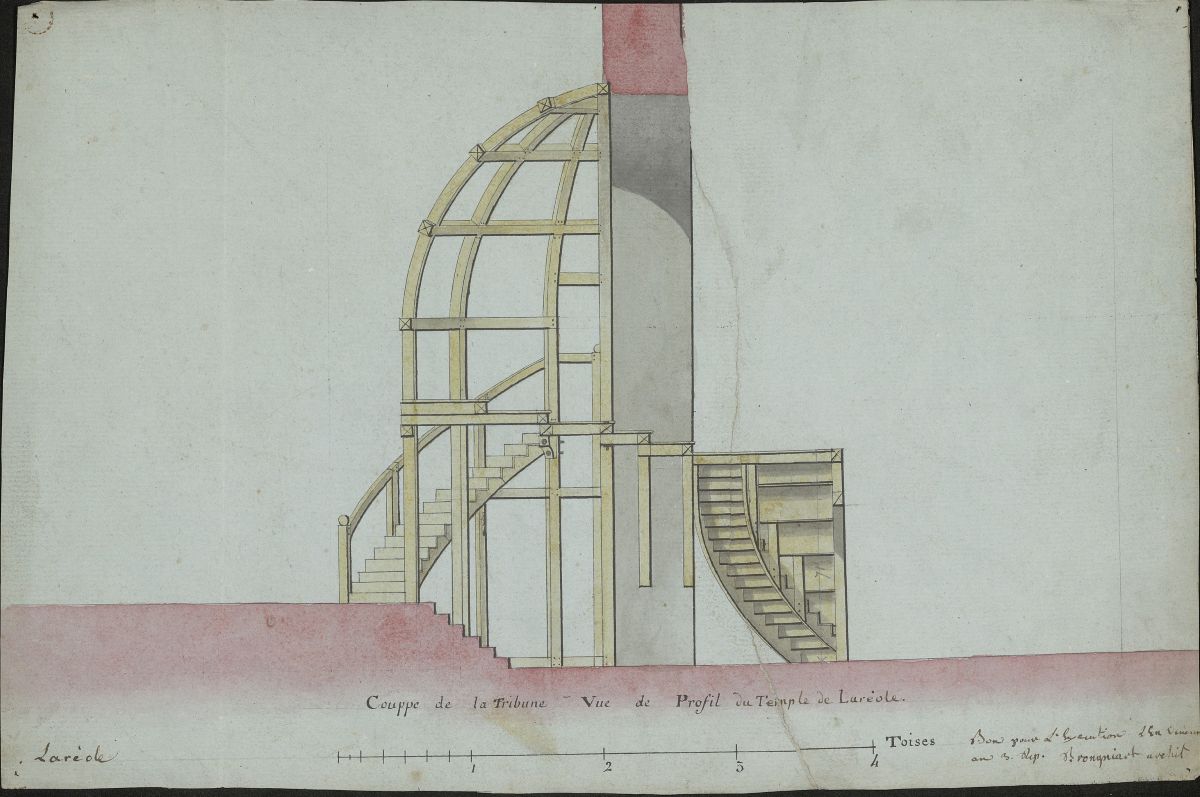
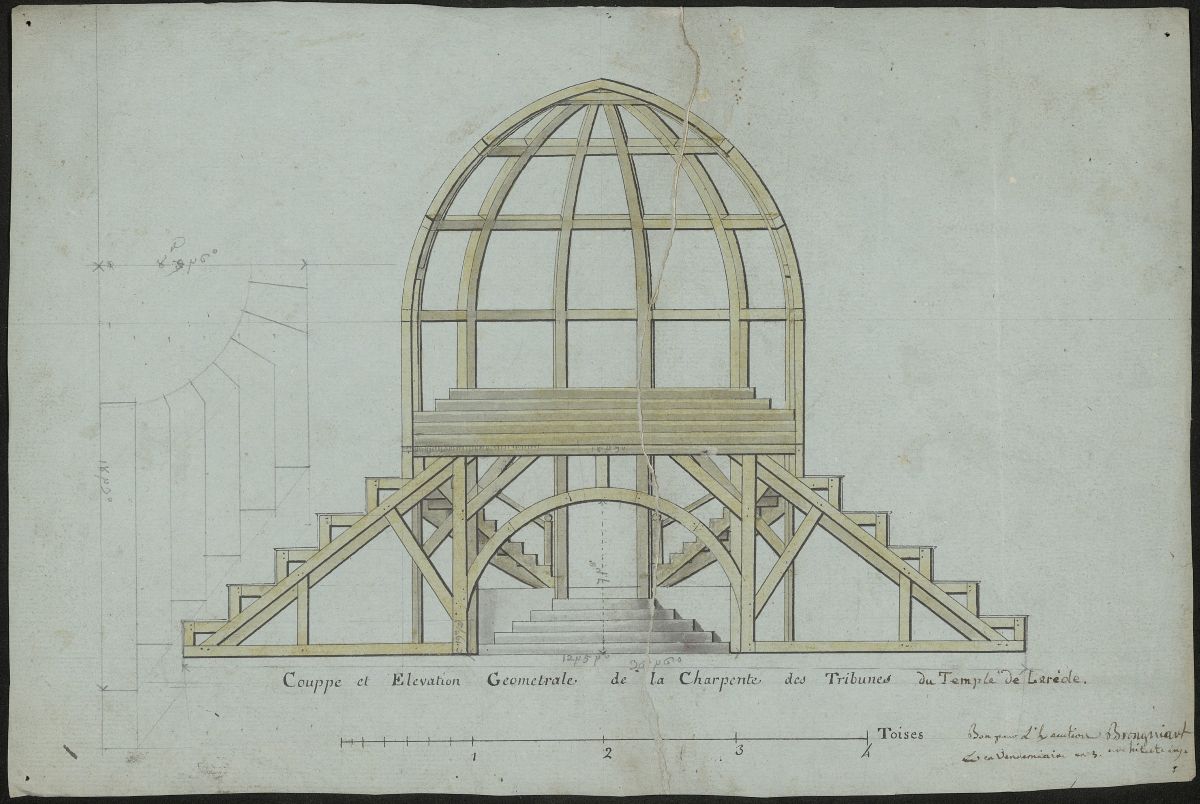
Construction drawings capture the architect’s flair for liturgical theatrics (Figs. 6 and 7). Brongniart choreographed two ways of accessing the tribune. Orators could mount the stage either by stairs that led directly from the nave or by passing under the platform and then ascending a staircase concealed behind the tribune. This second path enabled the speaker to appear suddenly as if by magic. In the south transept, directly facing the orator’s tribune, Brongniart installed an elevated platform with rows of bleachers that likely accommodated members of the political elite. This intervention revived a common feature of France’s Roman Catholic churches, the banc d’oeuvre, which was an enclosed section of pews installed immediately opposite the pulpit where the churchwardens and other notable lay members of a congregation sat during mass.
Brongniart planned to install panels bearing inscriptions on either side of these tribunes. The inscriptions in the drawings are written in a pseudoscript. On the verso of one sheet, however, is a verse written by the revolutionary poet Ponce-Denis Écouchard Lebrun. These lines, which appear to be in Brongniart’s hand, may have been proposed as an inscription:
do not invent your god
vain mortal vile atom
cease to worship
an august phantom
cease to conceive of
a triple unity
and give death
to divinity.[39]
This verse is a veritable prayer of deconsecration. The conversion of the church into a Temple of Reason marked not just the end of the building’s Christian usage but also the termination of Christian divinity. No longer was Saint-Pierre the house of God or the gate of heaven.
Remodeling the transept required major structural interventions. The plan and elevations show that Brongniart removed a pier on both sides of the transept to create a single arch wide enough to accommodate the elevated platforms. Beyond functioning as a proscenium for the tribunes, the single arches would have also served to relieve the loads formerly carried by the pier and what were likely two smaller arches. Brongniart recognized the cascading effect this would have on the crossing’s vaults. On the plan, the architect drew in pencil the ribs and boss that would be impacted by the removal of the piers. Even if the wooden tribunes were relatively cheap and easy to construct, remodeling the building’s vaulting system was a dangerous, expensive, and technologically complex undertaking that likely exceeded the abilities of the women, children, and elderly people that Ysabeau recruited to work on the project.
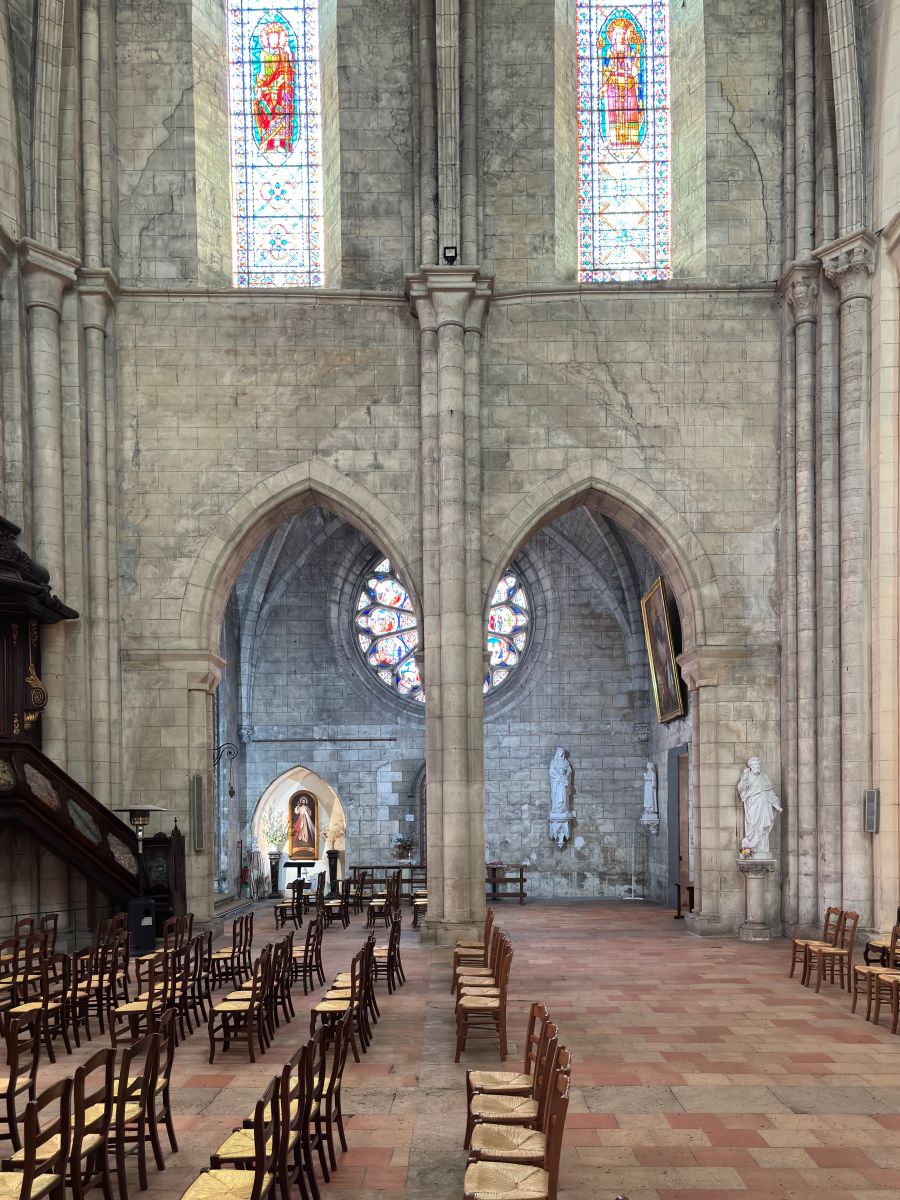
Surprisingly, existing conditions in the church suggest that Brongniart’s designs for the transept were actually carried out. Currently, a single pier and two narrow pointed arches separate the nave from the transept, but a close inspection of the north and south transept walls reveals structural deformities on each side as well as faint visual impressions of a pointed arch of the same height and proportions as the ones shown in Brongniart’s drawings (Fig. 8).
The architect also envisioned a new coffered barrel vault for the sanctuary. Without altering the building’s existing vaulting system and roof, Brongniart planned to construct this new ceiling using additional arches. In the elevation drawings, the architect added on both sides of the nave a line of four arches that sprung from the church’s existing compound piers. He then created the vault by infilling the space between the new and existing ribs with a coffered membrane.
The entire intervention was probably an architectural sleight of hand. Given the expense of stone construction and the catastrophic risk of overloading the piers, Brongniart would likely have fashioned the new arches out of plaster supported by a wooden armature—a technique frequently used in the construction of ephemeral festival architecture.[40] He would also have used lighter materials like plaster or wood for the infill. Stone simply would not have been practical, especially as the coffering that Brongniart shows in the drawing is impossible to achieve with the kind of thin stone or masonry that was typically used to infill the space between ribs.
Brongniart was attuned to the sensorial dimensions of ritual space as well as the need to optimize the building as a vehicle of Republican instruction and devotion. The architect likely remodeled the ceiling to create an acoustic that was more accommodating to revolutionary liturgies. By reducing echo and reverb in the sanctuary, the coffered ceiling enabled the congregation to more easily and clearly hear the patriotic speeches delivered from the orator’s tribune in the transept.
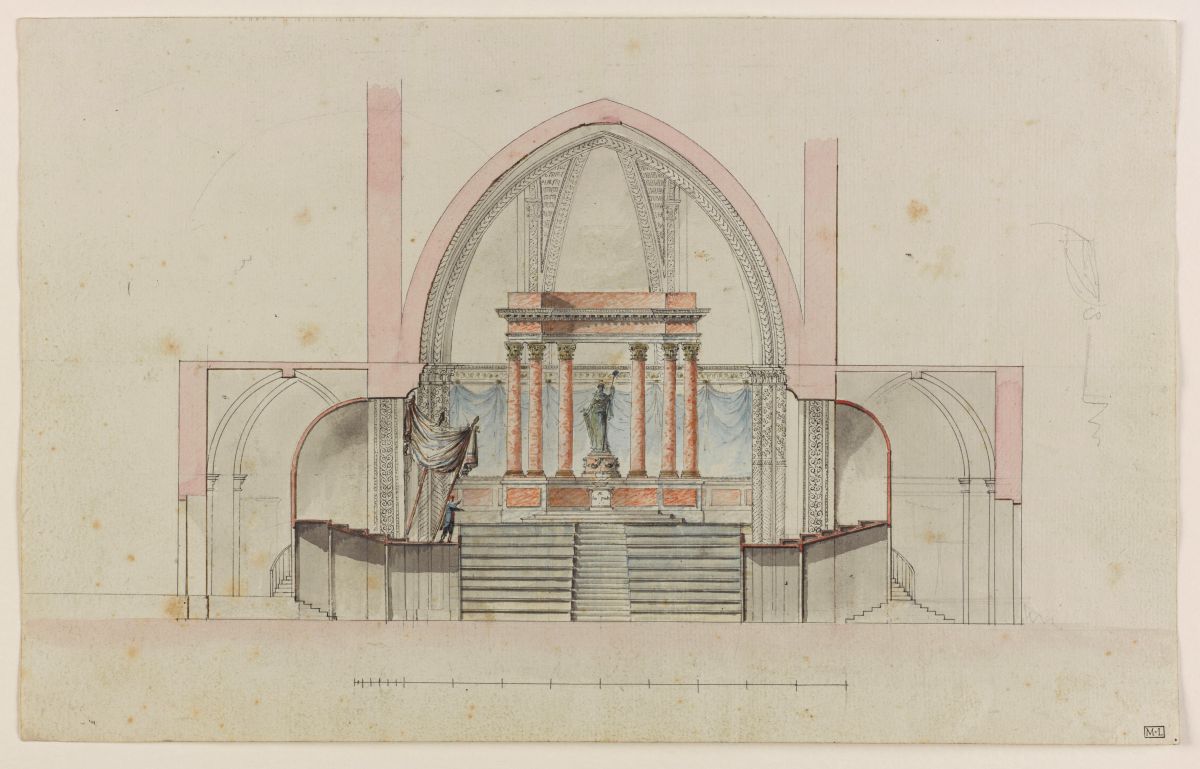
Further preserving former Christian usages of the space, Brongniart maintained the chancel as a devotional focal point. The architect proposed for the space a masonry plinth that raised the altar nearly 13 feet above the original floor with access from the nave afforded by a monumental staircase constructed from timber (Fig. 9). Much like the mountain altar in the former Cathedral of Saint-André, the elevated altar at La Réole offered a sense of spatial transcendence and fostered an upward looking reverential gaze. Constructed from what appears to be red marble, the altar sat on three raised steps and was framed by a baldachin made up of six red marble Corinthian columns. Given the formal similarities to a Christian altar, it is possible that Brongniart repurposed the church’s existing altar for revolutionary usage by removing Christian symbols and replacing them, as shown in the drawings, with either a brazier for incense or a female personification of Liberty carrying a Phrygian cap on a pike.[41] The result is an uncanny sacred space that embodied the Cult of Reason’s fragmented hybrid nature.
From Revolution to Restoration
The La Réole Temple of Reason offers a rich view of cultural and architectural processes of dechristianization. Repurposing a church for revolutionary usage proved to be no easy feat, and the distinction between church and Temple of Reason was quite slippery despite broader efforts to efface Christian references. In working to convert Saint-Pierre, Brongniart negotiated two difficult design determinants. On the one hand, the architect confronted an unstable religion that offered little in the way of established liturgical practice or belief that could guide his designs. On the other, Brongniart wrestled with the building itself especially as its envelope and vaulting system proved largely unalterable given material limitations.
Brongniart’s designs provide an inventive and spectacular image of religious upheaval, but they also underscore the extent to which revolutionary visual and material culture could never entirely erase or distance itself from what had come before. In the end, the drawings capture more than just the renovation of a building. They are also glimpses of the brief but profound moment when the Cult of Reason gripped a small town. Waves of religious change continued to wash through La Réole. By the time Brongniart approved the designs for construction in Vendémiaire Year III, Robespierre had already suppressed the atheistic cult. After only several months as a Temple of Reason, the building was rebaptized as a Temple of the Supreme Being.[42] By 1840, Saint-Pierre was officially Christian again: restored as a place made by God, a priceless sacrament beyond reproach.
Matthew Gin is Assistant Professor of Architectural History at the University of North Carolina at Charlotte, NC
Acknowledgments: My thanks to Daniella Berman and Jessica Fripp for our conversations about the revolutionary cults and to Alex Cabral who generously shared his knowledge of construction techniques. Thank you also to the editors and anonymous reviewers for their insightful comments.
[1] “Convention Nationale. Présidence de Laloi. Suite de la seance du 20 de Brumaire,” Gazette Nationale ou le Moniteur universel, no. 53: November 13, 1793, 215. All translations are mine unless otherwise indicated. When citing or quoting historical sources in French, I have, to the extent possible, preserved the original capitalization and spellings.
[2] The original reads: “…les voûtes gothiques, frappées si longtems de la voix d’erreur, et qui, pour la premiere fois ont retenti du cri de la vérité.” “Convention Nationale,” 215.
[3] The original reads: “Le fanatisme l’a abandonnée; les êtres raisonnables s’en font emparés: consacrez leur propriété.” “Convention Nationale,” 215.
[4] For a comparative analysis of the cults, see François-Alphonse Aulard, Le culte de la raison et le culte de l’être suprême (1793-1794): Essai historique (F. Alcan, 1892). On the Cult of the Supreme Being, see Jonathan Smyth, Robespierre and the Festival of the Supreme Being: The Search for a Republican Morality (Manchester University Press, 2018).
[5] There is no definitive number of how many churches were remade into Temples of Reason. Michel Vovelle estimates that there were 233 Temples of Reason just in the Gard region of southern France alone. Vovelle, “The Adventures of Reason, or From Reason to the Supreme Being,” in Rewriting the French Revolution: The Andrew Browning Lectures 1989, ed. Colin Lucas (Oxford University Press, 1991), 136. Temples of Reason were sometimes also called Temples of Liberty or Temples of Truth.
[6] Louis-Sébastien Mercier emphasized the scandalously sacrilegious nature of ceremonies staged in Paris’s Temples of Reason. Mercier, Le Nouveau Paris, vol. 4 (Fuchs, 1797), 139-45. One of the earliest histories to describe a Temple of Reason in detail is Marie Adolphe Thiers, Histoire de la Révolution Française, vol. 5 (Lebeau-Ouwrex, 1828), 341-43.
[7] Nigel Aston, Religion and Revolution in France, 1780-1804 (The Catholic University of America Press, 2000), 267.
[8] Temples of Reason are discussed briefly in James A. Leith, Space and Revolution: Projects for Monuments, Squares, and Public Buildings in France, 1789–1799 (McGill-Queen’s University Press, 1991), chap. 7; and in Mona Ozouf, Festivals and the French Revolution, trans. Alan Sheridan (Harvard University Press, 1988), 83-105.
[9] Allam Braham, for instance, dismisses as anomalous the ephemeral decorations and theaters built during the Revolution. See Braham, The Architecture of the French Revolution (University of California Press, 1980), 251. On the visionary tradition, see Emil Kaufmann, Three Revolutionary Architects: Boullée, Ledoux, and Lequeu (The American Philosophical Society, 1952).
[10] On efforts against the Roman Catholic Church, see Aston, Religion and Revolution in France, 1780-1804, chap. 10; André Latreille, L’église Catholique et la Révolution française (Hachette, 1946); John McManners, The French Revolution and the Church (Harper & Row, 1970).
[11] Michel Vovelle, The Revolution Against the Church: From Reason to the Supreme Being, trans. Alan José (Ohio State University Press, 1991), 176.
[12] Octave Gauban, “La religion et le clergé à La Réole pendant la Révolution,” Revue Catholique de Bordeaux (1891), 182-83.
[13] On unstable notions of the sacred, see Lynn Hunt, “The Sacred and the French Revolution,” in Durkheimian Sociology: Cultural Studies, ed.Jeffrey C. Alexander (Cambridge University Press, 1988), 25-43.
[14] Charles Lyttle, “Deistic Piety in the Cults of the French Revolution,” Church History 2, no. 1 (1933): 22–40.
[15] On mountain iconography, see Monique Mosser, “Le temple et la montagne: Généalogie d’un décor de fête révolutionnaire,”Revue de l’art 83 (1989): 21-35.
[16] Ian Germani, Jean-Paul Marat: Hero and Anti-Hero of the French Revolution (E. Mellen Press, 1992), 72-73.
[17] Aston, Religion and Revolution in France, 1780-1804, 270.
[18] On festivals marking the abolition of slavery, see Caroline Crounin, “Étude scénographique des fêtes en faveur de l’abolition de l’esclavage en France (février-juillet 1794),” Annales historiques de la Révolution française 339 (January-March 2005): 55-77.
[19] Lucidor F. Corbin, Discours de la citoyenne Lucidor F. Corbin, créole, républicaine, prononcée [sic] par elle-même au Temple de la Raison, l’an 2e de la Liberté (Paris, 1793-94).
[20] “Renvoi aux comités de correspondance et d’instruction publique de l’adresse de la société populaire de Turny… en annexe de la séance du 15 floréal an II (4 mai 1794),” in Archives parlementaires de la Révolution Française, first series (1787-1799), vol. 90, 1972, 57-58.
[21] Patrice L.R. Higonnet, Goodness Beyond Virtue: Jacobins During the French Revolution (Harvard University Press, 1998),236. In Vienne, the Temple of Augustus and Livia was rebaptized as a Temple of Reason. Jeremy Knight, Roman France: An Archaeological Field Guide (Northwestern University, 2001), 172.
[22] Colin Lucas, The Structure of the Terror: The Example of Javogues and the Loire (Oxford University Press, 1972), 288.
[23] Alan Forrest, The Revolution in Provincial France: Aquitaine, 1789-99 (Clarendon Press, 2006), 150.
[24] “Une deputation de la Société Républicaine de la Réole est entrée…” 17 Ventôse Year II, E DEPOT 9924, 1 D 2 (1793-1795), f. 5r, Archives Départementales de la Gironde.
[25] “Citoyens, nous avons celebre la fette de la raison…” likely 1793, P 10, no. 13, Archives de Bordeaux Métropole.
[26] Extrait desregistres du conseil général de la commune de Bordeaux: Du 7 Frimaire 1793…, 7 Frimaire 1793, P 10, no. 3. Archives de Bordeaux Métropole.
[27] For an overview of Brongniart’s design work, see the catalog Alexandre-Théodore Brongniart, 1739-1813: Architecture et décor (Musée Carnavalet, 1986). The Revolution’s impact on Brongniart’s career is discussed in Louis de Launay, Une grande famille de savants: Les Brongniart (G. Rapilly, 1940), 27-32.
[28] Jacques Silvestre de Sacy, Alexandre-Théodore Brongniart (1739-1813): Sa vie, son oeuvre (Plon, 1940), 90-93. On the construction industry in Paris during Year II, see Allan Potofsky, Constructing Paris in the Age of Revolution (Palgrave Macmillan, 2009), chap. 4.
[29] Brongniart’s work in Bordeaux belongs to a larger remaking of the city during the Revolution. Michel Figeac, “Révolution et urbanisme à la fin du XVIIIe siècle: Bordeaux entre vandalisme, iconoclasme et spéculation immobilière,” Histoire, Économie et Société 33, no. 3 (September 2014): 67-83.
[30] de Sacy, Alexandre-Théodore Brongniart (1739-1813), 90.
[31] “Le Conseil général de la Commune…,” 29 Pluviose Year II, E DEPOT 9924, 1 D 2 (1793-1795), n.f., Archives Départementales de la Gironde.
[32] “Le Conseil général de la Commune…,” 29 Pluviose Year II, E DEPOT 9924, 1 D 2 (1793-1795), n.f., Archives Départementales de la Gironde.
[33] Forrest, Society and Politics in Revolutionary Bordeaux (Oxford University Press, 1975), 119.
[34] On Saint Pierre’s history, see Jacques Gardelle, Aquitaine Gothique (Picard, 1992), 131-35; Gauban, Histoire de La Réole: Notice sur toutes communes de l’arrondissement (Vigouroux, 1873), 373-75.
[35] “Le Citoyen Brongniart ingenieur a Remis sur le Bureau…,” 29 Ventôse Year II, E DEPOT 9924, 1 D 2 (1793-1795), f. 15r, Archives Départementales de la Gironde.
[36] “Arrêtent que la municipalité de la Réole…,” 19 Germinal Year II, E DEPOT 9924, 1 D 2 (1793-1795), f. 28v, Archives Départementales de la Gironde.
[37] The other is a set of drawings by the architect Auguste-Firmin Chabrier from 1795 for the Marseille Temple of Reason. Philippe Bordes, “Réattu et le temple de la raison de Marseille,” in Marseille en Révolution, ed. Claude Badet (Editions Rivages, 1989), 159-73.
[38] For examples, see Jean-Paul Bouillon, Monique Mosser, and Daniel Rabreau, Les Fêtes de la Révolution (Musée Bargoin, 1974).
[39] For the full poem, see “Vers sur dieu,” in Odes républicaines au peuple français, composées en Brumaire, l’an II… (Imprimerie nationale des lois, III), 48-50.
[40] On the construction of temporary decorations, see Matthew Gin, “Something Old, Something New: Repurposing and the Production of Ephemeral Festival Architecture in Eighteenth-Century Paris,” in Material Cultures of the Global Eighteenth Century: Art, Mobility, and Change, ed. Wendy Bellion and Kristel Smentek (Bloomsbury Academic, 2023), 61-80.
[41] Local authorities made similar adjustments when transforming the high altar at Chartres Cathedral for revolutionary usage. See Mary Kathryn Cooney, “‘May the Hatchet and the Hammer Never Damage It!’ The Fate of the Cathedral of Chartres during the French Revolution,” The Catholic Historical Review 92, no. 2 (2006): 206-7.
[42] A service held in the La Réole Temple of the Supreme Being is described briefly in “Procès-verbal de la célébration de la fête de la commune de La Réole… lors de la séance du 21 brumaire an III (11 novembre 1794),” in Archives Parlementaires de 1787 à 1860. Première série (1787-1799), vol. 101, 2005, 98-9. On the conversion of the La Réole Temple of Reason into a Temple of the Supreme Being, see François-Georges Pariset, “L’Architecte Brongniart: ses activités à Bordeaux et à La Réole (1793-1795),” Bulletin et mémoires de la Société Archéologique de Bordeaux, vol. 62 (1965), 220-22.
Cite this article as: Matthew Gin, “The Revolution’s Sanctuary: Designing the La Réole Temple of Reason, Year II,” Journal18, Issue 21 Revolutions (Spring 2026), https://www.journal18.org/8124.
License: CC BY-NC
Journal18 is published under a Creative Commons CC BY-NC International 4.0 license. Use of any content published in Journal18 must be for non-commercial purposes and appropriate credit must be given to the author of the content. Details for appropriate citation appear above.
