Monica Anke Hahn
The instructions directed the young reader to be “on the Stage facing the Audience.” In front of those gathered—siblings, parents, friends—the child began to move the cut-out figures in Act I Scene 1 of Three Fingered Jack, a paper theater published c. 1850 (Fig. 1). The printed booklet that accompanied the 22 17 x 21.5 cm engravings with the protagonists, backdrops, wings, and set pieces of the play had advised, “Care should be taken in cutting out the Characters that the number of Plate or Set Piece be marked on the back of the same, that they may correspond with the book.”[1]
Perhaps it was the child’s father who had bought the toy theater in the Shoreditch neighborhood of London, at Mr. Webb’s Theatrical Warehouse. The play booklet cost fourpence, but the entire set, in the large size and hand-colored, could cost a guinea or more.[2] Once the young person had cut out all the components, a restaging of the play could begin:
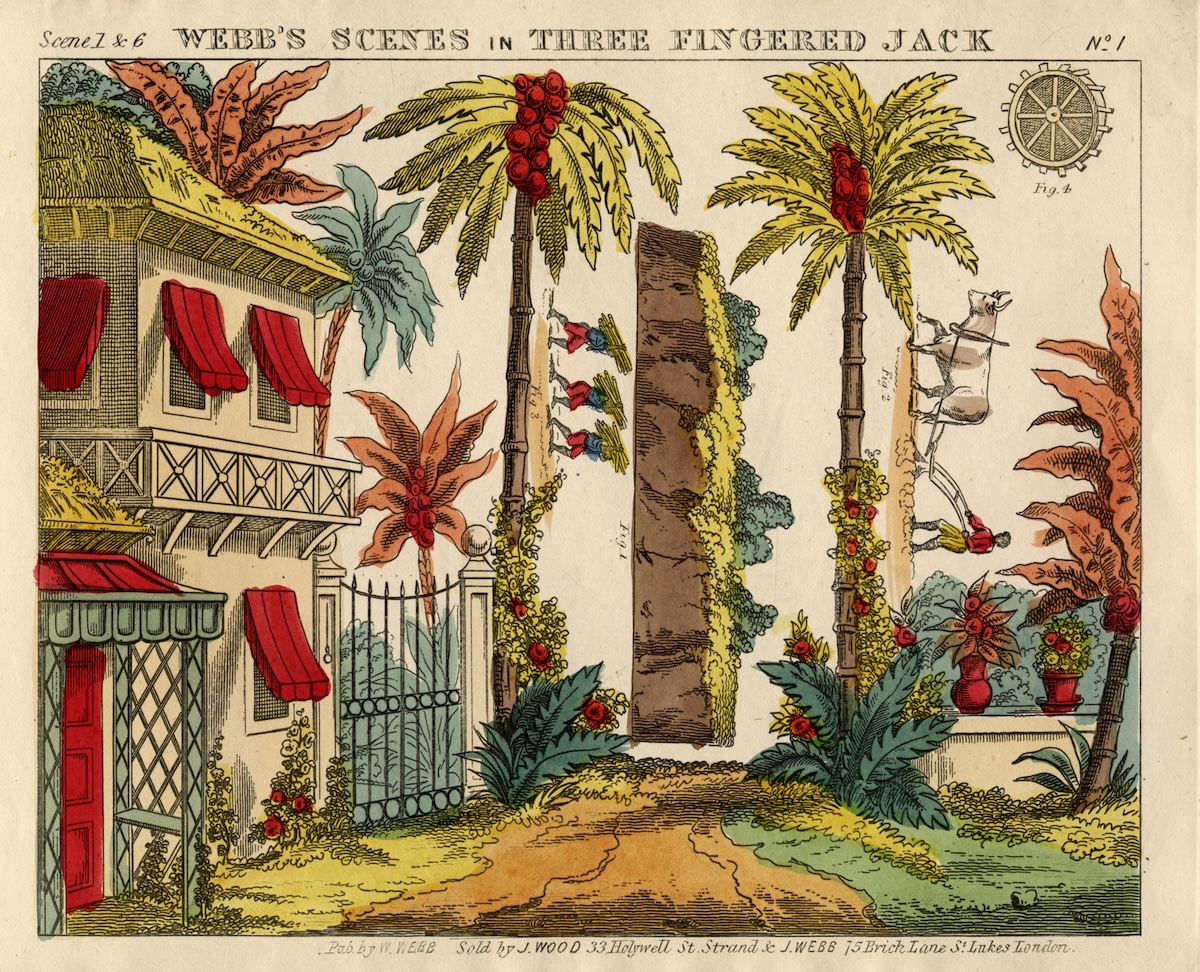
SCENE 1 — View of A Plantation in Jamaica. Formed by 2 scenes Nos. 1 and 2. Cut out No. 1 and place fig. 1 a short distance behind, then fig. 2 behind fig. 1; the figures to move across from LH [left hand], and fig. 3 still further behind fig. 2, the figures move from RH [right hand] to LH, the whole backed by No. 2 Scene, (foreign tree wings, No. 7.) Fig. 4 out of No. 1, to be put where marked on No. 2, forming, when fixed, a sugar mill at work. Quashee’s Wife discovered, LH pl. 2, and Sam’s wife, RH singing.[3]
On this day, the youth would perform the infamous story of Jack, the real-life Black man who escaped enslavement in Jamaica in the late-1770s and evaded capture until his murder in 1781. The British public were fascinated with the story of Jack and his exploits from its first publication in newsprint in 1780. A book appeared in 1799, quickly followed by a pantomime stage play, a novel based on the pantomime, and a fictionalized epistolary tale (all issued in 1800), and, by the mid-nineteenth century, a stage melodrama. Over the last two decades scholars have attended to the varying representations of this figure, who signified slavery and colonization, but also revolt.[4] To date, however, this toy theater has not been considered in these analyses.
A careful examination of this material trace of a figure of rebellion and revolt in colonial Jamaica at once complements and pushes against previous understandings of the story of Jack’s resistance in the British mind in the late eighteenth and early nineteenth centuries. This essay suggests that the fraught relationship between imperial representation and the unstable meanings of Jack’s resistance could be enacted in the toy theater, which staged a space for young consumers to examine Jack, resistance, colonization, slavery, and revolution. Webb’s toy theater expanded possibilities for revolutionary agency in reimagining the story of Three-Fingered Jack. Although toy theaters often served as vehicles of the British colonial project, individuals who constructed and performed with them could engage in subversive practices that disrupted their intended messages. By focusing on the toy theater as a site of embodied, domestic performance, this essay asks whether manipulating these figures merely reproduced colonial authority through the containment of resistance, or whether it might also have produced a vicarious apprehension of enslavement’s violence that unsettled imperial hierarchies.
By situating toy theaters within the histories of colonial Jamaica and the wider Caribbean, this essay contributes to the larger thematic concerns of this special issue on revolution. Designed for youthful, predominantly elite white consumers, the medium of toy theater enables us to consider how revolution was both materially constituted through images and objects and encountered through intimate, embodied acts of play. The circulation of theatrical representations of Three-Fingered Jack draws directly on Jamaica’s fraught history of enslavement and rebellion, while also resonating with the broader revolutionary context shaped by the Haitian Revolution. Together, these uprisings underscore how art and performance mediated metropolitan encounters with the specter of Black insurrection within the domestic sphere. By treating toy theaters as both domestic amusements and potential sites of subversive engagement, this study suggests how art objects and performative practices not only reflected but also helped shape broader revolutionary imaginaries in the Atlantic world.
Webb’s toy theater version of John Fawcett’s pantomime play Three-Fingered Jack permitted a greater potential for subversion and revolutionary agency than its source material. The toy theater’s broad stage directions, the fungible nature of its interchangeable scenery, and its roots in the transgressive pantomime genre allowed the home director to creatively reinterpret and undermine the play’s racist, colonial narrative. Ultimately, while the printed playbooks and sets reinforced the authority of the plantation and the colonial order, the imaginative act of restaging the play at home potentially allowed users to subtly unsettle those same hierarchies and contemplate resistance and revolt.
Jamaican Contexts and Early Narratives of Jack
W. Cole, another English toy theater publisher, promised that his Juvenile Dramas would “afford endless amusement, combined with rational instruction, to the youthful classes of society,” but despite his claim that they contained “no sentiment or expression improper to the tender minds of youth,” the story of Three-Fingered Jack, later published by the much better-known William Webb in toy theater form, was a violent and gory one.[5]
Jamaica’s economy and social structure were shaped profoundly by plantation slavery and the transatlantic slave trade from the mid-seventeenth century onward. After the British seized the island from Spain in 1655, sugar plantations proliferated, relying on the forced labor of enslaved Africans imported primarily from West and Central Africa. Enslaved people endured brutal working conditions, violent punishment, and rigid social controls, while sustaining networks of resistance. The plantation system created a starkly hierarchical society in which the wealth of British colonists depended entirely on coerced labor, while enslaved communities continually sought autonomy through flight and periodic revolts. The persistence of rebellion underscores both the violence of the system and the resilience and agency of the enslaved, revealing the complex dynamics of power, resistance, and survival that defined Jamaica’s plantation society in the Atlantic world.
The British public first encountered the figure of Three-Fingered Jack through reports in the Jamaican Royal Gazette in 1780 and 1781. According to colonial legend, Jack had lost two fingers in a duel with a Maroon tracker, a bodily mark that quickly became a sensational shorthand for his identity in British accounts. These accounts described Jack as the leader of a formidable band of self-emancipated people and framed his actions as a threat to colonial order and public safety. A royal proclamation offered a substantial reward for his capture, and subsequent reports in the Gazette sensationalized his violent death at the hands of a Black man named John Reeder. The dismemberment and public display of Jack’s body by the Maroons who captured him were presented as proof of colonial mastery, underscoring how spectacular violence functioned as a tool of deterrence and control. These early narratives constructed Jack simultaneously as a criminal outlaw and as evidence of the ever-present danger of rebellion within Jamaica’s enslaved population.
The Gazette and its supplements were published in Kingston, and so the news of Jack’s escape, dramatic capture, and murder likely took some time to cross the Atlantic. Much more quickly available was the narrative recorded by the surgeon Benjamin Moseley, who had practiced in Kingston from 1768 to 1784, and who claimed to have first-hand knowledge of the events. In A Treatise on Sugar (1799), which presented the history of the cultivation and use of sugar cane, its medicinal uses, and the popularity of refined sugar, Moseley relayed the story within the context of a description of “the occult science of Obi…for the purposes of bewitching people, or consuming them by lingering illness.”[6] Here, “Obi” refers to a system of spiritual and ritual practices in Jamaica—rooted in West African traditions and often associated by Europeans with sorcery or magic—that enslaved and free Black communities were believed to wield for protection, healing, or vengeance.
Moseley’s account situates Three-Fingered Jack within this framework, linking his exploits to the fearsome power of the Afro-Caribbean religious practice of Obeah. The figure of Jack thus embodies both the real and imagined threats posed by enslaved and rebel resistance, reflecting the British fascination with, and anxiety about, the subversive potential of Afro-Jamaican cultural knowledge. Published in London in 1799 and reprinted in an expanded edition in 1800, Moseley’s recounting of Jack’s story quickly reached a wide and eager audience. A flurry of representations of the tale followed in 1800: a two-act pantomime play, a novel based on the pantomime that also invented Jack’s youth in Kaarta, and an epistolary novel that imagined letters to Jack in Jamaica from his mother in Africa.[7]
Staging Jack: From Pantomime to Toy Theater
The pantomime theater genre allowed for and encouraged transgressive subjectivity and resistance. Becoming wildly popular in the eighteenth century, pantomime plays began to appear on the Georgian stage as a form of “afterpiece” that followed a night’s mainpiece —whether a tragedy or comedy—and provided a diversion at the end of the evening. Beginning in the 1720s, pantomimes became the favored genre of afterpiece.[8] Though known since ancient and medieval times, this English dramatic form began to adapt the characters and plots of Italian commedia dell’arte and became called pantomime in the first half of the eighteenth century. It featured stock characters, such as Harlequin, a comic persona who often engaged in improvisational, slapstick physical comedy. These characters functioned as stereotypical, stylized representations with whom audiences could identify and whose actions collapsed the distinctions of high and low culture. For example, one of the standard plot lines in a Harlequinade pantomime was the ability of the hero to transform a character, even himself, into another character, or one object or place into another. Pantomimes regularly deployed satire; these farces mocked social conventions and hierarchies by modifying the stock plot to address issues of the day.
The play by John Fawcett, Obi; or, Three-Finger’d Jack, premiered on July 2, 1800 at London’s Theatre Royal Haymarket, commonly called The Haymarket. Opened in 1720, the Haymarket was one of the patent theaters licensed to perform spoken drama in London, alongside Drury Lane and Covent Garden, giving it a privileged position in the theatrical hierarchy. Its significance lies not only in its official status but also in its role as a site of experimentation with emerging genres, including pantomime, farce, and other afterpieces. In this context, The Haymarket functioned as a space where theatrical innovation, spectacle, and popular taste intersected. By presenting plays with magical transformations, visual trickery, and comic exaggeration, the theater played a key role in shaping the aesthetics and expectations of London theatergoers, making it a critical reference point for understanding how plays like Three-Fingered Jack were adapted and consumed.
The Haymarket’s embellishment of the tale introduced a love story between a plantation owner’s daughter, Rosa, and a dashing English sea captain, Orford. The curtain rises to reveal “A View of extensive Plantations.” It is the morning of Rosa’s birthday, and preparations are underway for a celebration. Sparks fly during her brief introduction to the captain, but the mood turns ominous when Orford returns that afternoon, having been attacked offstage by Three-Fingered Jack. Terror overtakes Rosa and the enslaved people on the plantation at the invocation of his infamous name. The following five scenes of Act 1 recount Orford’s profession of love to Rosa, Jack’s visit to an “Obi Woman” for a protective charm, Jack’s ambush of the Planter and Orford, a royal decree calling for the capture of Jack, and the preparations of the expedition led by the enslaved characters Quashee and Sam, who have been promised their freedom by the Planter if they are successful in their defeat of Jack.
The plantation expedition is in pursuit of Jack in Act 2, with Rosa disguised as a young sailor to assist in the rescue of Captain Orford, whom Jack has imprisoned in his subterranean lair. Jack captures Rosa but does not recognize her as the Planter’s daughter. He makes the “sailor” his servant, and, after singing Jack to sleep, Rosa effects the wounded Orford’s escape. Drawn out of his cave, Jack engages in mortal combat with his enslaved pursuers, but he is defeated and killed. The pantomime ends with “Publick Rejoicings, occasion’d by the Overthrow of Three-Finger’d Jack.”[9]
The play was a hit among London theatergoers. The Morning Chronicle raved, “The new grand pantomimical drama, was received with the most unbounded applause, and will be repeated till further notice.”[10] The Haymarket staged the pantomime thirty-nine times in its first season, again twenty times in 1801, and fifteen times in 1802.[11] It played at regional theaters during these years as well and continued to be staged in the ensuing decades with some variations and adaptations. A version of the pantomime play with much more elaborately described stage directions was published in 1825, and by mid-century a melodramatic play with spoken dialogue appeared with a significantly altered plot.[12]
Jack’s story had many “afterlives,” as Diana Paton has put it, from the initial newspaper accounts and Dr. Moseley’s telling to the pantomime, novels, and other adaptations that followed, including the toy theater printed and sold around mid-century by William Webb.[13] JK Green, William West, and Benjamin Pollock were prominent toy theater publishers whose prints began appearing in London shops at the end of the eighteenth century and proliferated in the nineteenth. Originally intended as tools for professional stagecraft training rather than children’s toys, these theaters eventually made their way into private homes, with William West among the first to publish in the early nineteenth century, followed by others.[14] Printed sheets of characters and scenes could be cut out and mounted on cardboard in order to perform on miniature wooden stages the popular plays of the day. The toy theater prints came with the backdrops, wings, props, and all of the dramatis personae necessary to stage a miniature version of a particular play. Sheets of extra figures could also be purchased to supplement the cast with additional poses.[15]
Webb’s toy theater follows faithfully both the 1800 staging and that described in the 1825 publication, which provided additional stage directions. His decision to base his toy theater on the earlier pantomime tradition rather than the later melodramatic adaptation of Three-Fingered Jack is significant. Melodrama, which emerged fully in the 1830s, relies on spoken dialogue and moral legibility, working to contain Jack’s rebellion within a stabilized ethical framework of imperial law, moral reform, and social order. Pantomime, by contrast, privileges gesture, spectacle, and transformation—formal qualities that align with the material and performative logic of toy theater and resist narrative closure. Produced around mid-century, well after the Haitian Revolution, and after emancipation in Jamaica, Webb’s toy theater stages Jack as a belated but persistent figure of insurrection: rebellion is displaced into the colonial past even as its gestures remain available for domestic rehearsal. The pantomime genre’s openness allows the toy theater both to manage and to reactivate the specter of Black revolt, revealing the revolutionary imaginaries that continued to circulate within British culture into mid-century.
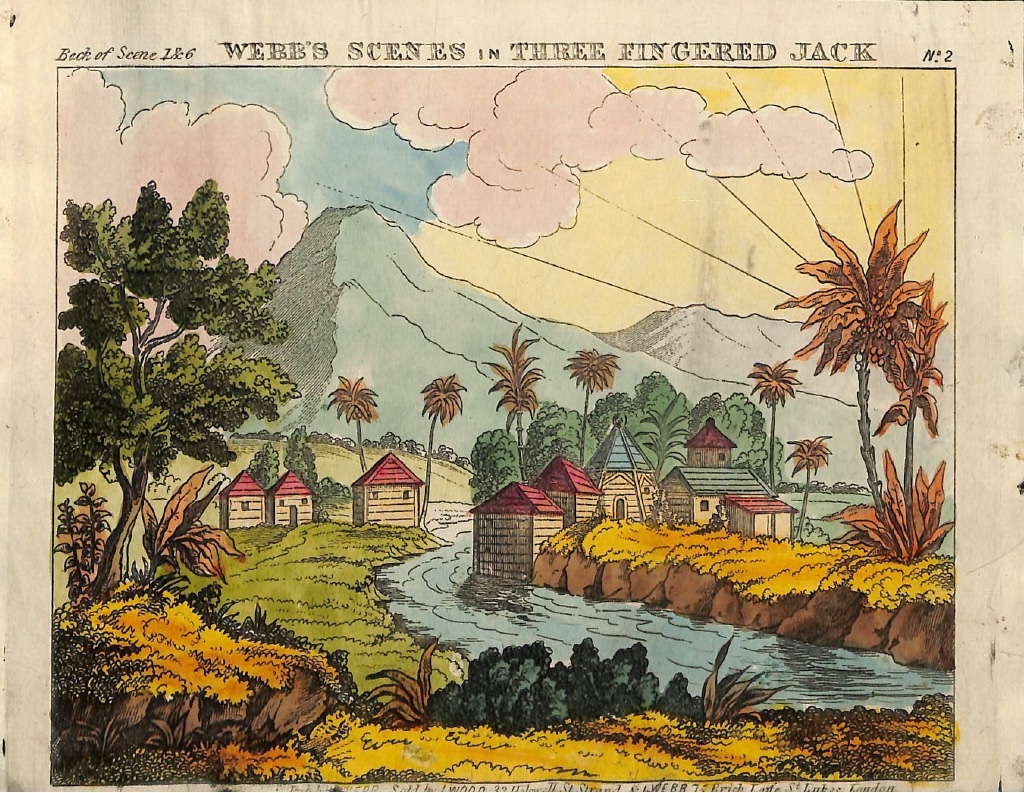
Scene 1 is comprised of the first two plates of prints (Fig. 2, 3). As the instructions indicated, plate 2 provided the backdrop, a mountain in the distance, and a collection of small buildings in the middle ground indicating the plantation sugar mill (Fig. 2). Plate 1, placed slightly in front of this backdrop, represented the Planter’s grand house at the left, with a path leading back toward the river and the mill, flanked by two palm trees (Fig. 3). Printed on this same plate are three separate small scenes, intended to be cut out and placed between the house and the background scene. These include a Black man driving a plow pulled by an ox, and three Black men carrying bundles of sugar cane on their backs. A fourth piece to be cut out depicted a waterwheel, which the director of the toy theater would affix to the mill building along the riverbank behind. Before the first song began, the director would move the figure plowing across the stage with the left hand toward the right, and the group of men carrying cane with the other hand toward the left, as indicated in the accompanying booklet. Webb’s toy theater encouraged the young parlor theater operator to reenact each of the twelve scenes in the pantomime using the twenty-two prints in the set, from the interior of the Planter’s house, to the Obi Woman’s cave, the events of Jack’s ambush of the Planter’s hunting party, Captain Orford’s imprisonment in Jack’s cave, his rescue by Rosa, and of course Jack’s defeat and murder. The physical manipulation of these miniature enslaved figures by a (presumably white) handler highlights how the toy theater materialized colonial hierarchies for domestic spectators: the director literally controlled the laboring bodies, transforming plantation violence into a spectacle for entertainment. At the same time, the intimate and iterative nature of the toy theater also made visible moments of escape, resistance, and disruption, suggesting that even within a medium organized around the reproduction of colonial authority, there was potential for imagining subversive interventions.
Containment and Subversion in the Domestic Theater
Jack’s ambush of the Planter and his subsequent pursuit, capture, and death form the dramatic core of all retellings of the events of 1780–81 across the media of print, stage, and toy theater. As scholars have noted, however, these narratives differ markedly in how they frame Jack’s rebellion and its political meaning.[16] The earliest Royal Gazette reports situated Jack among Maroon communities in Jamaica’s Blue Mountains—societies of formerly enslaved people long engaged in armed resistance, guerrilla warfare, and the harboring of self-emancipated people, and whose conflicts with British authorities had repeatedly exposed the fragility of colonial control.[17] Jack’s story thus emerged in the wake of sustained insurgency, including the First Maroon War (1728-1739/40) and later large-scale uprisings such as Tacky’s Rebellion of 1760, which demonstrated the capacity of enslaved Africans to organize coordinated resistance and destabilize the plantation order.[18] These histories form the backdrop against which Jack was understood not merely as an individual outlaw but as part of a broader Atlantic tradition of rebellion—one that continued to inform the revolutionary imaginaries mobilized by later cultural representations of Three-Fingered Jack.
Srinivas Aravamundan notes that the earliest newspaper accounts framed Jack primarily as a threat to law and order, who was defeated by the Maroon John Reeder.[19] By the time Benjamin Moseley published his account nearly two decades later, however, the emphasis had shifted from collective resistance to a focus on Obeah, recasting Jack as a solitary rebel whose power derived from “black magic” and was ultimately overcome by Christianized “white obi.”[20] The pantomime and novels that followed in 1800 further altered these affiliations, replacing Maroon resistance with Christianized enslaved men who pursue and defeat Jack, thereby neutralizing the political implications of revolt. More recently, scholars such as Frances Botkin, Jenna Gibbs, and Kathleen Wilson have situated Fawcett’s Obi; or, Three Finger’d Jack within the intense abolition debates of the period, emphasizing its multivalent appeal: Jack could appear simultaneously as criminal, antislavery figure, or revolutionary hero, even as the narrative ultimately restores colonial order. Shaped by metropolitan anxieties generated by the ongoing Haitian Revolution, the pantomime staged rebellion only to contain it, celebrating British authority through spectacle and moral resolution.[21] The toy theater amplifies this logic by miniaturizing revolt for domestic performance, rendering insurrection visually legible while preserving Jack’s audacity.
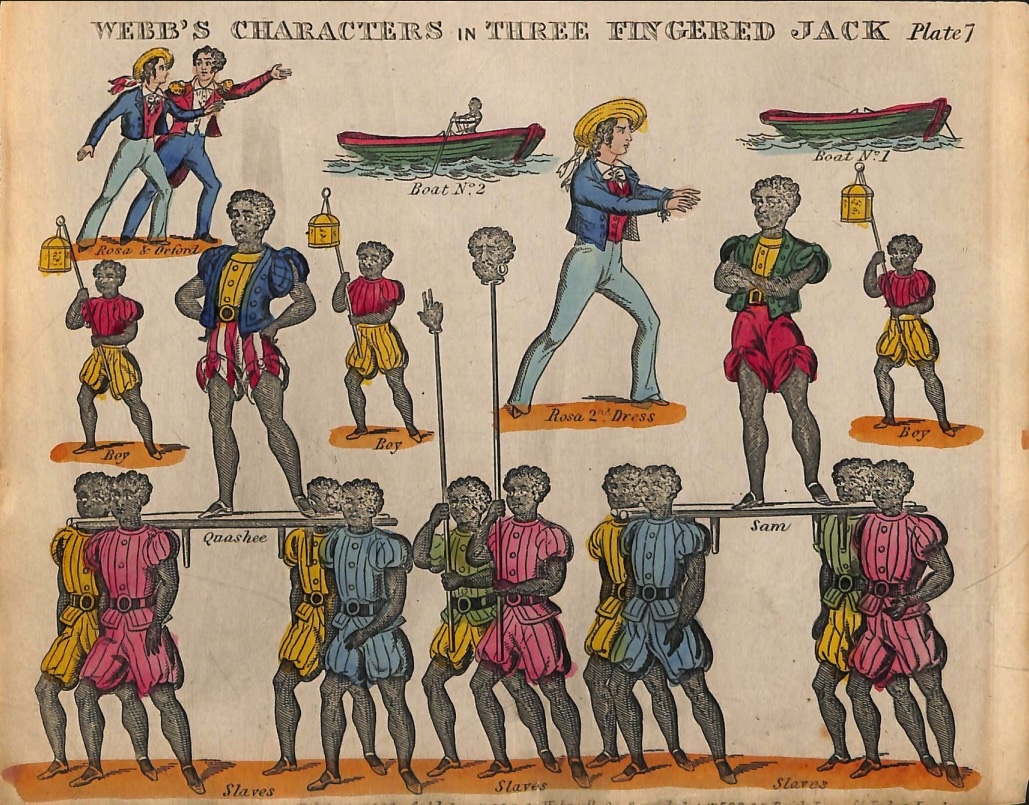
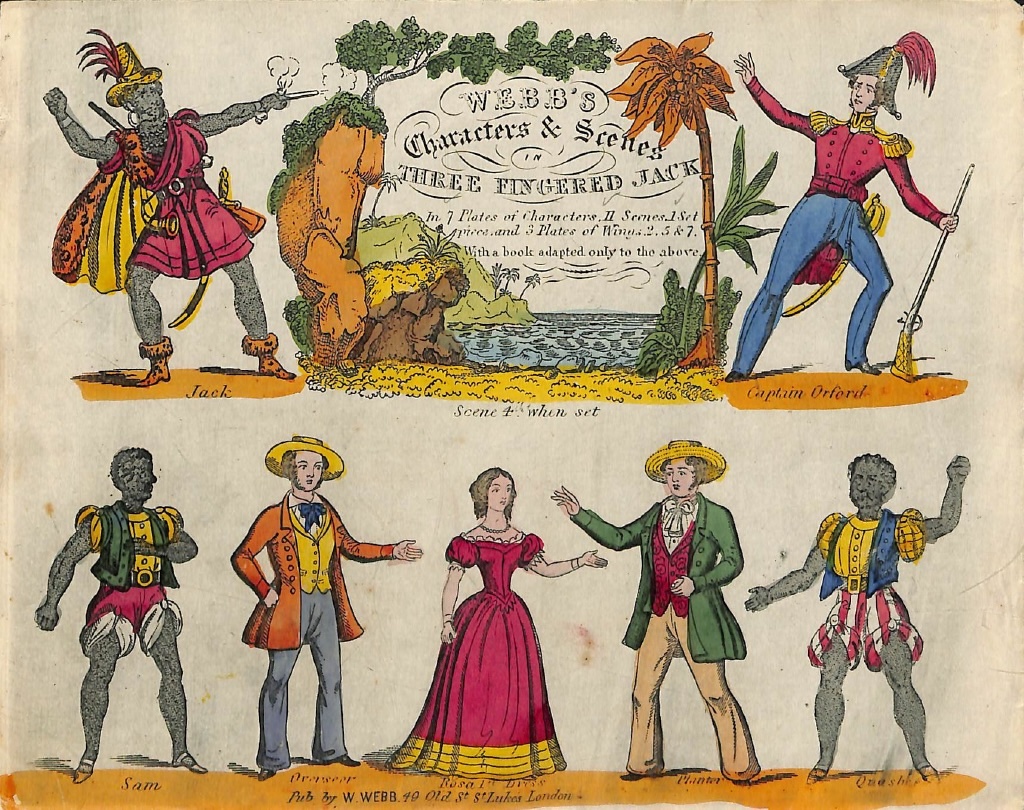
The critical tension identified by scholars—that the pantomime simultaneously conjured and curtailed revolutionary possibility—becomes even more apparent when considered through Webb’s toy theater. By translating the drama into a material and performative medium for domestic use, the toy theater not only reiterates but sharpens the ideological work of containment, showing how rebellion could be visually and theatrically re-scripted into narratives of planter authority and loyalist reward. Consider plate 7 of Webb’s toy theater, which depicts characters for cutting out and placing in various acts and scenes (Fig. 4). The bottom half of the sheet shows the heroic Quashee and Sam, each borne aloft by four enslaved men, two additional men bearing Jack’s head and his infamous three-fingered hand on pikes. The playbook describes the “grand procession,” at the end of which the Planter addresses Quashee and Sam: “Valiant men! To you I owe a deep and lasting debt of gratitude, for saving my daughter from a terrible death. Accept, then…the freedom of your wives and children—no longer my slaves but friends.”[22] The Planter rewards Quashee and Sam with liberty, but for having rescued Rosa and restoring the rightful order of the plantation.
Even as it represents a restoration of colonial order and racial domination, however, the play also had radical potential, as Jeffrey Cox points out, with its “important representation of slave resistance working both through armed revolt and through the creation of a counter-culture grounded in the magic of Obi.”[23] Similarly, Yasser Shams Khan describes Jack as a “defender of his right to liberty, as well as an uncivilized wretch who instigates havoc and mischief, disrupting the idyllic order of the plantation,” while, according to Peter Reed, the pantomime “lionizes Jack as it plots the antihero’s ill-fated rebellion.”[24] Although the play inevitably ends with Jack’s death and dismemberment, the plot allows for some leeway in perspectives on slavery, rebellion, freedom, and revolt. The mechanics of Webb’s toy theater permit an even greater range of possibilities for revolutionary agency in retelling the tale of Three-Fingered Jack.
Staging, License, and Imaginative Play
The booklet that accompanied the print set for the toy theater gives fairly specific stage directions to the home theater director, indicating from which side the various characters should enter and exit, and their activities. However, there was more than enough latitude within these instructions for the individual directors to take license with the staging. Take, for instance, the final scene of “desperate combat” described in the playbook:
Jack disarms Quashee, when a struggle takes place. Draw off figures combatting and put on Jack and Quashee bottom of p. 6, Jack is about to strangle Quashee when Tuckee with pistol, RH [Right Hand] pl. 6, appears at top of rock, between two scenes, he fires and wounds Jack, who leaves his hold, Quashee then springs up and stabs Jack in the breast. Draw off the figures, and put on Quashee stabbing Jack, RH p. 6.[25]
The actions of the struggle, Quashee’s recovery, and the stabbing all invite ample interpretation by the director of the toy theater. Playbooks for later toy theaters offer similar latitude, often with even less prescriptive language: in Benjamin Pollock’s The Corsican Brothers (c. 1875), a fight is described simply as, “The weapons cross—Combat of some minutes,” and then resumes “as before…After fighting a short time, they both Exit.”[26] In Pollock’s Sleeping Beauty of the Wood (c. 1875), the booklet instructs only at one point, “A comic fight takes place.”[27] It is easy to imagine a young person, playing with the toy theater at home, imaginatively staging dances, fights, and even murders in ways not anticipated by the authors of the scripts. Yet this imaginative engagement carries complex implications. For a (presumably white) Briton in the metropole, far from Jamaica, physically enacting Quashee’s struggle or Jack’s rebellion raises questions about the spectator’s positionality: does manipulating these figures reproduce colonial authority by controlling and containing acts of resistance, or might it cultivate a vicarious understanding of the violence and injustice of enslavement, fostering empathy with abolitionist perspectives? The toy theater thus functions as a site of tension, simultaneously mediating the power of colonial narratives and enabling the imaginative exploration of rebellion and resistance. It made it possible for metropolitan audiences to experience and rehearse revolutionary acts domestically.
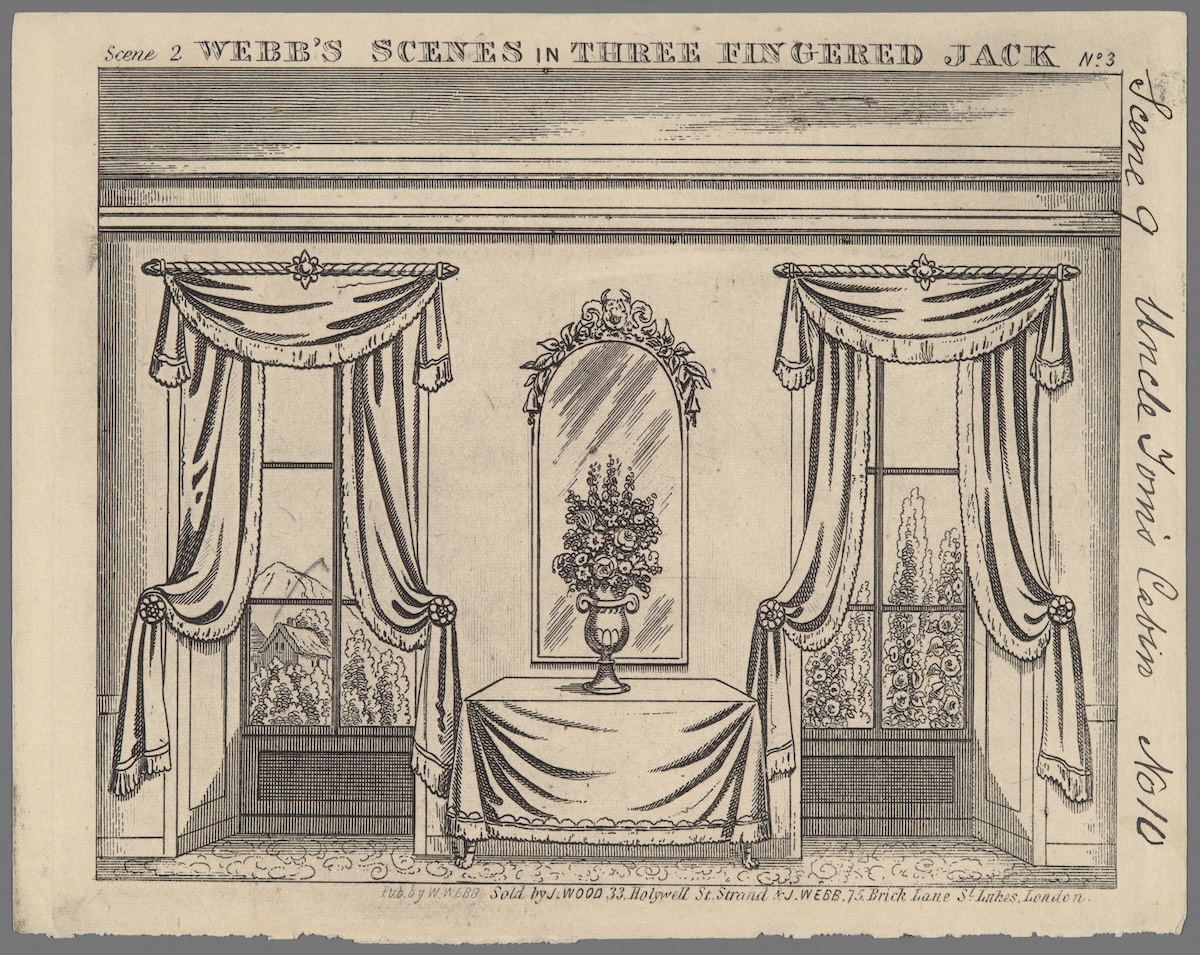
Of course, the play director is under no obligation to follow the instructions in the playbook, or the course of action in the script of the toy theaters at all. While the bundles of prints sold for constructing toy theaters included backdrops and wings for that particular play, at home amateur theater directors might easily mix and match at will. Recently, Sharon Aronofsky Weltman has suggested that consumers of these objects “would write their own adaptations or create original stories,” and that they “afforded…the opportunity to create completely new adventures.”[28] Daniel O’Quinn points out that “toy theater is perpetually open to play, to new scenarios and configurations.”[29] In fact, Figure 5 shows the backdrop described as “Inside of Planter’s House” in the playbook for Three Fingered Jack, yet another hand has written in the margin in ink, “Scene 9 Uncle Tom’s Cabin,” a story with a rather different hero (Fig. 5). William Webb also published a toy theater for staging the adaptation of Harriet Beecher Stowe’s novel, which appeared simultaneously on several London stages only months after the book’s British publication in 1852.[30] Scene 9 takes place in a “Room in Mr. Bird’s House.” The easy interchangeability of a plantation house for a politician’s home, or of a British colony for the free state of Ohio, permits an extension of this interchange by the users of the toy theaters themselves.[31]
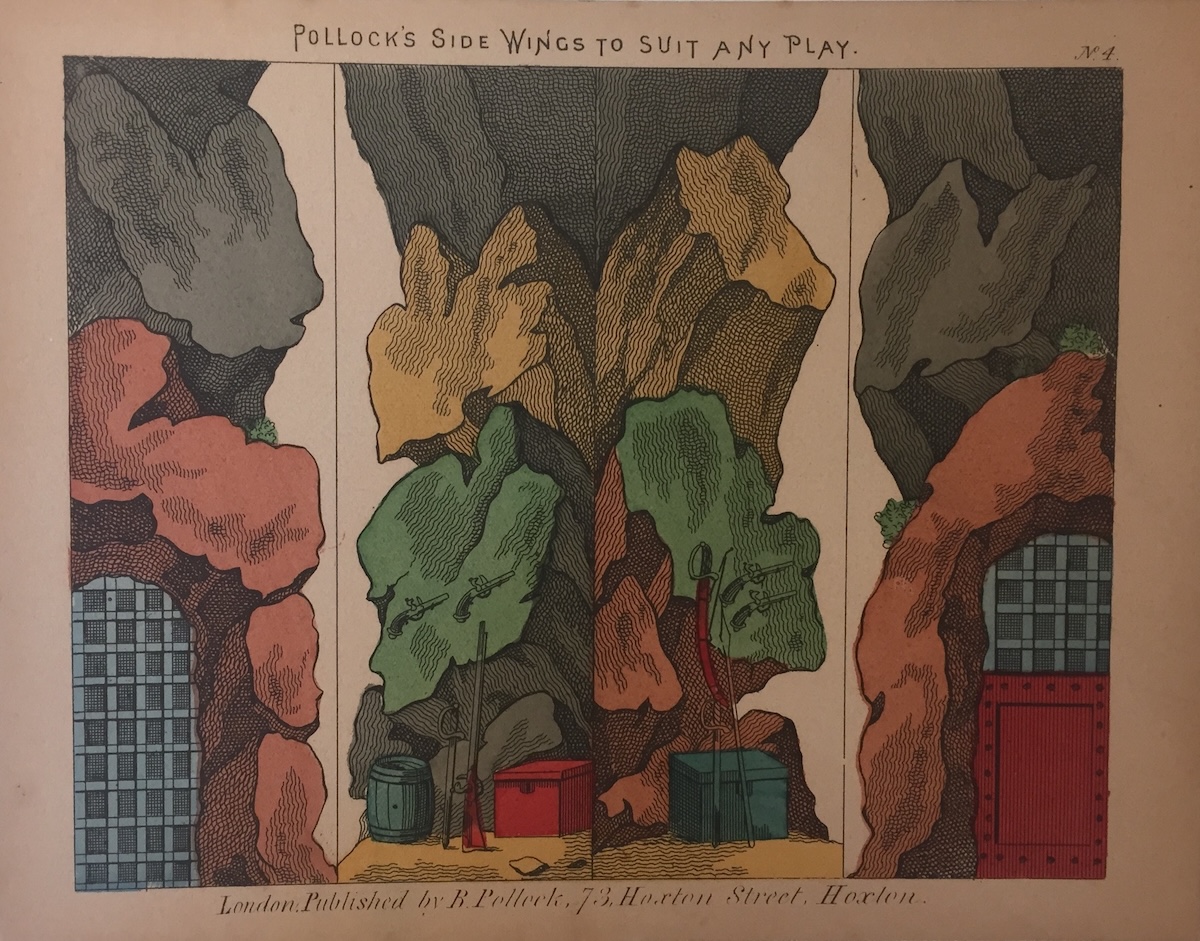
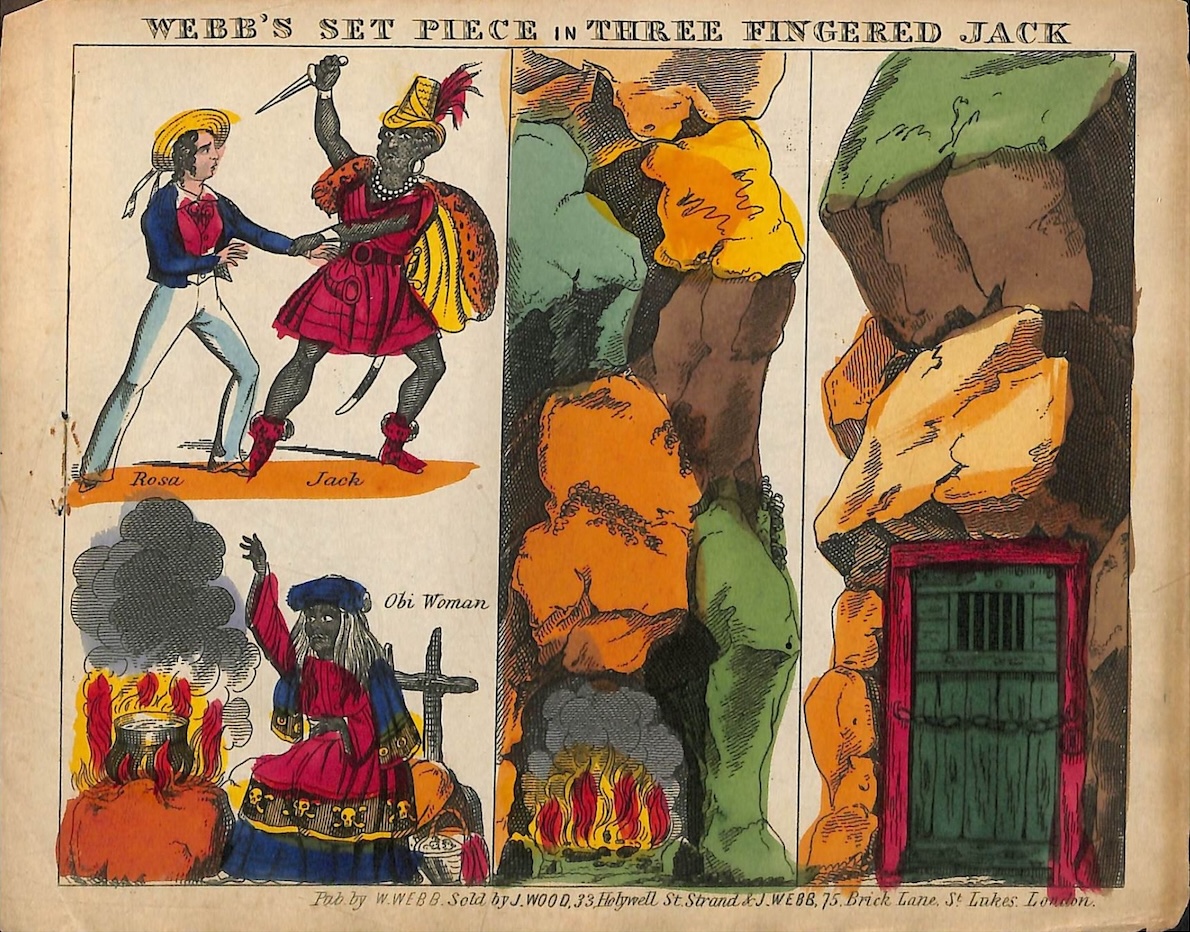
Even within the set of toy theater prints sold for Three Fingered Jack, two plates indicate their potential use for staging other plays. The headings on No. 2 and No. 5 read “Webbs Chamber Wings” and “Webbs Rock Wings,” denoting their interchangeability among many plays. Printsellers published generic backdrops and wings that could be used for any toy theater production. The rocks in “Pollock’s side wings to suit any play,” for example, bear a striking resemblance to the rocks and cave lairs in in Webb’s Three Fingered Jack (Fig. 6, 7). In this way, Jack’s hideout might become less unique or frightening in its interchangeability, because its fictionality could be recognized by those familiar with such stock wing designs. However, the tantalizing reverse possibility remains that the potential threat of rebellion and murder exists in every play. The fungible materiality of toy theaters also permits, perhaps even invites, transgressions in the restaging of plays.
While the Obi pantomime was not satirical in the Harlequinade mode, Peter Reed points out that the audiences would have recognized the play’s roots in existing British stage conventions. As the Whitehall Evening Post observed, Obi “resembles several representations of a similar kind, yet it is well put together, and excites a strong interest throughout.”[32] Reed suggests that Jack’s Obeah magic reflects the kinds of theatrical transformations that happened on the afterplay stage.[33] Through its evocation of more traditional farcical and satirical pantomime plot lines, the Obi pantomime offers the potential, however unrealized, of social and cultural critique. Webb’s toy theater, in its fidelity to the plot of the 1800 and 1825 playscripts, and not the later dialogue-heavy melodrama, further solidifies its relationship to subversive pantomime conventions.
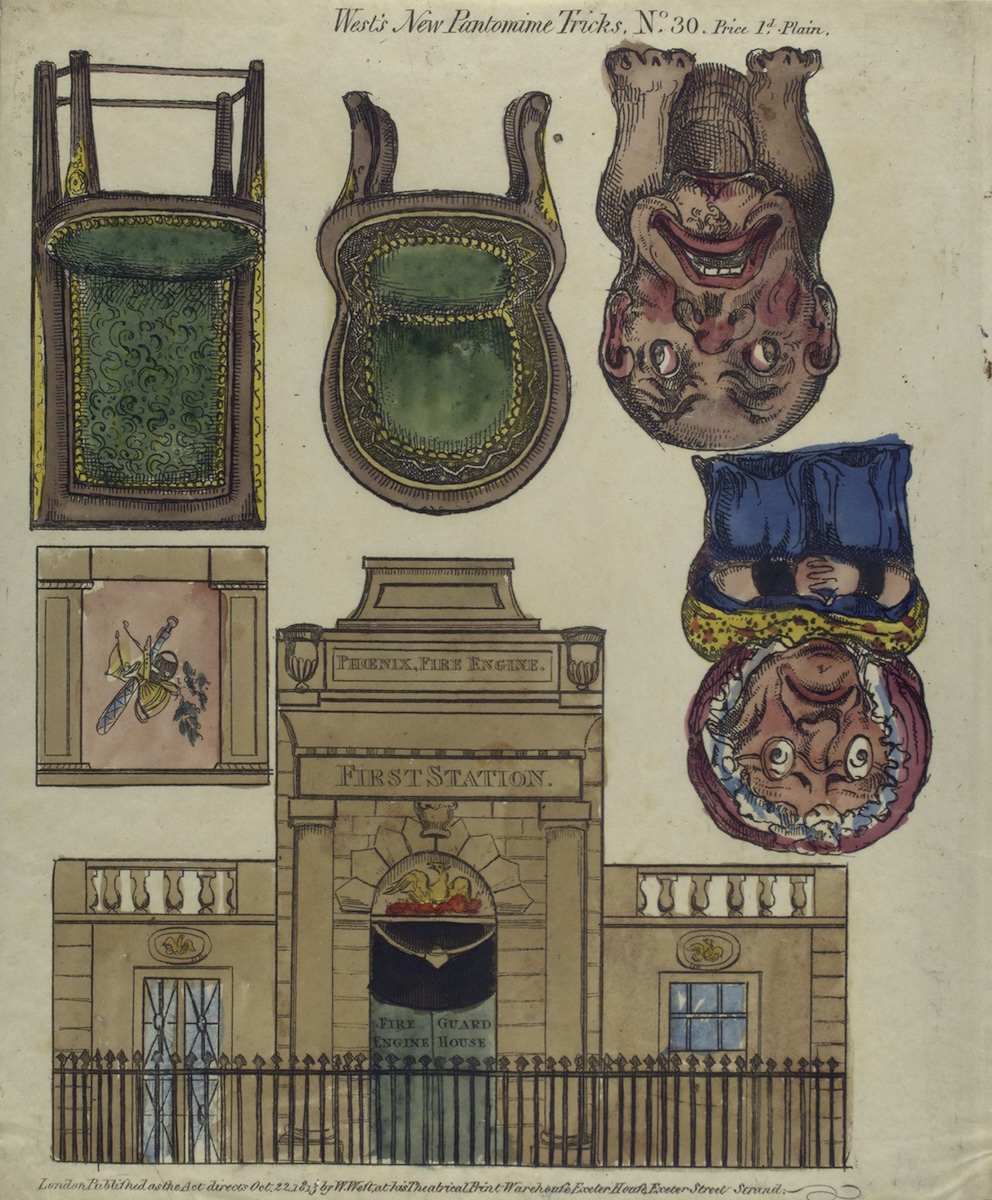
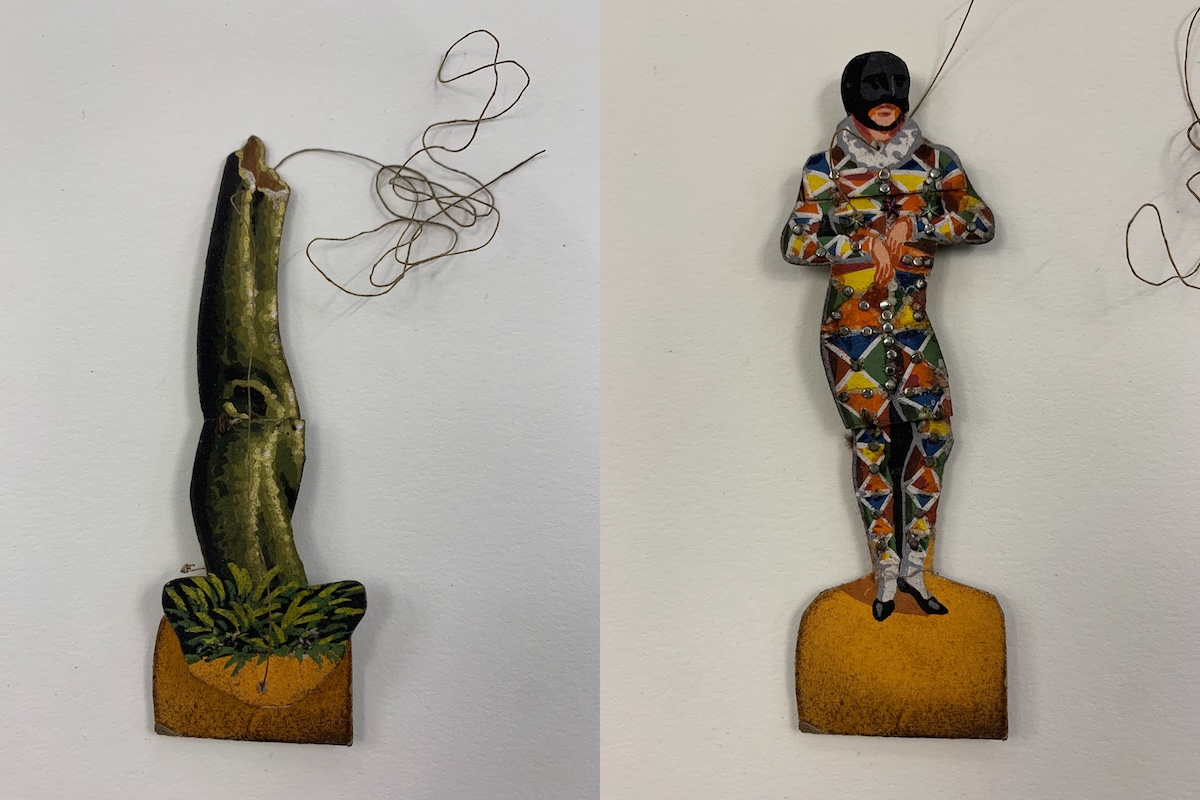
The toy theater offers a material equivalent to the stage’s capacity to destabilize narrative and social hierarchies through visual and narrative tricks in its evocation of the Harlequinade pantomime mode. The cut and mounted props and set pieces of toy theaters lent themselves particularly well to the pantomime tricks of the Harlequinades, and special sheets were printed to assist in the magical transformation that Harlequin always effected in the afterpieces. Figure 8, for example, presents the makings of the transformation of an old woman into a grimacing bulldog or a chair (Fig. 8). The dotted lines on some prints indicate how the pieces would align, and where they might be cut out and folded so that, with a pull of a string from above, the figure of Harlequin (or the director of a toy theater) could transform them with a tap of his magic bat. In a remarkable surviving example of a constructed transformation piece, a tree trunk quickly changes into Harlequin himself with a tug of the string (Fig. 9).
Building on the transformational logic of the Harlequinade, Webb’s toy theater extends this magic to the story of Obi, where the material manipulation of props and figures allows viewers to enact moments of danger, escape, and reversal. Just as Harlequin’s transformations delighted and surprised audiences, the shifting forms of boats, figures, and other stage pieces in Obi invite a reconsideration of narrative authority, highlighting moments in which enslaved characters act with agency and momentarily upend the colonial order. In this way, the toy theater does more than replicate the pantomime’s tricks: its material and performative possibilities create a space for radical undermining of the racist and hierarchical assumptions embedded in the play, allowing domestic performers and audiences to experiment with, and even stage, subversive interventions.
In the last scene of Act 1 of Obi, Captain Orford and the enslaved man Tuckey have been bird hunting when Jack ambushes them and throws Tuckey from a rocky cliff into the water below. Luckily there happens to be an empty rowboat in the water, into which Tuckey climbs and safely returns to shore. Plate 7 of Webb’s toy theater contains two pieces for the home staging of Tuckey’s escape from Jack—the empty boat, and the boat with Tuckey rowing (Fig. 4). As in the evocation of satirical pantomimes in the transformational magic of Obeah in the Haymarket theater, here on the home stage the material transformation of the boat recalls the upended order of toy theater trick pieces. While Diana Paton argues that Obi’s “antislavery case is consistently undermined in the writing or staging of the story,” the toy theater can indeed enable a more radical destabilization. The pantomime genre and the material form of the toy theater invites and even encourages transgressions and the subversion of the racist colonial narrative that imbues the play.
The story of Three-Fingered Jack in toy theater form underscores the extent to which narratives of rebellion and empire were never static, but rather subject to continual rearticulation across print, stage, and parlor performances. While the printed playbooks reinforced the authority of the plantation and colonial order, their materiality allowed creative manipulations that could subtly unsettle those hierarchies. Well into the nineteenth century, Jack’s story carried multivalent meanings: a warning against rebellion, a defense of colonial rule, and, at times, an occasion through which audiences might contemplate Black resistance and revolt.
Monica Anke Hahn is Assistant Professor of Art History at the Community College of Philadelphia in Philadelphia, PA
[1] Three Fingered Jack: A Drama in Two Acts, Written Expressly for, and Adapted Only to Webb’s Characters & Scenes in the Same, Webb’s Juvenile Drama (W. Webb, n.d. [c. 1850]). Although the prints that comprise the toy theater set are not dated, they indicate that they were also for sale at Joseph Wood’s shop at 33 Holywell Street. The esteemed antiquarian bookseller Laurence Worms notes that Wood had his printshop at this address from 1845 until about 1860. See Worms, “J. T. Wood of the Strand,” The Bookhunter on Safari, July 30, 2013, https://ashrarebooks.com/2013/07/30/j-t-wood-of-the-strand/ (all web links accessed February 11, 2026).
[2] “Advertisements & Notices,” Derby Mercury, August 17, 1825. In 1850, one guinea had the buying power of five days wages of a skilled tradesman. National Archives’ Currency Converter, http://www.nationalarchives.gov.uk/currency-converter/.
[3] Three Fingered Jack: A Drama in Two Acts, 5.
[4] See Frances R. Botkin, Thieving Three-Fingered Jack: Transatlantic Tales of a Jamaican Outlaw, 1780-2015 (Rutgers University Press, 2017); Charles J. Rzepka, “Rzepka, Introduction: Obi, Aldridge and Abolition,” Romantic Circles Praxis Series (August 1, 2002); Frances R. Botkin, “Revising the Colonial Caribbean: ‘Three-Fingered Jack’ and the Jamaican Pantomime,” Callaloo 35, no. 2 (2012): 494-508.
[5] “Advertisements & Notices,” Derby Mercury, August 17, 1825.
[6] Benjamin Moseley, A Treatise on Sugar (Printed for G. G. and J. Robinson, Paternoster-Row, 1799), 170-71. The discussion of Three-Fingered Jack appears on pages 173-80.
[7] Botkin, Thieving Three-Fingered Jack; Rzepka, “Rzepka, Introduction”; Botkin, “Revising the Colonial Caribbean,” 494-508.
[8] David Worrall, Harlequin Empire: Race, Ethnicity and the Drama of the Popular Enlightenment (Pickering and Chatto, 2007), 1–10, 24.
[9] John Fawcett, Songs, Duets, & Choruses, in the Pantomimical Drama of Obi or, Three-Finger’d Jack: Invented by Mr. Fawcett, and Perform’d at the Theatre Royal, Hay Market. To Which Are Prefix’d Illustrative Extracts, and a Prospectus of the Action, 3d edition (Printed by T. Woodfall, and sold at the Theatre, [1800], n.d.).
[10] “Arts and Culture,” Morning Chronicle, July 3, 1800.
[11] Jeffrey N. Cox, ed., Slavery, Abolition and Emancipation, vol. 5 (Routledge, 1999), 202.
[12] See Samuel Arnold and Fawcett, Obi; or, Three-Finger’d Jack!; a Serio Pantomime, in Two Acts, Duncombe’s British Theatre, Volume 59 (Duncombe and Moon, 1825); Obi; or, Three fingered Jack. A melodrama in two acts (Thomas Hailes Lacy, The New British Theatre (late Duncombe’s), No. 469), 1854.
[13] Diana Paton, “The Afterlives of Three-Fingered Jack,” Essays and Studies 2007, no. 1 (2007): 42.
[14] David Powell, Printing the Toy Theatre (Pollock’s Toy Museum Trust, 2009), 8.
[15] One could also buy “Wooden Stages with the Machinery for the scenes…These are made to take to pieces, and printed directions given with them for their use.” “Advertisements & Notices,” Derby Mercury, August 17, 1825.
[16] See Botkin, Thieving Three-Fingered Jack; Jeffrey N. Cox, “Theatrical Forms, Ideological Conflicts, and the Staging of Obi,” Romantic Circles Praxis Series (August 1, 2002); Paton, “The Afterlives of Three-Fingered Jack.”
[17] See Trevor G. Burnard, Jamaica in the Age of Revolution (University of Pennsylvania Press, 2020); Trevor G. Burnard, “Slavery and the Enlightenment in Jamaica and the British Empire, 1760–1772: The Afterlife of Tacky’s Rebellion and the Origins of British Abolitionism,” in Enlightened Colonialism: Civilization Narratives and Imperial Politics in the Age of Reason, ed. Damien Tricoire (Springer International Publishing, 2017), 227-46; Kathleen Wilson, Strolling Players of Empire: Theater and Performances of Power in the British Imperial Provinces, 1656-1833 (Cambridge University Press, 2022); Botkin, Thieving Three-Fingered Jack.
[18] See Vincent Brown, Tacky’s Revolt: The Story of an Atlantic Slave War (Belknap Press of Harvard University Press, 2020).
[19] William Earle, Obi, or, The History of Three-Fingered Jack, ed. Srinivas Aravamundan (Broadview Press, 2005), 13. In treaties after the First Maroon War, Maroons agreed to return self-emancipated enslaved people to their enslavers.
[20] Moseley, A Treatise on Sugar, 178. For more on Obeah, see Eugenia O’Neal, Obeah, Race and Racism: Caribbean Witchcraft in the English Imagination (University of the West Indies Press, 2020); Alan Richardson, “Romantic Voodoo: Obeah and British Culture, 1797-1807,” Studies in Romanticism 32, no. 1 (1993): 3–28.
[21] Jenna Gibbs, “Toussaint, Gabriel, and Three Finger’d Jack: ‘Courageous Chiefs’ and the ‘Sacred Standard of Liberty’ on the Atlantic Stage,” Early American Studies 13, no. 3 (2015): 627-30. See also Botkin, “Revising the Colonial Caribbean”; Wilson, Strolling Players of Empire, 242-45.
[22] Three Fingered Jack: A Drama in Two Acts, 20.
[23] Cox, “Theatrical Forms,” para. 7
[24] Yasser Shams Khan, “Variant Rebellions: Psychic Compromise in Obi; or, Three-Fingered Jack,” The Eighteenth Century 62, no. 3/4 (2021): 270; Peter P. Reed, “Conquer or Die: Staging Circum-Atlantic Revolt in Polly and Three-Finger’d Jack,” Theatre Journal 59, no. 2 (2007): 253.
[25] Three Fingered Jack: A Drama in Two Acts, 20.
[26] The Corsican Brothers, or, The Fatal Duel. Pollock’s Characters and Scenes in the Corsican Brothers (B. Pollock, n.d. (c. 1875-99)), 15.
[27] Sleeping Beauty of the Wood, or, Harlequin and the Magic Horn. Pollock’s Characters & Scenes (B. Pollock, n.d. (c. 1875-99)), 14.
[28] Sharon Aronofsky Weltman, “Toy Theater: Transgression and Transmediation in the Victorian Home,” Nineteenth-Century Contexts 46, no. 5 (2024): 644, 649.
[29] Daniel O’Quinn, “Some Versions of Spectacle: Worldmaking and the Regency Toy Theater,” in The Visual Life of Romantic Theater, 1780-1830, ed. Diane Piccitto and Terry F. Robinson (University of Michigan Press, 2023), 86. On the “recycled” and “customized” potential in which “new fantasies could be represented and read,” see Liz Farr, “Paper Dreams and Romantic Projections: The Nineteenth-Century Toy Theater, Boyhood and Aesthetic Play,” in The Nineteenth-Century Child and Consumer Culture, ed. Dennis Denisoff (Routledge, 2016), 51.
[30] Hazel Waters, “Putting on ‘Uncle Tom’ on the Victorian Stage,” Race & Class 42, no. 3 (2001): 31.
[31] It is worth noting that Uncle Tom’s Cabin was published and staged on the eve of another major conflict precipitated by ruptures over slavery—the American Civil War. In this context, Ohio is especially significant for its role in the Underground Railroad, paralleling the earlier function of Maroon communities in Jamaica and elsewhere, which facilitated the self-emancipation of enslaved people decades before. The juxtaposition underscores how toy theater, through its flexible staging, could allow domestic audiences to engage imaginatively with multiple sites of resistance and liberation across the Atlantic world.
[32] Quoted in Reed, “Conquer or Die,” 254.
[33] Reed, “Conquer or Die,” 255. Susan Valladares also notes the “subversive energies” infused in the pantomime tradition in “Afro-Creole Revelry and Rebellion on the British Stage: Jonkanoo in Obi; or, Three-Fingered Jack (1800),” The Review of English Studies 70, no. 294 (2019): 291.
Cite this article as: Monica Anke Hahn, “Three-Fingered Jack: Staging Resistance in the Toy Theater,” Journal18, Issue 21 Revolutions (Spring 2026), https://www.journal18.org/8095.
License: CC BY-NC
Journal18 is published under a Creative Commons CC BY-NC International 4.0 license. Use of any content published in Journal18 must be for non-commercial purposes and appropriate credit must be given to the author of the content. Details for appropriate citation appear above.
