
Rebecca Yuste
For a long time, I had eagerly wished that our nation would take advantage of the many opportunities offered by these truly fortunate islands, both for their climate and the ingenuity of their inhabitants, in order to naturalize in them the most precious fruits of the King’s domains in America and Asia, as well as to spread the advances in botany throughout Europe.[1]
While virtually unknown in English-language scholarship, the Orotava Garden on the island of Tenerife emerged as a crucial site of transoceanic botanical exchange in the late eighteenth century.[2] Established in the Canary Islands, an Atlantic archipelago long imagined as a threshold between the known and unknown worlds, the garden occupied an ambiguous position between the metropole and the colony.[3] Designed to acclimatize plants arriving from Spain’s American and Asian territories before their transfer to the Iberian Peninsula, the garden operated as a fragmentary and relational space, forming one node within a broader network of botanical infrastructure across the eighteenth-century Spanish empire. The garden was created to address one of the central challenges of imperial botany: transporting and cultivating plants across different climates and long distances, providing an intermediary space where specimens from Europe, Asia, and the Americas could be grown and exchanged.
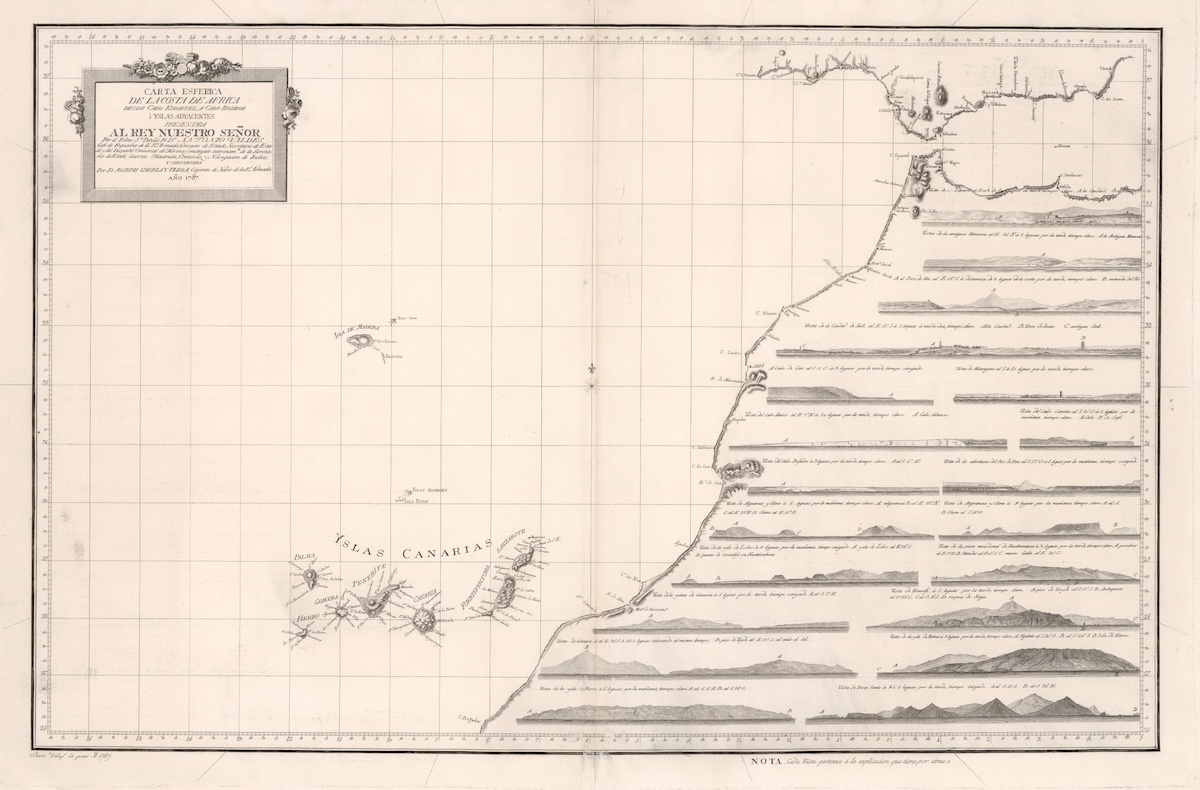
In the eighteenth century, the Canary Islands were at the forefront of Enlightenment scientific inquiry. Their geographic position—off the coast of Africa and on the path of the trade winds—made them an ideal resting place for voyages traversing the Atlantic, for scientific expeditions, merchant ships, and slave-trading vessels alike. The archipelago is extraordinarily biologically and topographically diverse, especially given the size of the islands. The seven islands that compose the Canary Islands are volcanic in origin and share some general features: steep cliffs plunge toward the Atlantic Ocean floor while deep ravines cut through mountain ranges, giving way to rugged peaks and extreme differences in elevation. As shown in the 1789 Atlas marítimo de España, the islands’ profiles rise dramatically when approached from the water, appearing sharp, craggy, and precipitous (Fig. 1).
However, differences in elevation, exposure to prevailing winds, and proximity to the African mainland produced varied microclimates from one island to another. Fuerteventura and Lanzarote, the easternmost islands and those closest to the Sahara, for example, are characterized by sweeping arid landscapes, rocky mountain faces, and white sand beaches. The western islands, such as La Palma, are able to sustain temperate subtropical rainforests through the moisture of the trade winds, which is trapped by high mountain peaks. Tenerife, one of the central islands, boasts dozens of microclimates, organized around the imposing volcanic massif of Mount Teide. The northern part of the island is humid and slightly cooler, home to ancestral pine and laurel forests, while the southern coastlines are largely sunny and arid, as Mount Teide blocks much of the northern rainfall.[4]
The variation in climate and the fertile soil of the central and western islands also made them well suited for human settlement and agricultural use. The earliest Guanche settlers, the indigenous inhabitants of the Canary Islands, arrived from North Africa around the first millennium BCE. The archaeological record indicates that they harvested barley, wheat, and legumes, and raised herding animals like goats and sheep.[5] On the fringes of a European cultural consciousness, the Canary Islands remained largely isolated from developments in both Iberia and North Africa, and the Guanches remained pastoralists until Spanish subjugation. As the environmental historian Alfred Crosby writes of the islands,
The Fortunate Isles were rich in livestock, and therefore in hides and tallow, and in a sort of moss called orchil that brought a high price from European dyers; and rich in people to sell as slaves. They were islands well worth raiding and worth having.[6]
Spanish conquest of the Canary Islands began in the early years of the fifteenth century and lasted until 1496, when Tenerife was taken by Alonso Fernández de Lugo (1456–1525). By the late fourteenth century, raiders were capturing Guanches along the coast of the archipelago and selling them into bondage in Valencia, Seville, Lisbon, and Barcelona.[7] A spiritual intervention shortly followed, as Spanish missionaries, led largely by the priest Alfonso de Bolaños (d. 1478), arrived to convert the indigenous inhabitants, the first step toward extending the reconquista across the Atlantic. Religious influence gave way to political power in the later fifteenth century, as the crown sought to extend its reach and solidify its position in the region, especially vis-à-vis France and Portugal, who had each laid claim to parts of the archipelago.[8] The first Spanish military expeditions to Tenerife began in the 1460s.
It was on these islands, too, as the historian Manuel Lobo Cabrera argues, that some of the first experiments in plantation slavery occurred, experiments that anticipated agricultural and plantation systems later developed across the Spanish Caribbean.[9] Although some indigenous Guanches were incorporated into Christian society through missionary efforts and conversion, many were also enslaved.[10] Meanwhile, enslaved people brought from Africa, including regions under Muslim rule, became an increasingly important source of labor as the colonial economy expanded. They were forced to work in a variety of industries, including agriculture, herding, and artisanal trades. European landowners introduced crops and livestock intended to generate export revenues, organizing production around the labor of enslaved people. Sugar became especially important, helping establish an agricultural model that would later be developed on a much larger scale throughout the Atlantic world.[11] Sugarcane was most likely first introduced in the Canary Islands in 1483 by Pedro de Vera, who built the archipelago’s first sugar mill the following year.[12] Enslaved laborers worked on the plantations and in the mills, satisfying Europe’s insatiable appetite for sugar.
However, slavery existed alongside other forms of labor in the Canary Islands in this period. Enslaved laborers worked alongside free people and came from a variety of ethnic and racial backgrounds; the racial and physical markers associated with Caribbean slavery, for example, were less pronounced in the Canary Islands. In addition, manumission was more common than in the Americas, where freedom was seldom bought or granted.[13] As the sugar boom on the Canary Islands waned in the late sixteenth century, the demand for enslaved labor declined, and slavery became less central to the islands’ economy, persisting in domestic and urban settings, as opposed to the plantations of the Americas.
The islands therefore served as a kind of imperial laboratory, where European experimentation in conquest, crop production, bondage, and the economic systems that sustained them could unfold in a relatively contained environment. This archipelago thus became a microcosm, an allegory for empire, a workshop for the practices of economic botany and chattel slavery, to be repeated, propagated, refined, and cultivated in Spain’s overseas territories. The Canary Islands were the first stage in Spain’s expansion into the Atlantic, an experiment in extending the reach of the crown’s power to territories distant from the Iberian Peninsula.
The archipelago also played a practical role in the conquest of the Americas as a stopover. In 1492, Christopher Columbus famously spent six weeks on the island of La Gomera, just west of Tenerife, before crossing the Atlantic.[14] Spanish ships often stocked up on supplies, enlisted crewmen, and made repairs on their way to the Americas. English voyages to Virginia and Australia also passed through the Canary Islands, as did many of the scientific expeditions that left Europe to discover, map, and measure the world: those of Nicolas Baudin, Louis Antoine de Bougainville, James Cook, and Alejandro Malaspina, to name a few.[15] Alexander von Humboldt began his voyage to the Americas with a stop in Tenerife in 1799 before continuing on to New Granada, Peru, New Spain, and the newly founded United States. The Canary Islands were thus, as historian Alfredo Herrera Piqué has called them, an attractive scientific stopover, geographically well situated, with abundant opportunities to study the natural world, close enough to the European capitals that they were known, yet far enough away that their landscape remained unusual.[16] In short, they occupied one of the paradoxes of archipelagic space by the eighteenth century: at once isolated and interconnected, both marginal and central to scientific exploration and the mechanisms of Enlightenment empire.
Botany and the Enlightenment
By the eighteenth century, the role of the Canary Islands within the Spanish empire had begun to take on new significance. Whereas the preceding centuries had been shaped largely by conquest, colonization, and the establishment of plantation economies, the Enlightenment brought a renewed interest in the systematic study of the natural world in the pursuit of economic wealth. Botany gained new prominence in learned and courtly Spanish circles, promising new forms of revenue for the Crown. The Spanish monarch Carlos III (1716–1788, r. 1759–1788) sponsored four botanical expeditions to the New World, seeking plants with potential applications in medicine and industry, an enterprise we would today call economic botany.[17] Cinchona bark, for example, harvested from trees native to the Andes, remained an essential treatment for malaria and generated considerable revenue for the Spanish Crown.[18] On their expeditions, Spanish botanists searched for other plants that could prove equally profitable, including American equivalents to Asian spices—cinnamon, black pepper, cloves, and nutmeg—whose cultivation within the empire promised to reduce dependence on foreign trade.[19]
Unlike mineral wealth, botanical wealth could be propagated and cultivated, in theory, ad infinitum. Plants could be collected in one corner of the empire and brought to another: breadfruit, for example, native to the South Pacific, was introduced by the British to Caribbean plantations and grown in Indian botanical gardens, championed as cheap food for enslaved populations and a solution to famine.[20] As we have seen, the cultivation of sugarcane, another Asian crop, proved enormously profitable. One of the earliest plants brought by the Spanish to the Canary Islands, it traveled with Columbus to Hispaniola and quickly formed the backbone of the slave plantation economy. However, plants also demanded continual care. They were vulnerable to salt air, drought, darkness, changes in temperature, and the violence of long ocean voyages. The success of Spanish economic botany therefore depended on the ability to sustain living organisms, once collected, across enormous distances. Before a specimen could be planted in the Royal Botanical Garden in Madrid, it first had to survive months at sea.
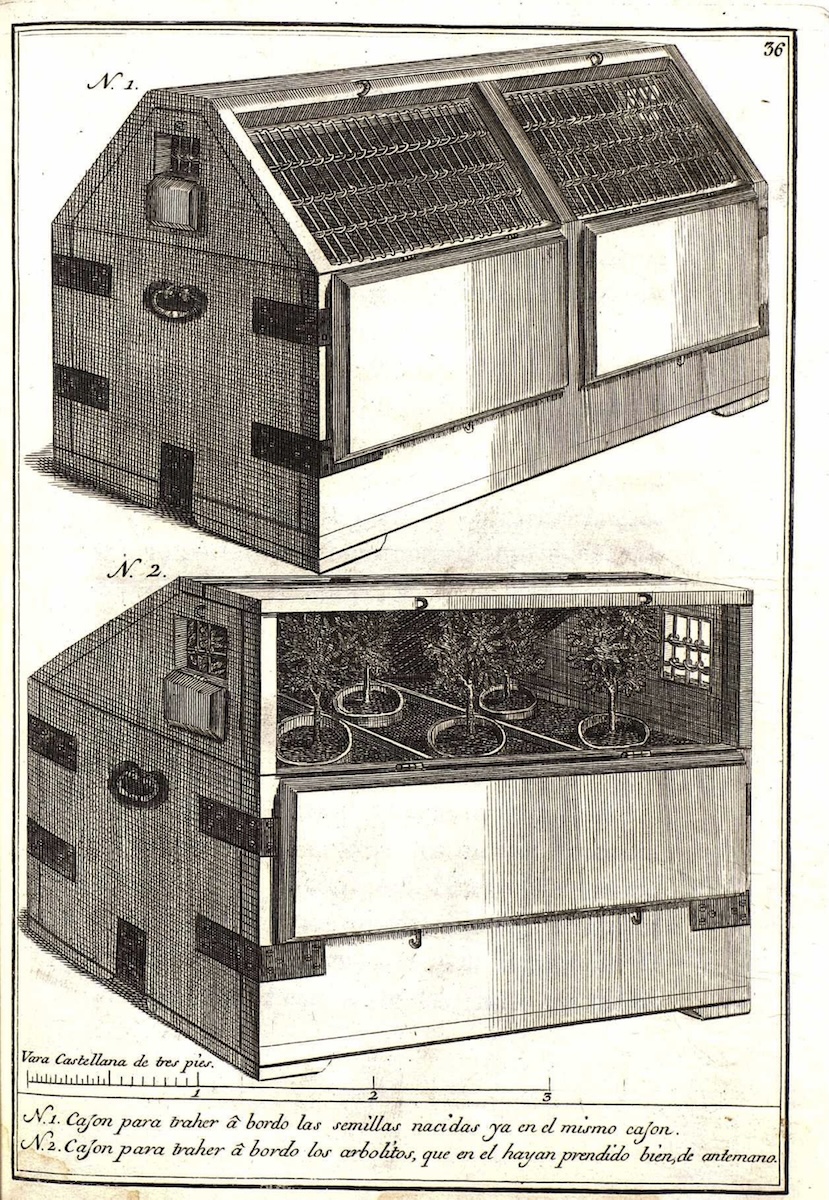
The movement of plants consequently required engineered environments in which they might survive their transoceanic journeys. Throughout the eighteenth century, European scientists developed an array of devices intended to regulate temperature, humidity, light, and ventilation during transport.[21] Cases, drawers, and wooden chests—known in Spanish sources as cajones—formed carefully engineered microclimates within which seeds, cuttings, and saplings could endure the transatlantic crossing (Fig. 2). Constructed with trellised interiors, adjustable shutters, glazed openings, and compartments designed to stabilize fragile specimens, these containers functioned as portable machines for acclimatization—modifiable architectural ecosystems. The potted saplings in the lower image, for example, could be exposed to sunshine and warm air on the deck of a ship or sheltered from the elements if the weather turned. The architecture of the box sought to reproduce, in miniature, the environmental conditions necessary for life, allowing tropical plants, for example, to survive journeys that would otherwise prove fatal. Success, however, was never guaranteed. Many specimens arrived in Madrid shriveled by salt, wilted from the heat, or otherwise weakened beyond recovery, unable to survive the cold Castilian winters or Madrid’s long, hot, dry summers.[22]
These transport boxes suspended their specimens in space and time, regulating their conditions of life and attempting to collapse environmental and spatial difference. In capturing a plant, in rendering it portable and docile, naturalists were constructing a kind of global visual botanical language, one in which plants from different biomes could be read side by side, detached from the ecological relations that had sustained them. In this respect, the cajones participated in a broader visual culture of imperial botany, alongside botanical illustrations, herbarium specimens, and printed catalogs, through which the diversity of the natural world was rendered legible across geographical distance. Yet while illustrations, which translated plants into images, could be easily reproduced, circulated, and examined independently of their living referents, the cajones necessarily preserved the living and material presence of the specimens, maintaining the conditions under which they might survive displacement. Catalogs and herbaria, by contrast, did not depend on light, water, wind, or sun; the living plant always did.[23] Its legibility as a botanical object remained contingent upon the environmental conditions that sustained it. Only by remaining alive could the plant participate in this emerging global visual scientific culture. Yet doing so required the continual mediation of the very environmental differences that its transportation sought to overcome.
Planting Empire
The Orotava Garden thus became a solution for the larger problem of acclimatization. As nodes in this global system of botanical exchange, the Canary Islands, and especially Tenerife—the largest and historically the most populated island in the archipelago—were prized for their gentle climate, fertile volcanic soil, ease of irrigation, and geographical position, which allowed quick travel both to Europe and to the Americas.[24] If the cajón created a temporary climate capable of sustaining plants in motion, a garden could provide a larger and more stable environment in which to nurse plants back to health before they continued to Spain, an environmental threshold between the Old World and the New.
Thus, in August 1788, the Spanish crown resolved to establish a garden in the Canary Islands, where botanists could cultivate plants from Asia and the Americas, especially those from tropical climates.[25] The garden was overseen and partly conceived by Alonso de Nava Grimón, Marqués de Villanueva del Prado (1757–1832), a prominent Canarian who served as a kind of intermediary between the islands and the Peninsula over the course of his career.[26] A core member and eventual president of the Real Sociedad Económica de Amigos del País de Tenerife, one of the principal vehicles of Enlightenment thought on the island, Nava advocated for the development of industry, the establishment of cultural and educational institutions, and the adoption of new technology, stimulating scientific inquiry and the improvement of all aspects of public life.[27] The Orotava Garden should thus also be understood in this context, as part of a broader Enlightenment vision for the island, where science could be harnessed for local social and economic development, as Nava aimed to position Tenerife as an active participant in a global republic of scientific letters.[28]
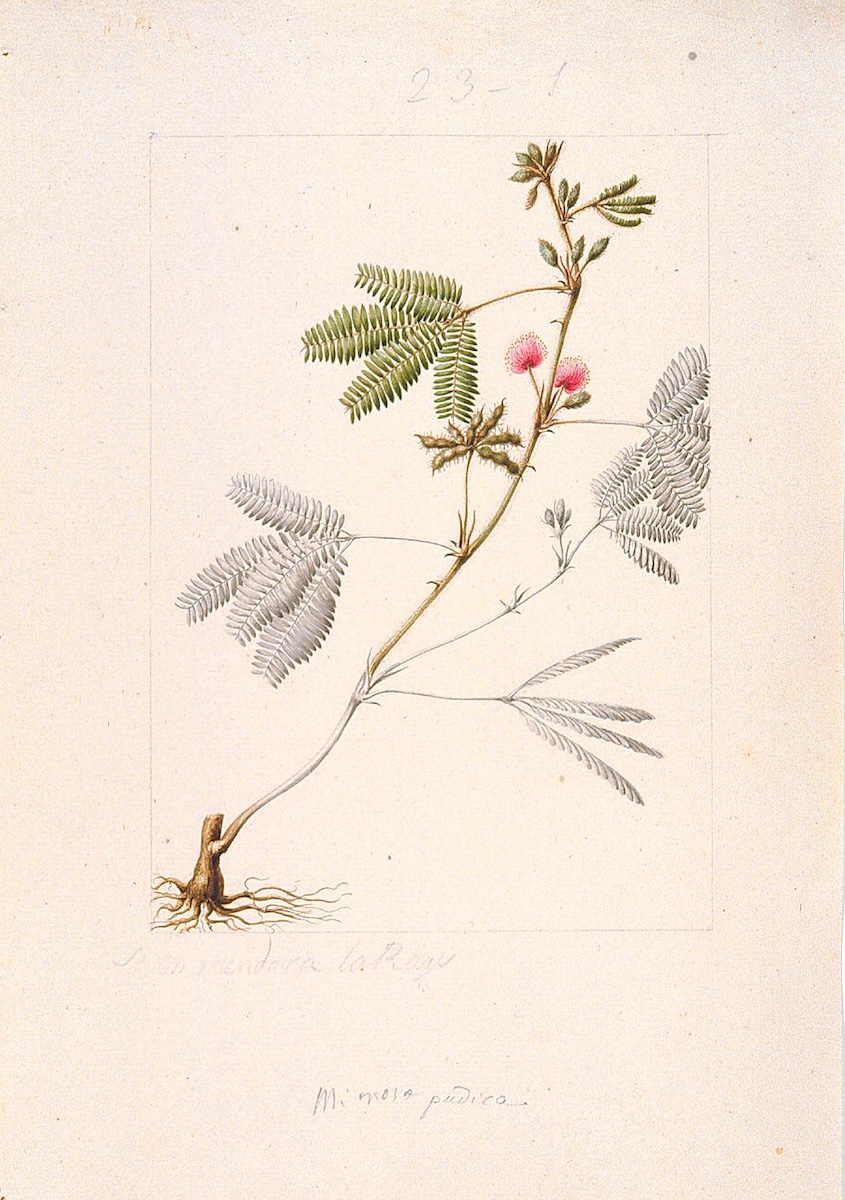
Along with the royal decree establishing the garden, seeds and plants were sent to Nava in Tenerife, “so that on the lands of this island, which are more similar to those of Asia and America, a plantation can be established.”[29] These specimens, which were originally from a shipment to Spain from the Philippines, included seeds, roots, and cuttings from cotton, cumin, nutmeg, cinnamon, and ginger plants. In addition to economically profitable plants, like those mentioned, inventory lists also include various ornamental species, often noted simply as “exquisite flowers.”[30] In the following years, the garden received shipments of botanical specimens from Peru in October 1789 and February 1792. Nava also sent a package of seeds from Tenerife to Madrid in July 1789, which included Caribbean, South American, and Asian species such as Mimosa pudica (Fig. 3).[31] Nava was also in close correspondence with Casimiro Gómez Ortega (1741–1818), the director of the Royal Botanical Garden in Madrid, keeping him informed about the botanical experiments underway and the plants that proved most successful, while seeking his advice on the use of built structures to shelter plants from the cold.[32] Ortega would prove an invaluable resource both to Nava and to other botanists working in the Atlantic world, as he provided both bureaucratic support and scientific expertise to those in the field, often without the political connections or financial resources needed to carry out their work.
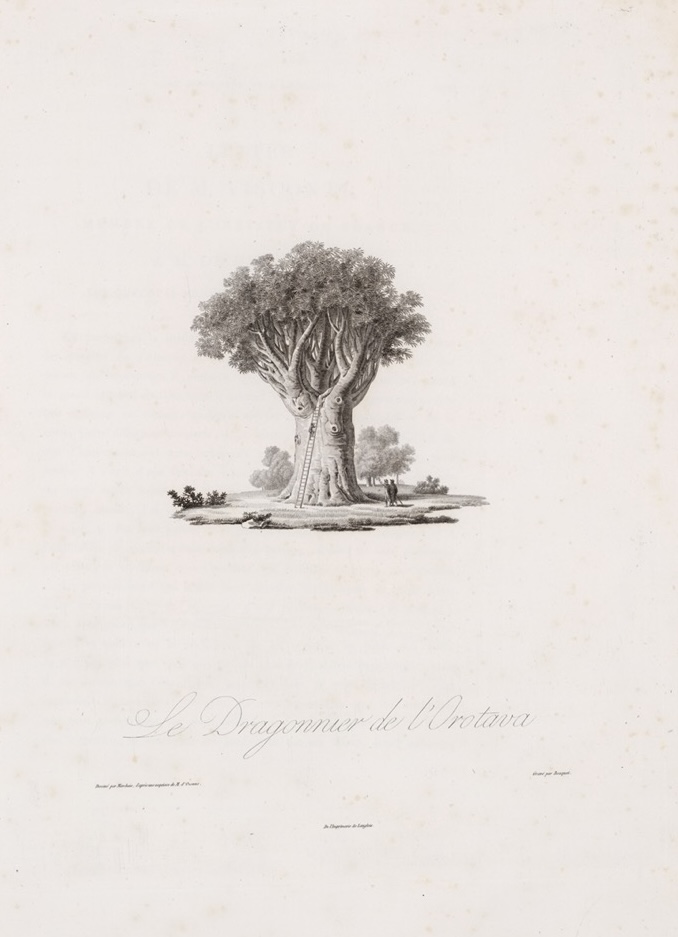
The first seeds that arrived on Tenerife were planted immediately, and by 1790, plans were underway for the garden’s permanent site in the Orotava Valley, which was chosen for its gentle climate—just over a kilometer from the sea, with fertile soil, mild breezes, and a slight elevation that tempered heat and humidity.[33] The specimens listed in the planting schemes demonstrate the wide geographic scope of the garden: among them were the American sycamore, the neem tree from South Asia, dame’s rocket, a purple-flowering European plant, and the opium poppy.[34] When Alexander von Humboldt visited the garden in 1799, he encountered the famous native dragon tree and noted that the plants were arranged in their Linnaean order, something he deemed “very hostile to their cultivation,” as it privileged taxonomic clarity over environmental need (Fig. 4).[35] Although there are no existing plans of the eighteenth-century garden, and it is difficult to say for certain how the space was organized, it is most likely that specimens were planted in garden beds, arranged in a formal rectilinear grid around a central fountain, characteristic of Spanish eighteenth-century garden design.[36] The garden was probably planted by paid laborers and gardeners; some were specialists in agriculture, while others were not.
Taken together, the Orotava Botanical Garden emerges as a crossroads of imperial botanical exchange, connecting the plants gathered on expeditions to the imperial capital, providing an intermediary space between sites of extraction and those of collection and knowledge production. An Edenic landscape, the fertile Orotava Valley rendered distant parts of the empire climatically analogous, collapsing, homogenizing, and equalizing geographic space within the garden. Because the garden was prized for its ability to simulate other environments, Spanish scientists sought to move past the specificities of environment and climate, rendering the entirety of the Spanish empire visible, knowable, movable, and controllable in the service of the Spanish Crown. From the specimen collected in a distant forest, for example, to the sapling transported across the ocean in the cajón, to the mature tree cultivated in the garden, each stage of botanical exchange occupied a different scale of imperial intervention. These nested spaces—seed, cajón, garden, island—formed a connected sequence of environments, with Tenerife as a mediator. The garden was thus central to and distant from the metropolitan circuits of imperial power, within and without.
Through the process of acclimatization, botanists believed they could slowly adapt tropical plants to the climates of Europe, more fully integrating and standardizing overseas economic networks, a central aim of the Crown.[37] The promise, and fiction, of perfect acclimatization was that climate itself could become negotiable, that plants could become infinitely mobile resources, and that their environments of origin would no longer determine the possibilities of their profitable futures. As Humboldt asked, “Does not this fact prove that the bread-fruit might flourish in Calabria, Sicily, and Granada?”[38] In this way, the garden, and the archipelago of the Canary Islands more broadly, became a site where the geographic distance that characterized European empire was rendered negotiable, and where imperial space could be reordered through cultivation. Above all, at least for the eighteenth-century scientists and bureaucrats, this remained a site where plants continued to embody the economic promise of continual territorial expansion, of distant shores boasting botanical riches, ripe for the taking.
Rebecca Yuste is the Frances Yates Curatorial Fellow at the Warburg Institute in London, UK
[1] “Mucho tiempo había que deseaba yo con vivas ansias que nuestra nación se aprovechara de tantas proporciones como la ofrecen esas islas verdaderamente afortunadas, así por su clima como el ingenio de sus habitantes, para connaturalizar en ellas los más preciosos frutos de los dominios del Rey en América y Asia, no menos que para propagar por Europa los progresos de la botánica.” Casimiro Gómez Ortega to Alonso de Nava, Marqués de Villanueva del Prado, Madrid, December 28, 1788, Archivo General de Indias (AGI), Indiferente 1544, reproduced in Alejandro Cioranescu, Historia del Jardín de Aclimatación de La Orotava (Instituto Canario de Investigaciones Agrarias, 2010), 114.
[2] While the Orotava Garden was as consequential as its sister gardens in Lima or Mexico City, it is rarely discussed in English-language scholarship. For more information on the Mexico City botanical garden, see Rick A. López, Rooted in Place: Botany, Indigeneity, and Art in the Construction of Mexican Nature, 1570–1914 (University of Arizona Press, 2025), 73–82.
[3] As Francisco Morales Padrón observes, the Canary Islands have existed in the European literary imagination since the time of Homer as a barrier or curtain between worlds. Francisco Morales Padrón, Sevilla, Canarias y América (Ediciones del Excmo. Cabildo Insular de Gran Canaria, 1970), 13.
[4] Philip Ashmole and Myrtle Ashmole, Natural History of Tenerife (Whittles Publishing, 2016), 4.
[5] Juan Bethencourt Alfonso, Historia del pueblo guanche, vol. 1, Su origen, caracteres etnológicos, históricos y lingüísticos, ed. Manuel A. Fariña González (Francisco Lemus, 1991), 67–90.
[6] Alfred W. Crosby, “An Ecohistory of the Canary Islands: A Precursor of European Colonialization in the New World and Australasia,” Environmental Review 8, no. 3 (1984): 219.
[7] Antonio Rumeu de Armas, La conquista de Tenerife, 1494–1496 (Aula de Cultura de Tenerife, 1975), 22–5.
[8] Rumeu de Armas, La conquista de Tenerife, 71–7.
[9] “Canarias conoció el sistema esclavista desde el mismo momento en que los europeos tocaron sus costas.” Manuel Lobo Cabrera, La esclavitud en las Canarias orientales en el siglo XVI: negros, moros y moriscos (Ediciones del Excmo. Cabildo Insular de Gran Canaria, 1982), 29.
[10] Although the Guanches were technically protected from enslavement by papal bull, they suffered a severe population decline in the early modern period as a result of violence and disease, as did Indigenous American populations. The Guanche language was lost in the seventeenth century, as most Guanches were forced to convert and assimilate.
[11] For more information on sugar cultivation in the Canary Islands, see Benedicta Rivero Suárez, El azúcar en Tenerife: 1496–1550 (Instituto de Estudios Canarios, 1991).
[12] Crosby, “An Ecohistory of the Canary Islands,” 228.
[13] About one-quarter of enslaved people were granted freedom or purchased it during their lifetimes. Freedom could be granted by monarchs or obtained through marriage or with the assistance of friends or parents. Lobo Cabrera, La esclavitud en las Canarias orientales, 257–83.
[14] For more information about the sojourn of Columbus on La Gomera, see Antonio Tejera Gaspar, Colón en La Gomera en el viaje del descubrimiento (Ediciones Idea, 2022).
[15] José M. Oliver Frade and Alberto Relancio Menéndez, eds., El descubrimiento científico de las Islas Canarias (Fundación Canaria Orotava de Historia de la Ciencia, 2007).
[16] Alfredo Herrera Piqué, Las Islas Canarias, escala científica en el Atlántico: Viajeros y naturalistas en el siglo XVIII (Rueda, 1987), 1–15.
[17] These expeditions, to Peru (1777–1788), New Granada (1783–1816), and New Spain (1787–1803), as well as the Malaspina Expedition (1789–1794), have been the subject of extensive scholarship in both English and Spanish. Daniela Bleichmar’s Visible Empire: Botanical Expeditions and Visual Culture in the Hispanic Enlightenment (University of Chicago Press, 2012) offers a synthetic understanding of the visual output of these expeditions. The collections of these expeditions have also been studied at length and published by the Consejo Superior de Investigaciones Científicas (CSIC). For example, see Paloma Blanco Fernández de Caleya, Mario Adolfo Espejo Serna, and Ana Rosa López Ferrari, eds., Catálogo del herbario de la Real Expedición Botánica de Nueva España (1787–1803) conservado en el Real Jardín Botánico de Madrid (CSIC, 2010).
[18] Stefanie Gänger, A Singular Remedy: Cinchona Across the Atlantic World, 1751–1820 (Cambridge University Press, 2021).
[19] Casimiro Gómez Ortega, Instrucción sobre el modo más seguro y económico de transportar plantas vivas… (Madrid: Joachin Ibarra, 1779), 39.
[20] Adrian P. Thomas, “The Establishment of Calcutta Botanic Garden: Plant Transfer, Science and the East India Company, 1786–1806,” Journal of the Royal Asiatic Society 16, no. 2 (2006): 168–72.
[21] The most famous, and perhaps the most effective, of these devices was the Wardian case, designed in 1829 by Nathaniel Bagshaw Ward. For more information on botanical transportation, see Luke Keogh, The Wardian Case: How a Simple Box Moved Plants and Changed the World (University of Chicago Press, 2020).
[22] For more information on the Royal Botanical Garden in Madrid, see Carmen Añón Feliú, Real Jardín Botánico de Madrid: sus orígenes, 1755–1781 (Real Jardín Botánico, CSIC, 1987).
[23] The Kew Herbarium is one example of a collection that did not require the same upkeep as live specimens. For more information, see Zeynep Çelik Alexander, “Managing Iteration: The Modularity of the Kew Herbarium,” in Iteration: Episodes in the Mediation of Art and Architecture, ed. Robin Schuldenfrei (Routledge, 2020), 1–24.
[24] Vicente Rodríguez García, “La historia del jardín botánico de Tenerife en el siglo XVIII: las fuentes documentales del AGI de Sevilla,” in II Coloquio de Historia Canario-Americana (1977), vol. 2, ed. Francisco Morales Padrón (Cabildo Insular de Gran Canaria, 1979), 328.
[25] Royal decree (Real Orden) to Alonso de Nava, Marqués de Villanueva del Prado, San Ildefonso, August 17, 1788, AGI, Indiferente 1544.
[26] Nava was a prolific writer who outlined economic and political plans for his native islands. These writings can be found in Alonso de Nava Grimón, Obras políticas, ed. Manuel Hernández González, 2 vols. (Ediciones Idea, 2007).
[27] Several Sociedades Económicas de Amigos del País operated across the Spanish empire, each pursuing socioeconomic development and improvements in public life. They were instrumental in the creation of many institutions associated with the Hispanic Enlightenment, including botanical gardens and colleges of surgery, and often positioned themselves in opposition to universities and ecclesiastical institutions. Daniel García Pulido, “La Real Sociedad Económica de Amigos del País de Tenerife,” Cosmológica 4 (2024): 85.
[28] This was also largely the case with British imperial botanical institutions, as Richard Drayton argues in Nature’s Government: Science, Imperial Britain, and the ‘Improvement’ of the World (Yale University Press, 2000).
[29] “Para que en los terrenos de aquella isla mas análoga a los de Asia y América se siembre en uno mas plantíos.” List of seeds sent, San Ildefonso, August 27, 1788, AGI, Indiferente 1544, reproduced in Cioranescu, Historia del Jardín de Aclimatación, 89–90.
[30] “Semillas de flores exquisitas.” Cioranescu, Historia del Jardín de Aclimatación, 89–90.
[31] “Mimosa sensitiva, Citrius, Sida Palmata, Huenabana, Cassia Temerind, Sida Paniculata, Cosmia balsamifera, Tuglans Peruviana, Marañó, Psydium, Lantana.” List of seeds sent to the Real Jardín Botánico in Madrid, Tenerife, July 15, 1789, AGI, Indiferente 1544, reproduced in Cioranescu, Historia del Jardín de Aclimatación, 140–41.
[32] “Bien colijo también que será preciso usar de algún resguardo artificial para preservarla del frío en el primer inverno; pero dificulto al propio tiempo.” Alonso de Nava, Marqués de Villanueva del Prado, to Casimiro Gómez Ortega, Santa Úrsula de Tenerife, December 6, 1788, AGI, Indiferente 1544, reproduced in Cioranescu, Historia del Jardín de Aclimatación, 109–10.
[33] Alonso de Nava, notice on the terrain considered for the garden of exotic plants to be built on this island, Santa Úrsula de Tenerife, January 12, 1790, AGI, Indiferente 1544, reproduced in Cioranescu, Historia del Jardín de Aclimatación, 130.
[34] Planting scheme, reproduced in Cioranescu, Historia del Jardín de Aclimatación, 148.
[35] Alexander von Humboldt and Aimé Bonpland, Personal Narrative of Travels to the Equinoctial Regions of the New Continent, during the Years 1799–1804, trans. Helen Maria Williams, vol. 1 (London: Longman, Hurst, Rees, Orme, and Brown, 1814), 136.
[36] The design by Juan de Villanueva and Francesco Sabatini for the Royal Botanical Garden in Madrid uses this type of formal arrangement, as do the gardens at La Granja and Aranjuez, two royal residences outside Madrid. Such arrangements were also the norm for European botanical gardens, including the early gardens at Padua and Leiden. For more information on eighteenth-century Spanish gardens, see Carmen Añón and Mónica Luengo, Jardines de España (Lunwerg, 2003).
[37] This kind of reform was central to the larger Bourbon Reforms, which sought to increase state revenue and reorganize the overseas territories of Spain. For a historical overview, see Allan J. Kuethe and Kenneth J. Andrien, The Spanish Atlantic World in the Eighteenth Century: War and the Bourbon Reforms, 1713–1796 (Cambridge University Press, 2014).
[38] Humboldt and Bonpland, Personal Narrative, 1:136.
Cite this article as: Rebecca Yuste, “An Experiment in Global Botany: The Orotava Garden, Tenerife,” Journal18, Issue 22 Archipelago (Fall 2026), https://www.journal18.org/8343.
License: CC BY-NC
Journal18 is published under a Creative Commons CC BY-NC International 4.0 license. Use of any content published in Journal18 must be for non-commercial purposes and appropriate credit must be given to the author of the content. Details for appropriate citation appear above.
