This interview brings together Jonathan Michael Square, curator of Almost Unknown, The Afric-American Picture Gallery (Winterthur Museum, May 2025–January 2026), and Tyler Horne, Tour Programming Assistant at the Winterthur Museum. Inspired by William J. Wilson’s 1859 essay “Afric-American Picture Gallery,” the exhibition, Almost Unknown, brought the essayist’s imagined gallery to fruition using material and visual culture to explore Black self-fashioning and representation in the nineteenth-century United States. Drawing on Winterthur’s collection, the exhibition assembled objects, images, and texts to approximate Wilson’s speculative gallery, placing them in dialogue to foreground histories that had previously remained dispersed or unarticulated within the museum’s holdings. The conversation between Square and Horne examines Horne’s experience developing and leading interpretive tours in response to the exhibition, which sought to foreground African American histories throughout Winterthur’s permanent collection.
Square and Horne address the practical and intellectual processes involved in constructing a companion tour, the ways in which the exhibition unsettled conventional narratives associated with Winterthur’s decorative arts holdings, and the objects and interpretive strategies that most resonated with visitors. They also consider the relationship between the special exhibition and the historic house at Winterthur, which was once the residence of Henry Francis du Pont (1880–1969), and explore how interpretation can reframe permanent collections and architectural spaces. More broadly, their exchange reflects on Winterthur’s evolving institutional commitment to narrating fuller and more inclusive histories, as well as the enduring impact that the exhibition’s research and interpretive labor have had on the museum’s approach to its collections, public programming, and future interpretation.
Jonathan Michael Square: Tyler, could you begin by describing your role at Winterthur and how interpretation figures in your day-to-day work?
Tyler Horne: I am the Tour Programming Assistant at Winterthur. What makes the role unusual is that I both guide visitors and help design the interpretive frameworks that shape how tours and exhibitions are presented to the public. Most of my week is divided between leading tours and managing other guides, but I also spend time developing tour content, conducting research, and writing. This dual position—delivering interpretation while shaping it—was particularly important for Almost Unknown. It enabled me not only to guide the exhibition but to think through how it would function for different audiences.
JMS: What was your initial impression when you first encountered Almost Unknown, The Afric-American Picture Gallery?
TH: I was struck by the ambition of the premise. In his essay, William J. Wilson, a free Black intellectual who was writing in 1859, imagines a museum devoted to African American history before the Civil War. That mattered to me. Too often, African American history is framed as beginning with the Civil War, but Wilson was already articulating a much longer historical vision.
I will admit that I initially wondered whether Winterthur’s collection could sustain that project. But as we began digging into the holdings—textiles, architectural fragments, ceramics, and printed materials—it became evident that the stories were very much there; they simply had not been assembled in this manner before.
JMS: How did you orient yourself to the exhibition as you prepared to interpret it?
TH: I approached it through Wilson’s voice. I didn’t think of it as a neutral display. Wilson is making an argument. He has a specific political and intellectual vision, so my goal was to ensure that his voice remained present for visitors.
At the same time, preparing our guides to engage with the exhibition was very much an institutional effort. Under the leadership of Reggie Lynch, Winterthur’s Director of Interpretation, the Interpretation and Engagement team developed a series of readings and trainings designed to help guides approach the material with care and confidence. These included texts such as Frederick Douglass’s Narrative (1845), along with materials on figures such as James Forten and the Purvis family that helped situate the exhibition within broader histories of African American life and thought.
This work was important because it ensured that the guides had the tools to facilitate conversations that could occasionally be difficult. Rather than presenting the exhibition as a fixed set of facts, we tried to create space for dialogue, helping visitors connect the objects in the gallery to the wider historical contexts that Wilson was invoking.
JMS: As someone who designed the exhibition, I often think of curatorial work as being similar to fashion design: the object only comes fully alive when it is activated by a body. In your experience, how did the exhibition come alive through its interpretation?
TH: That analogy resonates deeply. The exhibition already embedded interpretation through the recorded narration and the spatial design, but what interpretation adds is dialogue.
A principle I rely on is historical empathy. In in guiding the interpretation of craft objects, we often speak of “the hand of the maker.” I extended that to the lives of those who made and used these objects. Rather than dictating meaning, I tried to create space for visitors to connect with the objects and to imagine the lives of the people who made and used them. Particularly with material this charged, the goal is to facilitate reflection rather than control it.
JMS: How did you think about aligning your tour with the exhibition without simply repeating it?
TH: One of the terms I kept returning to was “rhyming.” I didn’t want the house tour to duplicate the gallery, just as the objects in the gallery were not literal illustrations of Wilson’s essay. Instead, I wanted the interpretations to rhyme with one another.
By that I mean the interpretations echo the exhibition’s themes and arguments without replicating them. The gallery approximates Wilson’s imagined space; the house tour, in turn, approximates and extends the gallery. Each component shares a structure, a cadence, a set of concerns—but none is identical to the other.
This idea of rhyme became a useful way of thinking about interpretation more broadly. Interpretation does not reproduce the curator’s voice verbatim. It resonates with it. It moves in parallel. It creates continuity through variation. In that sense, the house and the gallery were in conversation, not replication.
JMS: Were there any specific objects or moments in the exhibition that resonated most strongly with visitors?
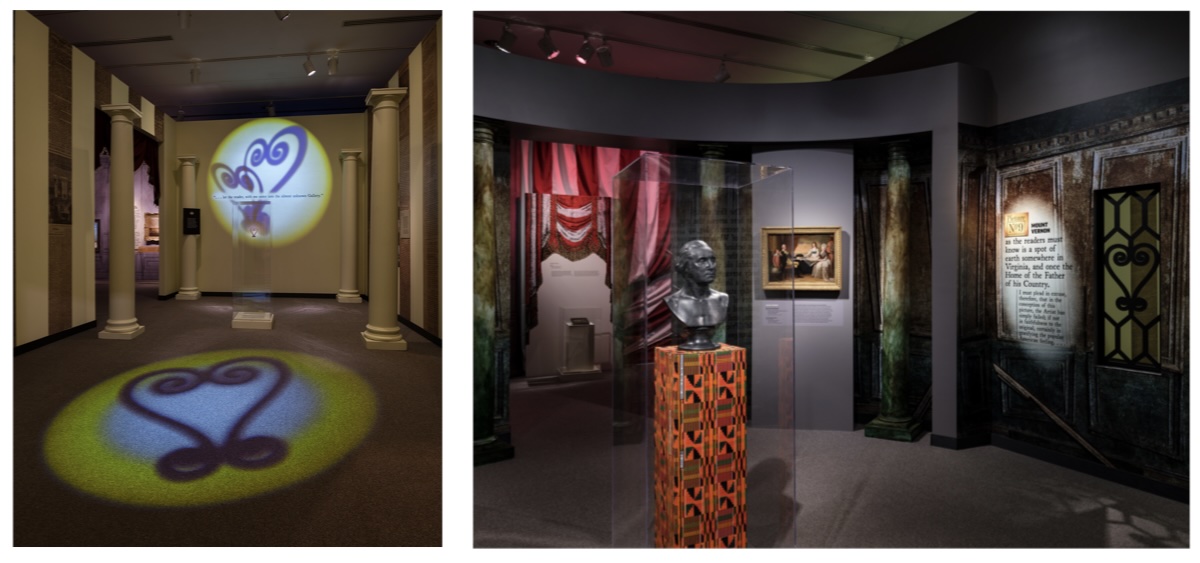
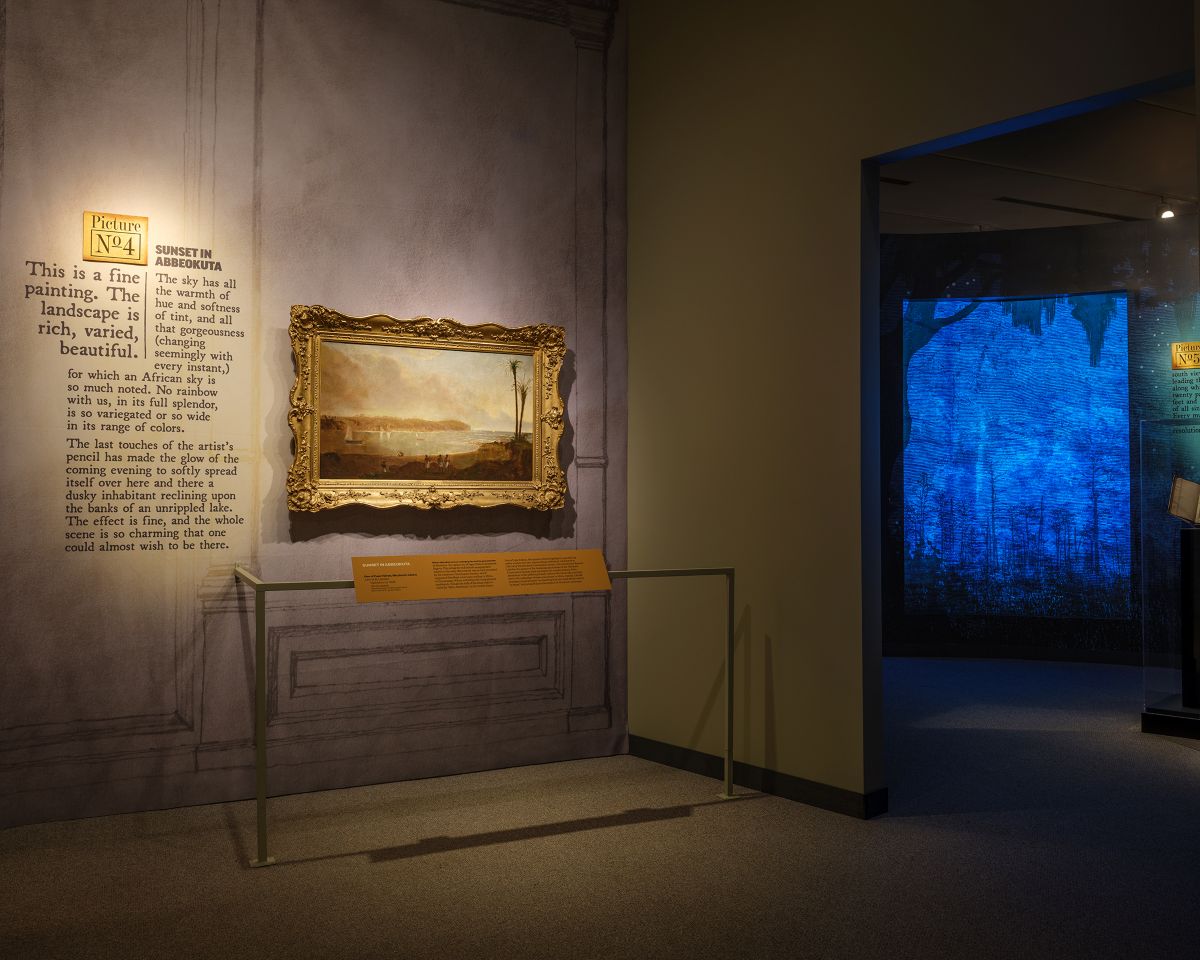
TH: The entrance made a strong impression. The projected Sankofa [a West African adinkra symbol, sometimes depicted as a bird turning its head backward and sometimes depicted as a heart-shaped figure with curled ends, signifying the importance of returning to the past in order to move forward] created an immediate visual and conceptual anchor (Fig. 1). Visitors frequently commented on the “Black” George Washington figure and the juxtaposition with the Mount Vernon imagery (Fig. 2). The winding “Black Forest” path [a darkened, immersive passage through the gallery that disrupted conventional sightlines and evoked both disorientation and reflection] also stood out (Fig. 3). It challenged expectations of a linear gallery and encouraged a more immersive experience.
The Phillis Wheatley volume prompted especially powerful responses, as did the Charleston slave badge. The latter, in particular, often elicited strong emotional reactions from visitors, including moments of silence, sadness, visible discomfort, and occasionally anger. In those moments, my role was to gauge the response. Sometimes visitors needed space. At other times, it required clearly stating that this is part of history, and that Winterthur is committed to telling complete histories.
JMS: Did you find that visitors arrived with specific expectations about Winterthur? If so, how did the exhibition reshape them?
TH: Yes, very much so. We have longtime supporters who are familiar with recent efforts toward more inclusive programming. But we also have visitors who think of Winterthur primarily as a bucolic estate, detached from difficult histories.
For this second group, Almost Unknown could be challenging. Yet it also helped expand our audience. We saw more visitors from Wilmington and a younger, more diverse public. I would say it was the most ambitious step Winterthur has taken toward integrating these histories into its core narrative.
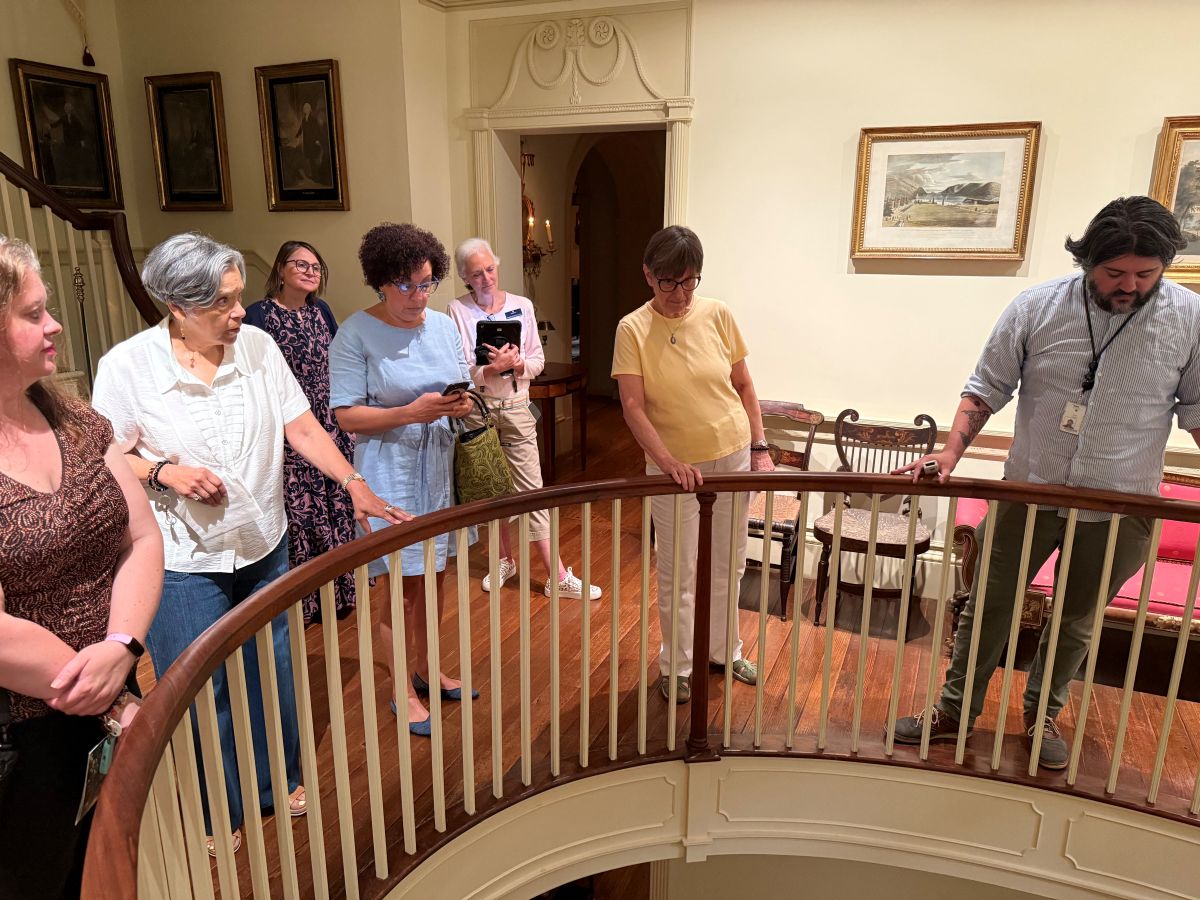
JMS: You developed the companion tour Continuing the Journey, which connected the gallery to the historic house. What kinds of connections did you draw?
TH: One example within the historic house is the Montmorenci staircase, originally constructed on a North Carolina plantation by named enslaved artisans. Traditionally, it was interpreted as a design object collected by Henry Francis du Pont. We reframed it to foreground the labor history embedded in it.
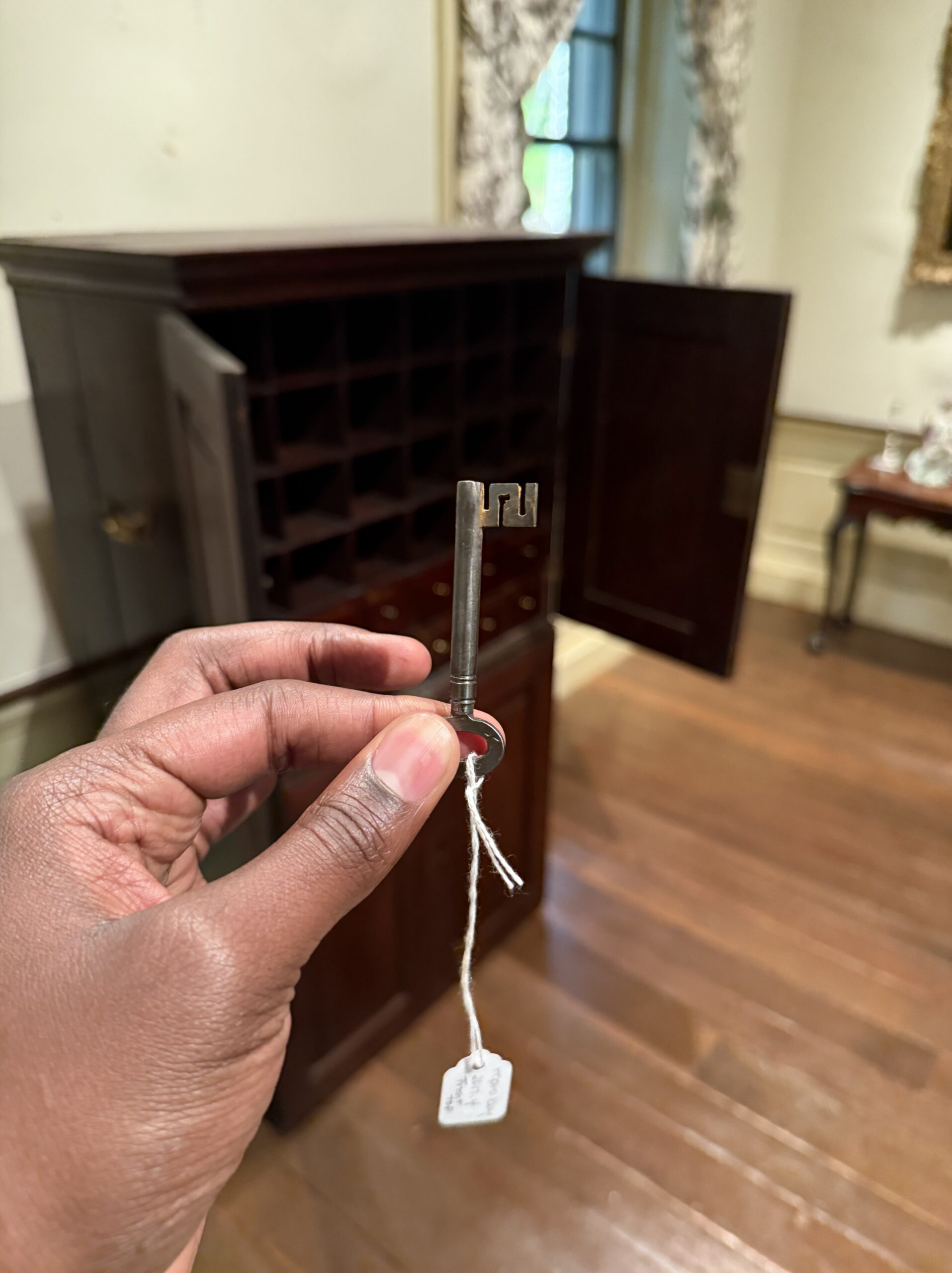
Another example is the ship captain’s desk with drawers labeled for ports, such as Bristol, Senegambia, Philadelphia, and Caribbean locations. That object physically embodies the triangular trade. It’s rare to find furniture that so clearly materializes the bureaucratic machinery of enslavement. Seeing those labels and hidden compartments makes the system tangible in a manner that textual documents alone cannot.
We also reinterpreted Audubon prints in light of Audubon’s participation in slave trading, and connected needlework traditions in the house to broader histories of Black women’s education and literary production.

JMS: Did preparing this tour change the way you broadly think about Winterthur’s collection?
TH: Absolutely. Many of the relevant objects were not cataloged under African American or enslavement-related categories. We had to search deeply for ceramics with abolitionist texts, architectural elements built by enslaved laborers, and rare printed materials—all of which were present in the collection but had not previously been linked to African American history or the history of slavery in Winterthur’s interpretation.
What changed for me was realizing that the capacity to tell these stories already existed within the collection. The exhibition assembled them. Now that the interpretive work is documented, it becomes institutional groundwork for future scholarship.
JMS: We spoke briefly about place—about Winterthur’s location in Delaware and its position between slavery and freedom. How do you see that shaping interpretation moving forward?
TH: Delaware’s border-state history complicates simple narratives. Northern Delaware differed significantly from the agricultural south of the state, yet slavery was legal here. That complexity is significant.
We are also beginning to incorporate Native histories into architectural tours, including land acknowledgment and reference to archaeological findings on the estate. Interpretation cannot stop with a single exhibition. It has to remain ongoing.
JMS: Finally, is there anything about your experience with Almost Unknown that you feel is important to document?
TH: I would emphasize that it is important for this work to continue. The symposium and continuing education programs extended the conversation, and modified versions of Continuing the Journey are still being offered.
What matters most is that the exhibition made these narratives part of Winterthur’s institutional memory. They are no longer hypothetical; they are searchable, teachable, and expandable. This ensures that future interpreters can build on this work, extending and refining the Winterthur Museum’s efforts to tell fuller and more inclusive histories through its collections and interpretive practices.
Jonathan Michael Square is the Assistant Professor of Black Visual Culture at Parsons School of Design in New York City.
Tyler Horne is Museum Guide/Tour Programming Assistant at The Winterthur Museum, Garden & Library in Winterthur, DE
The authors would like to thank Winterthur’s curatorial staff, who helped point them to pieces in the collection that told these stories, especially Leslie Grigsby, Winterthur’s Curator Emeritus of Ceramics, Matt Monk, Winterthur’s Curator of Textiles, and Laura Johnson, Curator of Costumes & Textiles, Smithsonian National Museum of American History.
Cite this note as: Jonathan Michael Square and Tyler Horne, “Rhyme, Not Replication: Curating and Interpreting Almost Unknown” Journal18 (April 2026), https://www.journal18.org/8240.
License: CC BY-NC
Journal18 is published under a Creative Commons CC BY-NC International 4.0 license. Use of any content published in Journal18 must be for non-commercial purposes and appropriate credit must be given to the author of the content. Details for appropriate citation appear above.
