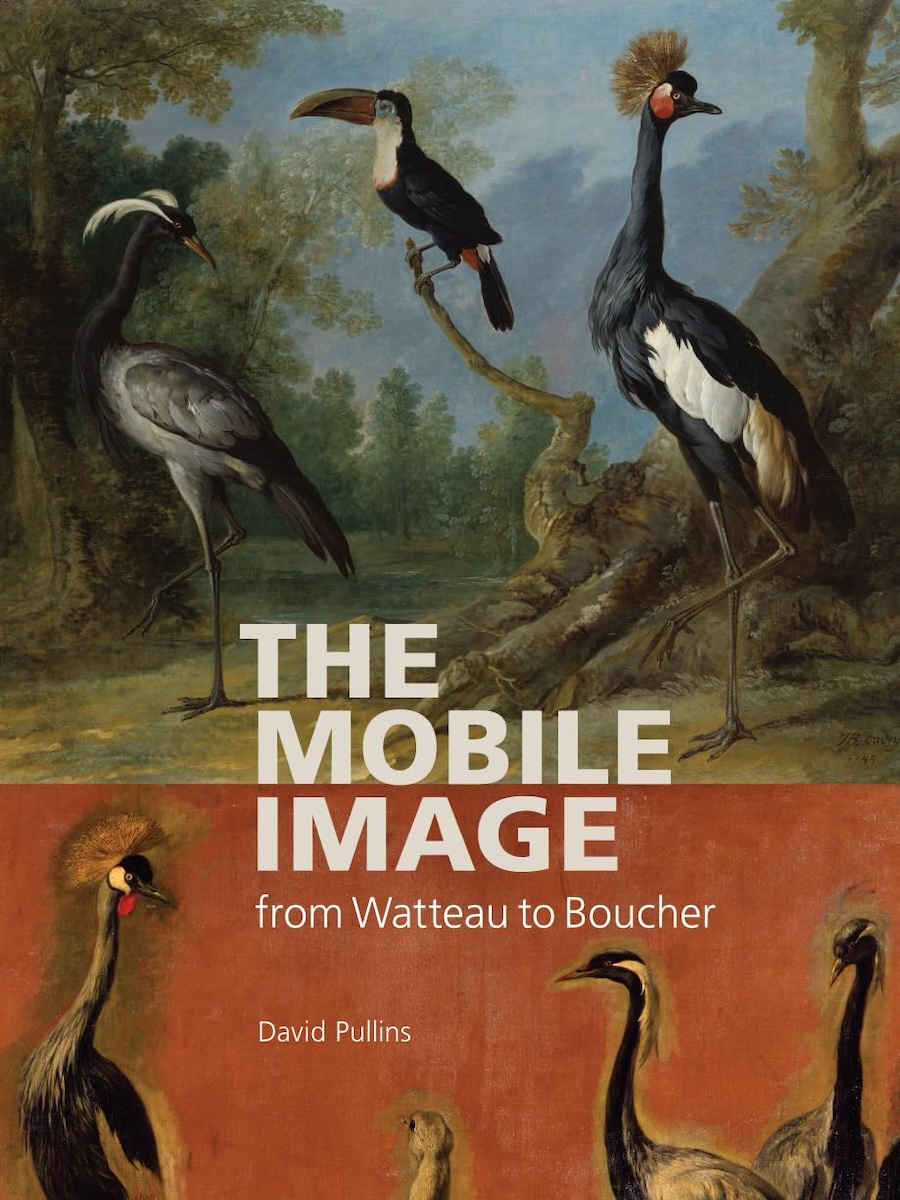
David Pullins, The Mobile Image from Watteau to Boucher (Getty Research Institute, 2024). 208 pp.; 115 color and 30 b/w illustrations. Paperback, $60. ISBN 978-1-60606-888-5.
In L’ombre du Grand Colbert (1752), Étienne La Font de Saint-Yenne complained that painting had been exiled from the walls of grand apartments and demoted to the decoration of objects like carriage doors. Displaced by gleaming mirrors and boiseries, painting was now “dragged through the streets,” where it experienced “the indignities of mud and was daily exposed to collisions with dung carts.”[1] Images were, indeed, habitually on the move in eighteenth-century Paris, but not just on the sides of vehicles. They traversed cobblestones, yes, but they also jumped across more noble media, from paper to porcelain. David Pullins’s monograph, The Mobile Image from Watteau to Boucher (2024), argues that these figures and motifs were, in fact, conceived in anticipation of their future deployment across surfaces and in space. Their eventual manipulation was not incidental but integral to their creation. Pullins locates the aesthetic logic of these “image-objects” in the very processes through and from which they emerged, and in the workshops in which they were made.[2] Through his attention to the operations of copying and pasting, rotating and reversing, transposing and translating, Pullins reveals that agility was one of the defining characteristics of art in this period.
To make this argument, the author reads against the grain of academic discourse. From the founding of the Académie royale de peinture et de sculpture in 1648, French academicians and art critics were intent upon articulating painting’s distinction from the objects onto which its imagery so often migrated: objects produced by artisans. The work of a painter was, the Académie’s founders emphasized, more noble than that of a craftsman.[3] This institutional logocentrism has continued to delimit the terms with which we tend to examine French painting of the ancien régime. Pullins seeks to redress this lingering “prioritization of text over image” by examining not just the reception of works of art, but also the conditions of their production.[4] In addition to examining the formal strategies that underpinned the creation of images and motifs in France in the first half of the eighteenth century, The Mobile Image puts pressure on the regimes of value that have, heretofore, made us overlook them.
La Font de Saint-Yenne’s lament implies that artists had dedicated all their talent to ornamental projects and were giving insufficient attention to autonomous works of art. What should have been of peripheral concern—the supplemental, the parergon—had assumed a central position. Pullins’s highly original and rigorous book locates this inversion of attention in the new ways that art was being taught, practiced, and consumed. As he writes in his introduction, his study investigates, “cutting-and-pasting as a modality that informed learning, seeing, and producing across eighteenth-century art and visual culture.”[5] Attention to this modality reveals the “deployment of artisanal knowledge at the intersection of the applied and fine arts” in a manner that allows us “to view painting obliquely.”[6] In his focus on the networks and infrastructures of artistic production, Pullins builds upon foundations laid by Katie Scott in The Rococo Interior (1995), bringing this workshop perspective to the period’s painting for the first time.
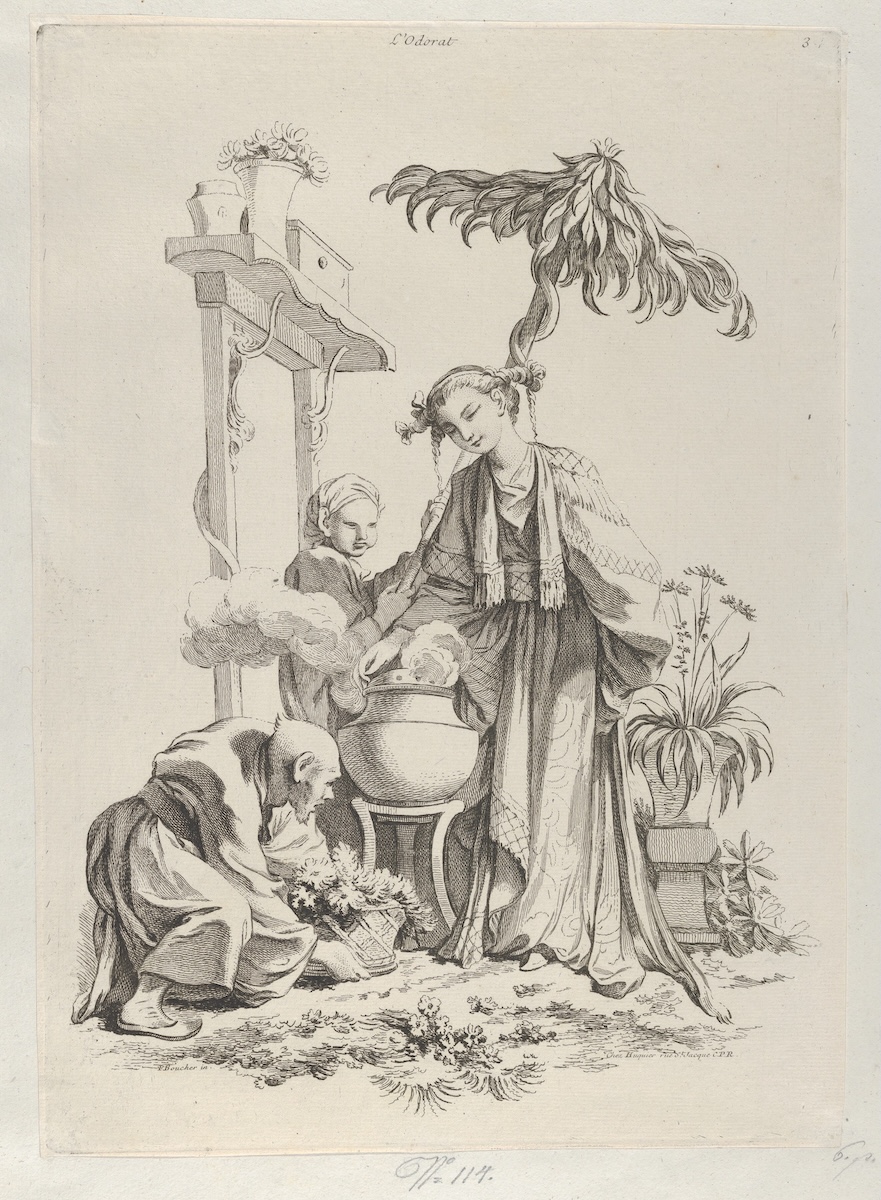
The Mobile Image opens with the practice of decoupage, an amateur pastime that reached a fever pitch in the 1720s. Pullins suggests that the books of material produced for scissors-armed clientèle mined a world of images—from flitting butterflies to entwined lovers—already primed for extraction. Gabriel Huquier’s sophisticated prints after Boucher’s Five Senses “epitomize” this approach, according to the author (Fig. 1). People and things are concentrated in the center of the sheet in a convex clump that suggests protrusion rather than recession. In this configuration, the individuals gathered around peep shows and censers look as though they could be plucked from the page and dropped onto a tabletop like the magots they loosely reference.[7]
Both livres à découper (cut-out books) and Huquier’s Five Senses are examples of printed recueils, a type of publication integral to the movement of images in early modern Europe since the advent of print. The recueil compiled variations on a given theme, from cartouche designs to allegories of the elements. This category of object, so crucial to seventeenth- and eighteenth-century French culture, has been discussed by scholars such as Kristel Smentek and Cordélia Hattori from the perspective of amateurs and collectors.[8] But the recueil could also refer to an album of various prints and drawings compiled for use in the workshop. For many artists working in France in the first half of the eighteenth century, the recueil was both the means and ends of image-making, an instrument of creation and dissemination. In his book, Pullins theorizes how this editorial convention fed back into artistic invention.
Antoine Watteau, Jean-Baptiste Oudry, and François Boucher—the star artists of this book—are well known to students of eighteenth-century French art. In The Mobile Image, Pullins suggests that these artists’ celebrity and the popularity of their playful and sensuous subject matter alone could not account for the liberal circulation of their motifs across media. He proposes, instead, that these images moved so proliferatively because they were made with such journeys in mind.
The book is structured methodically, with some notable patterns and deviations. The first three chapters are organized around specific transpositional operations and explore the movement of figures and motifs across different media. Throughout these chapters, drawing acts as the key instrument of transfer.[9] In the last chapter, on the other hand, the author focuses on a type of object—cinched and scalloped chantourné paintings—and the internal reconfigurations of motifs their curved frames generated. In chapters two and three, specific sub-sections are dedicated to the outputs and careers of Watteau, Oudry, and Boucher. Chapters one and four, by contrast, focus on broader trends in artistic training and practice. The shuttling between monographic and thematic vectors is symptomatic of one of the central issues this book addresses: the incommensurable status of painters who navigated multiple media, institutions, and publics at once.
Overall, the book’s unique structure encourages a kinetic reading of painting in this period, one focused less on paintings’ content or the subjectivity of the artists who made them than on their makers’ mechanical strategies. This structure appears motivated by a question Pullins shares early in the book: “What might be learned from simply thinking about how images function materially, whether they represent a character from ancient history or a flower?”[10] In answering this question, the book models a degree of close looking that will help all art historians look at images anew.
***
The first chapter provides an ambitious overview of drawing pedagogy across various settings in eighteenth-century France, from the well-known practices of the Académie royale to the lesser-known activities of the Académie de Saint-Luc, the École gratuite du dessin, and various provincial centers of instruction. “Dessin”—which means both “drawing” and “design” in French—was the practice that gave painters and craftsmen a common language, one that was especially useful in complex projects that involved multiple media. Pullins moves us beyond académie-focused accounts through his examination of alternative schools and manuals known as livres à dessiner. Ultimately, he argues for the primacy of copying and collating elements in two dimensions across the fine and applied arts.[11] The chapter concludes with reference to two of the most significant publishers of drawing books and crayon-manner prints (Huquier and Gilles Demarteau, respectively) to evoke the varied destinies of Watteau, Oudry, and Boucher’s drawings in print.
The second chapter addresses the arabesque, a decorative system that was at the height of fashion in the 1710s and 1720s, right when the three artists were in the throes of establishing themselves in Paris. Rather than argue against these painters’ decorative sensibilities, Pullins argues for them. He notes that while painters of ornament had, in the hierarchy of academic genres, the lowliest status, it was they who coordinated all hands in the space of the arabesque, “suturing [elements] together by means of ornamental filament.”[12] A section on Watteau explores the links between the artist’s ornamental and academic activities, suggesting that rather than having shed his decorative inclinations, as his eulogist suggested, he kept them. For Oudry, the author examines the artist’s embrace of the decorative field’s flexibility which could accommodate an incongruous array of figures from chocolate pots to hounds. Boucher, Pullins demonstrates, encountered this mode through his work on the Recueil Jullienne and various private cabinets.[13] In sum, the arabesque afforded a “combinatory” way of seeing motifs.[14]
Chapter three focuses on canvases fractured by recycled imagery and several hands. Pullins points out that while multiple authorship has long conferred value on the decorative arts, plural attribution has been avoided as a “destabilizing” intruder in the study of early modern painting. Pullins first turns to Watteau to discuss how collectors might have perceived acts of copying and borrowing, concluding that astute viewers might have enjoyed the challenge of picking apart such puzzling pieces. After an overview of Oudry’s cross-referential engagement with Pieter Boel and work with multiple specialists at the Gobelins, Pullins turns his attention to Boucher’s proclivity for lifting figures from other artists such as Abraham Blomaert. Pullins conveys how Boucher’s biographers and many art historians have often located Boucher’s prodigious corpus in his “fecundity,” which was supposedly fueled by genius, commercial savvy, and eros.[15] Pullins proposes, alternatively, that copying, which included the training of his own students to copy their master to ensure a coherent “house style,” was a key factor in the size and formal characteristics of his oeuvre.
Chapter four takes its title, “Miserable Places to Fill,” from La Font’s diatribe, in which he complained that the mode for mirrors had displaced painting to the periphery of decorative programs. Demoted to mere filler, paintings now had to adapt to the odd shapes left by boiserie panels.[16] Within the modular system imposed by boiserie, La Font feared that painting had been rendered interchangeable with textiles, mirrors, and wood panels, its status equal to any other home furnishing. Pullins likens this trend to publishers’ appetite for ornamental vignettes at the expense of substantive illustrations. He then pivots back to the Salon, the troubled reception of chantourné painting, and its beleaguered association with female patrons such as Madame de Pompadour. The chapter concludes by reading the centripetal arrangements developed for such shapely frames into several of Boucher’s rectilinear paintings.
The book’s epilogue considers the legacy of the “image as object” or “image-object,” first turning to the realization of motifs by Watteau, Oudry, and Boucher as porcelain figurines in royal manufactories. Rather than engage with paragone debates and their freighted historiography, Pullins turns deftly to the more self-conscious interrogation of painting’s status as a three-dimensional object pursued by post-war American artists such as Frank Stella to raise the specter of the medium’s enduring precarity.
The final chapters of The Mobile Image allude not just to the fragmented nature of canvases but also, by extension, to the fractured identity of their painters. Pullins has addressed this issue most directly in a 2017 article, in which he charts disjunctions between the reality of collaborative workshop practices and the discursive projects of the Salon and the art market, which privileged singular and secure authorship.[17] In that article, Pullins posed a series of evocative questions: “To what degree was this learning merely mimicry? Was it a positioning of oneself in relation to artists past and present? Or, finally […] a wholly independent process of self-discovery to reveal what was irreducibly the student-artist’s own all along?”[18] Indeed, what kind of authorial subject is produced through the sustained use of pastiche?[19] These questions remain open-ended, and perhaps unanswerable.
This book is committed to the inner workings of Parisian ateliers, but its technical findings could be readily applied to questions that look outward to these paintings’ wider contexts. I can think of three lines of questioning that would open the vital contributions of this book to an expanded field. First, given Watteau and Boucher’s extensive participation in chinoisierie imagery, it might be interesting to consider how such practices of copying were adapted in the incorporation of non-Western motifs.[20] Reading The Mobile Image alongside Isabelle Tillerot’s East Asian Aesthetics and the Space of Painting in Eighteenth-Century Europe (2024), which adopts a complementary approach to painting’s fragmentary nature in this period, would be instructive in this regard. Second, how exactly did the volatility of patrons’ fortunes (and the speculative architectural projects fed by their colonial investments) play a role in painting’s compulsory flexibility?[21] Finally, while the gendered connotations of painting that adapts to its surroundings is discussed in passing, how might this book’s intervention be used to complicate characterizations of the rococo as feminine?
The Mobile Image offers a lucid and convincing reappraisal of why art of this period looks the way it does by situating formal qualities long detected by art historians on a visual register in the nuts and bolts of artistic practice.[22] Interestingly, Pullins does not rely on the term “rococo” as a category to define the scope of his study. This is not just because the term used to describe art made during the reign of Louis XV was not coined until the turn of the nineteenth century. As Colin Bailey demonstrated in his essay “Was there such a thing as rococo painting in eighteenth-century France?,” the style (then called the “nouveau goût”) was largely defined by its detractors during its heyday.[23] In a 2017 article, Pullins spoke of the related word “rocaille” as a “category that was essentially developed through the non-linguistic, artisanal context of material manipulations.”[24] While Bailey articulates the conditions that excluded painting from these discourses, Pullins takes it upon himself to answer what “rococo” painting did in positive terms. He reconstructs the tacit strategies these artists deployed to adapt to their commercial and material constraints, but also to catapult themselves beyond them.
Sarah Grandin is Lecturer in the Arts of Early Modern France at the Courtauld Institute of Art, London
[1] “Nos peres auroient-ils pu prévoir qu’un jour des Curieux viendroient admirer les beautés d’un sçavant pinceau dans les vils réduits des angars & des remises! Rien n’est plus vrai cependant qu’avant que les Camaïeux eussent pris le dessus pour l’embellissement des Carrosses, on y a vû, & l’on y voit encore des Tableaux coloriés d’un prix & d’une perfection supérieure, ou du moins égale à ceux qui ornoient les appartemens des maîtres de ces maisons.” Étienne La Font de Saint-Yenne, L’Ombre du grand Colbert, Le Louvre, et la Ville de Paris (Paris, 1752), 204–5. Cited in translation in David Pullins, The Mobile Image from Watteau to Boucher (Getty Research Institute, 2024), 67–8.
[2] Pullins, The Mobile Image, 2.
[3] See Christian Michel, The Académie Royale de Peinture et de Sculpture: The Birth of the French School, 1648–1793, trans. Chris Miller (Getty Research Institute, 2018). The perceived threat of the mechanical to the Académie’s intellectual aims is addressed more pointedly by Donald Posner, “Concerning the ‘Mechanical Parts of Painting’ and the Artistic Culture of Seventeenth-Century France,” The Art Bulletin, 75, no. 4 (December 1993): 583–98.
[4] Pullins, The Mobile Image, 13.
[5] Pullins, The Mobile Image, 2.
[6] Pullins, The Mobile Image, 6.
[7] Daniëlle Kisluk-Grosheide, “The Reign of Magots and Pagods,” Metropolitan Museum Journal 37 (2002): 177–97.
[8] Cordélia Hattori, Estelle Leutrat, and Véronique Meyer, eds. À l’origine du livre d’art : les recueils d’estampes comme entreprise éditoriale en Europe (XVIe-XVIIIe siècles) (Silvana, 2010); Kristel Smentek, Mariette and the Science of the Connoisseur in Eighteenth-Century Europe (Ashgate, 2014), 56–91.
[9] Notably, while this is a book about painting, it engages the history of print and drawing in this period with great erudition.
[10] Pullins, The Mobile Image, 6.
[11] On drawing pedagogy at the Académie, see Emmanuelle Brugerolles, L’Académie mise à nu: l’École du modèle à l’Académie royale de Peinture et de Sculpture (Beaux-arts de Paris, 2009). For an overview of “livres à dessiner,” see Charlotte Guichard, “Les « livres à dessiner » l’usage des amateurs à Paris au XVIIIe siècle,” Revue de l’art 143, no. 1 (2004): 49–58.
[12] Pullins, The Mobile Image, 55.
[13] The full title of this work is Figures de différents caractères, de paysages, d’études dessinées d’après nature par Antoine Watteau, Peintre du Roy en son Académie Royale de Peinture et Sculpture, gravées à l’eau forte par des plus habiles peintres et graveurs du temps, tirées des plus beaux cabinets de Paris, 2 vols. (Chez Audran-Chez F. Chéreau, 1726–1728).
[14] Pullins, The Mobile Image, 81.
[15] See Katie Scott, “Reproduction and Reputation: ‘François Boucher’ and the Formation of Artistic Identities,” in Rethinking Boucher, ed. Melissa Hyde and Mark Ledbury (Getty Research Institute, 2006), 91–132; Ewa Lajer-Burcharth, “Image Matters: The Case of Boucher,” in Dialogues in Art History, from Mesopotamian to Modern: Readings for a New Century, ed. Elizabeth Cropper (National Gallery of Art, 2009), 277–303.
[16] “La science du Pinceau a donc été forcée de céder à l’éclat des Glaces, & des Vernis. La facilité méchanique de leur perfection & leur abondance ont exilé des appartemens le plus beau des Arts, à qui l’on n’a laissé pour azile que quelques misérables places à remplir, des dessus de portes, des couronnemens de cheminées & ceux de quelques trumeaux de Glace raccourcis par oeconomie.” La Font de Saint-Yenne, L’ombre du Grand Colbert, 203–4. Cited in translation in Pullins, The Mobile Image, 159.
[17] Pullins, “The Individual’s Triumph: The Eighteenth-Century Consolidation of Authorship and Art Historiography,” Journal of Art Historiography 16 (2017): 1–26.
[18] Pullins, “The Individual’s Triumph,” 25.
[19] Such a line of questioning is pursued in Ewa Lajer-Burcharth, The Painter’s Touch (Princeton University Press, 2018).
[20] See, for example, Nicolas Surlapierre, Yohan Rimaud, Alastair Laing, and Lisa Mucciarelli, eds. Une des provinces du rococo: la Chine rêvée de François Boucher (In Fine Éditions d’art/ Musée des beaux-arts et d’archéologie de Besançon, 2019).
[21] For analyses of this phenomenon, see: Nina L. Dubin, “Eros, Inc.: Cupid, Capital, and the Crash of 1720,” Art History 47, no. 4 (October 2024): 726–53; and Jason Nguyen, “Building on Credit: Architecture and the Mississippi Bubble (1716–1720),” Grey Room 71 (2018): 40–67.
[22] See, for example, Norman Bryson’s attribution of “rococo space” to the embrace of erotic over narrative priorities: “In Boucher, the threshold of irrelevance is high: the erotic image, which is concerned to present bodily postures and little more, does not want all that baggage of data describing exact location in a space from which the viewer is excluded.” Norman Bryson, Word and Image: French Painting of the Ancien Régime (Cambridge University Press, 1983), 96.
[23] Colin Bailey, “Was there such a thing as rococo painting in eighteenth-century France?,” in Rococo Echo: Art, History and Historiography from Cochin to Coppola, ed. Melissa Hyde and Katie Scott (Voltaire Foundation, 2014), 169–89.
[24] Pullins, “‘Quelques misérables places à remplir’ Locating Shaped Painting in Eighteenth-Century France,” Zeitschrift für Kunstgeschichte 80 No. 4 (2017): 544–71.
Cite this note as: Sarah Grandin, “The Mobile Image from Watteau to Boucher: A Review” Journal18 (September 2026), https://www.journal18.org/8304.
License: CC BY-NC
Journal18 is published under a Creative Commons CC BY-NC International 4.0 license. Use of any content published in Journal18 must be for non-commercial purposes and appropriate credit must be given to the author of the content. Details for appropriate citation appear above.
