Emily C. Casey
Did the American Revolution End in 1783?
In an unfinished oil sketch from 1783, the final year of the American Revolution, Benjamin West gathers the American commissioners who were present to negotiate the Treaty of Paris (Fig. 1). While they crowd the left side of the composition, the space that their British counterparts would occupy is an untreated expanse of empty canvas. Not wishing to cooperate in the commemoration of their historic concession, the British negotiators refused to sit for West. On a table before the Americans is an unfurling parchment. Intended to bear the language of the Peace Agreement, it, too, is blank.
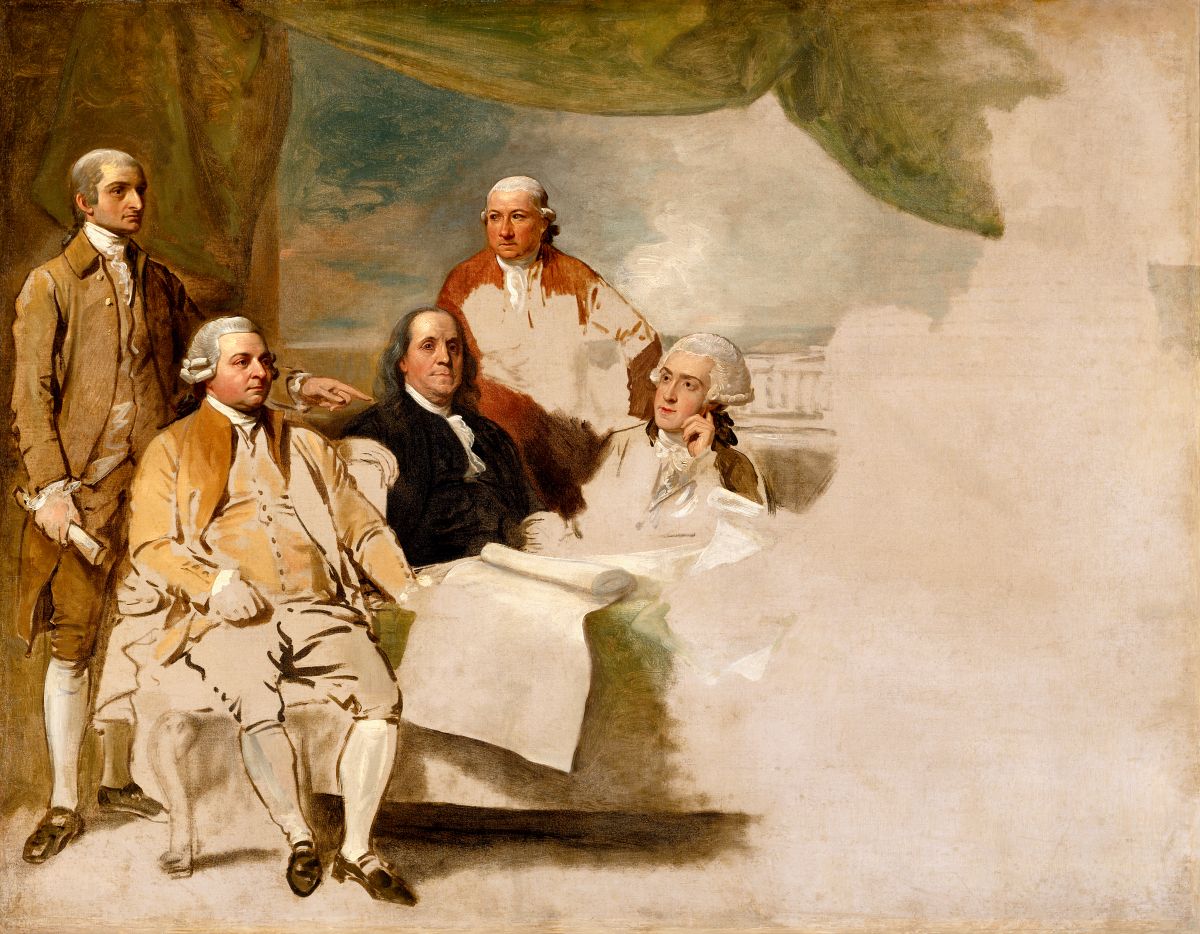
The work offers a reflection on irresolution at the end of the war. While George III had formally recognized the independence of the thirteen North American colonies, the Revolution was not really concluded. Disagreements over borders, maritime rights, and war debts were subjects of contention between the empire and its former colonies. Despite the rhetoric of liberty and freedom within the United States, Britain still held substantially more power over the new nation economically and politically. Further, the Revolution’s entanglements with other imperial contests in North America and beyond continued to reverberate. Different parties interpreted the outcome of the war in different ways. Intentionally or not, West’s Treaty of Paris visualizes this incomplete ending.
The semiquincentennial observances of 2026 treat the Revolution’s conclusion as a foundational moment that inaugurated the beginning of the US.[1] However, this anniversary also prompts reflection about the way the war continues to dilate across time. The concept of dilation—an expansion over space and time—suggests how the American Revolution has rippled over the centuries, extending into contemporary moments at various times in US history. For present-day viewers the equivocal memorialization in West’s Treaty of Paris speaks to both the Revolution’s ongoing meaning in American life and the unstable political landscape of 1783. The Revolution becomes a far less conclusive national achievement when considered through the lens of contested territories and fluid oceanic borders. This approach invites reflection on the continuing resonance of the eighteenth century in American politics as well as the role of revolutionary memory in US history. This essay turns to works of art that over history placed the Revolution into conversation with contemporary forms of US culture and patriotism. In so doing, it considers what it means to treat this originary conflict as an unfolding event that spilled over temporal and spatial boundaries, and that is still being politically and emotionally enacted today.
The Revolution’s supposed end at the signing of the Treaty of Paris, as represented by West, begs the question of its ends—not only the Revolution’s outcomes and impact in the eighteenth century, but moving forward through the nation’s history. What was the Revolution for, and who it was for? What is the “when” of the Revolution in light of its extended temporality? Thinking about the dilation of Revolutionary time aligns with literary scholar Katherine Binhammer’s conceptualization of the eighteenth century as a “colonizing temporality” that privileges imperial modes of recording, violently separating history from its complex and continuous spatiotemporal contexts.[2] These temporal modes are not identical: recognizing that the Revolution is still unfolding across time makes way for more narratives and historic actors than traditionally found in mainstream accounts of the war. However, both frameworks highlight the political dimension of time. While historicizing the Revolution has been a means of justifying colonialist narratives of national identity, these efforts have also frequently made visible the disjunctures between the Republic’s philosophic ideals and geopolitical realities.
West’s work attempts to transform the signing of the Treaty of Paris into a definitive historical moment that can be incorporated into a usable past for the new nation. However, the very fact of its incompletion points to the failure of such efforts. Later works that engage with the rhetoric and patriotism of the US nation-state surface other modes of political expression, such as grief, that contest the victorious mood of conclusion associated with the Revolution’s end. These images throw into relief the continuing urgency of Revolutionary memory and prompt us to question why we treat the Revolution as a distinct flashpoint—especially through the ritual of anniversaries—as opposed to an ongoing history whose shape emerges across many viewpoints.
The unfinished nature of Treaty of Paris suggests the narrative inventions bound up in the process of commemoration. The composite nature of Treaty of Paris—with figures painted at different times and not all from life—reveals how the artistic practice of recording history is a form of storytelling that interprets and remixes its source material. Pictured within the composition are the American delegation: John Jay, John Adams, Benjamin Franklin, Henry Laurens, and William Temple Franklin. Several of these men continued to shape the nation’s government during its first decades. However, their presence together is a fiction. Laurens and William Temple Franklin were not actually present at the signing of the Treaty, and the elder Franklin was the only subject that West did not paint from life. Also absent are members of the British delegation, Richard Oswald and his secretary Caleb Whitefoord.[3] West initially intended the painting to be the first in a series commemorating the events of the Revolution. However, with only the unfinished oil sketch begun, West abandoned the project, perhaps due to his political ambitions as a British court painter as well as other practical limitations of gaining first-hand access to the people involved. West seems to have encouraged his student John Trumbull to pursue a similar undertaking, as the younger artist began planning his own series of Revolutionary history paintings in the late 1780s while in West’s studio. Trumbull’s project took years, but eventually the paintings were acquired by Congress and hung in the Capitol Building.[4]
West’s canvas emphasizes the degree to which such a picture can present only a partial view of who was touched by the Revolution. While the work formally commemorates the signing of the Treaty of Paris between Britain and the US, it does not acknowledge the other treaties simultaneously being negotiated in the city that assured peace between various imperial forces in North America, including France and Spain. Its blend of presence and absence, historical fact and memorializing composite, evoke larger absences of those involved in the Revolution—most particularly, the Indigenous tribes and nations of North America as well as the free and enslaved Black inhabitants of its colonies. While the Revolution was not for these communities, instigated and directed as it was by white Anglo-European men looking to consolidate their own power and wealth, they fought in the war and stood to gain or lose much in terms of land and freedom. The empty portions of West’s composition create space to register both their absence from the war’s concluding negotiations and the continuation of such Revolutionary dynamics across time and history.
This tension between rhetorical ideals and colonial ambitions can also be read into Treaty of Paris. In the background, a roughly sketched, white columned building locates the scene in the French capital—an intellectual center of eighteenth-century humanist thought on liberty and autonomy. However, the sharp lines that usually give neoclassical architecture its clarity are fuzzy and indistinct here. This rendering might be suggestive of the unstable link between the Enlightenment language of American calls for independence and the actual geopolitical ends of the Revolution. In a similar fashion, the empty page before the negotiators, intended to bear the text of the treaty, resembles the form and placement of maps in eighteenth-century group portraits, such as in a portrait of the Washington family.[5] The geographer Heather Nicol argues, “[West’s] incomplete painting echoed the very real problem of a peace with incomplete borders.”[6] The possibility of future text or images filling the paper overlays the territorial contests that defined the contours of the early US republic and its growth onto the abstract language of political formation. “Inadvertently,” curator Sarah Lea observes, “the shadowy empty space in West’s unfinished picture evokes the violence and loss that haunts his chosen subject: the geopolitics of empire.”[7]
The Revolution was always about geopolitical exchanges of power and US ambitions on the North American continent and beyond. Thomas Jefferson’s well-known phrase the “empire of liberty,” which he coined during the war and continued to use through his presidency, blends the lofty language of freedom in the Declaration of Independence with the operations of settler colonialism.[8] This was borne out in the decades following the Revolution by US efforts to recruit Canada into the union as well as encroachments on Spanish-held lands in Florida and Indigenous territories to the nation’s west. Indeed, the Revolution and its aftermath made way for US expansion across the continent while simultaneously prompting a shift in British imperial strategy that further aligned it with the emerging networks of capital and exploited populations around the globe.[9]
West’s Treaty of Paris is a starting point, rather than an ending point. It invites us to explore what other works of art make visible and obscure—and how such objects thereby manifest and disrupt the colonizing temporality of a Revolutionary memory that continues to be used to justify US expansionist power through democratic ideals. Ranging from a nineteenth-century photograph to a twenty-first century performance work, the works of art brought together in this essay are not a definitive set of examples. Nor do they represent a unified narrative. Rather, the interweaving of familiar and less known cultural creations during later wars and debates about the nation and its citizens offer a means of seeing the unresolved Revolution within a history of America still unfolding today.
The Revolution and the Formation of American Patriotism
Looking at the Revolution as an episode with multiple and yet-to-be concluded ends is not merely an act of the present moment, but rather a practice that has shaped the construction of the US throughout its history. By re-presenting the Revolution, artists (consciously or not) grafted the war’s rhetorical narrative of philosophical virtue and political ideals onto ongoing efforts to form and expand the nation. However, their work also frequently made palpable the ongoing nature of the Revolution by leaving unresolved the gaps between its legacy and contemporary realities.
Such a disjuncture was visualized in a painting made some thirty years after the Treaty of Paris. We Owe Allegiance to No Crown (1814) appears as if it could be about the Revolution—an American sailor steps on a broken chain, waving the US flag, while Liberty, holding a Phrygian cap and staff, crowns him with laurels. This iconography evokes the Age of Revolutions while the sailor’s costume and the presence of the Star-Spangled Banner, designed in 1813, reference the US’s first official war, the War of 1812 (1812-1815). Painter and sign maker John Archibald Woodside created the work in the Revolutionary city of Philadelphia as a patriotic response to American naval successes in the conflict. Regularly commissioned to design shop signs or banners for local clubs and organizations, Woodside was skilled at synthesizing political sentiments into compelling images.[10]
The War of 1812 was sparked by geopolitical instability at the conclusion of the Revolution, including the fundamental question of US expansion on a continent where Indigenous nations continued to assert their sovereignty and where British and Spanish colonial powers claimed territory. The US Navy was formed during the war in response to restrictions American ships encountered in their attempts to access international trade networks. Such restrictions inhibited the realization of US sovereignty following the Revolution. The War of 1812 was therefore a kind of Revolutionary redux, bringing Britain and the US into renewed conflict over unresolved questions of war debt, territory claims, and trading rights. The outcomes were mixed. The US made almost no military or diplomatic gains. The recursive quality of the issues at stake in this conflict is evidenced in Woodside’s borrowing of Revolutionary tropes. Even as the painting celebrates the new US Navy and patriotically (re)asserts American independence, it does so under the same visual and political terms of the Revolution. It thereby betrays the degree to which these terms continued to be necessary in a world where US sovereignty was still not a given.
Despite indeterminate gains, the War of 1812 inaugurated a form of patriotism in the US that has continued to define the nation. Because its battles largely took place out of the public eye—in areas farther from US urban centers such as on the Great Lakes and Atlantic and along the border between British Canada and the US—the war’s significance was largely shaped for its American public through culture. Its events, regardless of their actual outcomes, became the building blocks for a national narrative of moral and military triumph that produced the signs and symbols of American identity today, including the flag and the national anthem.[11] We Owe Allegiance to No Crown demonstrates this: allegorical and national symbols crowd out the sort of equivocations betrayed in West’s Treaty of Paris. To be sure, the commercial background of its maker and the work’s propagandistic message means that subtlety is not its point. Crucially, however, the painting cements a robust patriotic narrative tested in the first decades of the Republic that would inform more nuanced forms of visual culture. In this way, despite their difference in tone, both works operate at the intersection of the geopolitical realities they represent—a US unstable and incomplete in its formation—and the narrative of US power they seek to construct.
Cultural and political leaders in the US compensated for their lack of power on the international stage at this moment with rhetoric that positioned the new nation as a global exemplar of liberty. While the US did not gain any policy concessions from Britain at the war’s conclusion, it did achieve access and control of western North American territories—land that Britain had pledged to the Confederacy of Six Indigenous Nations in exchange for its support during both the Revolution and the War of 1812.[12] Instead of maintaining these commitments to their allies, the British empire declined to defend the territory, making way for US expansion at the expense of Indigenous land sovereignty.[13] US expansion westward had been incorporated into the founding of the nation; at the Treaty of Paris, Britain ceded Northwest Native territory to the US despite its promises to Indigenous allies and without their permission. At the Treaty of Ghent, which concluded the War of 1812 by returning to the post-Revolutionary status quo vis-à-vis Britain and the US, Britain once again betrayed its allies and opened the way for US expansion through the seizure of Native land.[14] In this context, Woodside’s evocation of Revolutionary ideals justified contemporary US imperial ambitions as a natural result of the Republic’s embodiment of the Enlightenment values of liberty and freedom.[15]
At the same time, considering the Revolution’s continuous unfolding in the context of US settler colonialism also troubles ideas about its legacy. Where We Owe Allegiance to No Crown reveals the instability of US sovereignty on water and in relation to its former empire, the work of Native historians also makes clear the contingency of Revolutionary claims on land and in relation to a web of sovereign and confederated Indigenous polities. Settler expansion across North America was not a smooth process, nor one in which the US held all the power. Historian Michael Witgen has argued that scholarship has neglected the numerous and diverse Native peoples who held power across the continent and influenced the formation of its contemporary nation states.[16] Such a perspective ruptures the presumption of Manifest Destiny, which treats settler expansion as an inevitable outcome of independence. It also challenges the conclusiveness of the Revolution: Witgen observes that, in regions occupied but not controlled by the US, “US sovereignty operated conditionally” in relation to the powers and agency of Indigenous polities.[17]
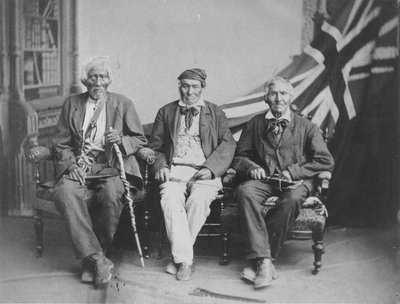
Another image commemorating the War of 1812 from a Canadian perspective—a photographic portrait from 1882 of the surviving Six Nations warriors who fought with the British (Fig. 2)—begs the question of who the war was for, whose narratives of sovereignty it bolstered, and what its memory meant to the diverse communities involved in its progress and aftermath. At the beginning of the century, all three individuals pictured were young men, some teenagers. By 1882, they were the last warriors to represent the role of Indigenous allies in Britain’s war with the US. Young Warner, John Tutela, and Sakawaraton, also known as John Smoke Johnson, are seated in Victorian armchairs in a studio. The arms of the chairs overlap, creating a visual connection between the men, even as their postures and direct gazes highlight their autonomy within the picture. Dressed in European-style clothes, they carry objects, like a feathered leather bag and tomahawk, that highlight their identities as Indigenous warriors. Softly out of focus in the background, a large British Union Jack stretches from the top right of the composition to its center.
While it is possible, from a US perspective, to consider 1815 and the Treaty of Ghent as another “end” to the Revolution, for Indigenous polities the American Revolution and the War of 1812 were not discrete military events. Rather, they formed part of ongoing colonial negotiations and conflicts over sovereignty and land rights with multiple European imperial powers. Indigenous North Americans did not appear in West’s portrait of the Jay Treaty signing because they were not invited to the diplomatic negotiations, despite the fact that they were sovereign polities who allied with both the British and Americans.[18] When the War of 1812 began, the band of Six Nations warriors was about 300 strong. By the time it ended, battles had reduced their numbers by thirty percent. Six Nations communities were decimated by the loss of land, family, and property destruction.[19] The later portrait of the surviving Six Nations fighters registers the many peoples absent from West’s scene who had a stake in the North American wars, which continued to reverberate in their lives and national experiences.
As a commemoration of the War of 1812, the photograph ambiguously represents multiple and overlapping points of view about the imperial contests that preceded it. In the 1880s, Canada was a self-governing dominion that still existed under the aegis of the British empire but had consolidated its territories and political autonomy. Articulations of Anglo-imperial pride laid the groundwork for a Canadian national identity. Using a visual vocabulary that relates back to works like We Owe Allegiance to No Crown, the photograph juxtaposes war fighters with a flag in a familiar patriotic gesture that works to incorporate the historic episode of the war into the narrative of the contemporary nation. However, the process of centering members of the Six Nations—who were allies and not subjects of the British empire at the time of the war—reveals the instabilities at the heart of this and other settler national projects across North America, including the formation of the US.[20] Following Witgen, the photograph complicates commemorations of the Revolution as a temporally and geographically circumscribed US event. US independence was worked out, both on paper and in practice, through complex negotiations between Spanish, French, Dutch, and Indigenous agents across space and time.
By presenting a Canadian, and an Indigenous, view on the memory of the War of 1812, images like this photograph complicate the historic narrative being shaped by US patriotic representations like We Owe Allegiance to No Crown. Following the war’s conclusion, the Six Nations Confederacy began the process of defending their remaining northwest territories, sending emissaries to make peace with the Indigenous polities that had fought on the side of the US. This act further emphasized the sovereignty and autonomy of Indigenous communities who experienced and understood the war and its outcomes on their own terms and in relation to a broad network of Native and settler peoples. The portrait of Warner, Tutela, and Johnson disrupts the inexorable link between Revolution and westward expansion that popular histories of the US have solidified. Their position as Indigenous warriors—whose Confederacy made difficult decisions about alliances on the border between Canadian, Indigenous, and US territories—visualizes the complex network of peoples who shaped North American political life over the long eighteenth century. At the bicentennial of the War of 1812, Haudenosaunee oral historian Rick Hill reflected on the broken agreements that both the British and the Americans made with their Six Nations allies: “What does the honor of the Crown and the integrity of Congress mean in relation to their faithful allies and the long-standing land issues that have remained unresolved all this time?”[21] Hill’s framing touches on foundational narratives in Canada and the US, where national identity is based on a presumption of a morally justified cause. With this in mind, the photograph troubles the temporal and geographic contours of the Revolution, the War of 1812, and its legacies on the continent. As a commemorative image, the collective portrait of Indigenous leaders oscillates across time, asking viewers to consider what forms of Revolutionary repair have not been made but can perhaps still be realized.
The Revolution and Imperial Expansion
How we tell the history of the relationship between the end of Revolution and the War of 1812 matters because the rhetorical and cultural impact of this period has so much bearing on the ways that later narratives of US imperial power were formed. The speed and scale of displacement of Indigenous peoples following the passage of the Indian Removal Act in 1830 was only possible because the groundwork had been laid in the language and strategy of the Revolution.[22] Linking eighteenth-century formulations of liberty with contemporary geopolitics through artistic, literary, and political evocations of the Revolution has been fundamental to the expression of American patriotism from the nineteenth century onward. In these instances, the intrinsic relationship between the Enlightenment rhetoric of the Revolution and its settler colonial purpose become both more evident and increasingly complicated.
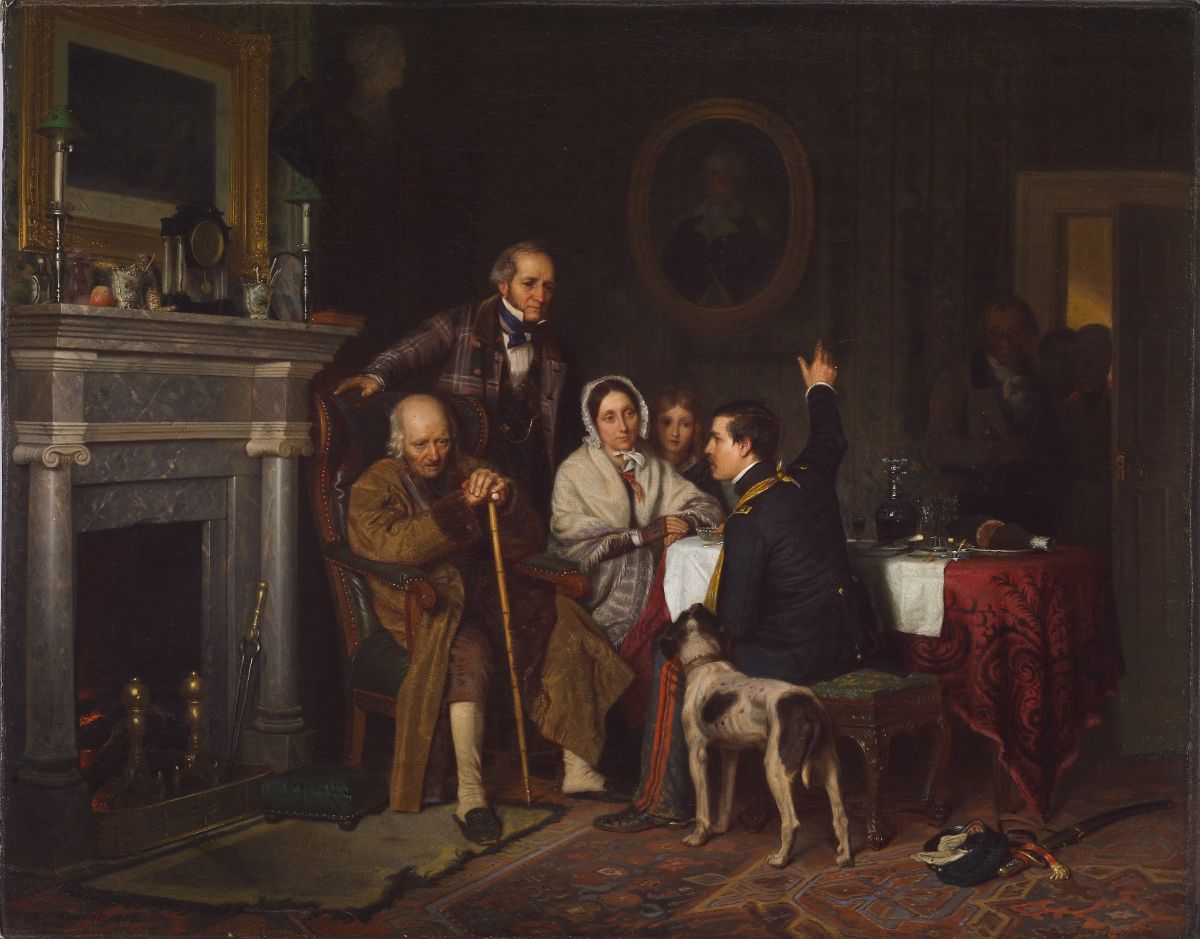
This unsettled tension is visualized in a painting from the middle of the nineteenth century, Richard Caton Woodville’s Old ’76 and Young ’48 (1849), that staged national debate over the Mexican-American War (1846-1848) within the shadow of the Revolution’s legacy and the domestic sphere of the home, where intersections of age, gender, and race inform the reactions of the different characters (Fig. 3). Following the US annexation of Texas in 1845, the US army invaded Mexico, precipitating the war. These expansionist actions served the settler colonial project of Manifest Destiny as well as the desire among Democrats to expand slavery across the nation. Like the War of 1812, the terms of this conflict advanced the language and rhetoric of American patriotism, in particular its incorporation of the nation’s past into arguments for its future.
Many details within the crowded parlor scene make the Revolution palpable. The work’s title and dynamic arrangement of figures highlight conflicting interpretations of the Revolution’s legacy between an older generation of war veterans and the next generation of men fighting in contemporary US wars. At the center of the busy composition, “Young ’48” raises one arm in speech, his other arm in a sling. The white audience before him includes a seated woman in a mob cap and a standing man with graying hair (presumably the young man’s parents), a girl, and a dog. In the doorway are three Black men and women whose faces and bodies are cast into shadow. They also listen to the young man’s speech. While all of these figures turn their faces toward him, he addresses himself to “Old ’76,” likely his grandfather, with balding head and a cane, who stares downward with a mournful expression.
The Revolution is further recalled in the composition through a portrait of a man in the uniform of the Continental Army, a bust of George Washington in the corner, and a framed print after John Trumbull’s Signing of the Declaration of Independence above the mantle. The inclusion of Trumbull’s painting, which was installed in the US Capitol Rotunda in 1826, in print form highlights the ambivalent ways the Revolution bears on both the past and present within Old ’76 and Young ’48. Woodville visualizes this fracture by including a crack in the glass that covers the print, a symbol of political division that the artist borrowed from one of his German compatriots in Düsseldorf, where he was working at the time.[23]
Trumbull’s original history painting, made some forty years after the signing of the Declaration, cast the events of the Revolution as part of a national history in formation for early nineteenth-century viewers. Such images became national symbols, working in tandem with expansionist policies and other political actions to shape ideas about who was included and excluded from its polity.[24] Woodville’s transposition of Trumbull’s Revolutionary setting into a domestic genre scene took place at a moment of accelerated American patriotism fueled by news of US progress in the Mexican-American war. But while history paintings like Trumbull’s were meant to be clear and emphatic in their national message, Signing the Declaration of Independence functions ambiguously in Woodside’s domestic setting and form. Although the print’s subject is identifiable, it is rendered in dim lighting that makes the scene difficult to discern.[25] Curator Marie-Stéphanie Delamaire contends that in depicting the print in this way, Woodville presents it as a static icon of Revolutionary history.[26] While the memory of the Revolution seems to overwhelm the details of the scene and provide heat to the exchange between the young soldier and his grandfather, its actual meaning is unclear. Is it just a shadowy symbol of the nation’s origin that remains in the past? If so, why does it loom so large?
In public discourse, those opposed to the Mexican-American War expressed concern that its aggressive expansionism diverged from the virtuous principles of the Revolution and destroyed what it had made.[27] While military aggression and territorial expansion were always implicit in the aspirations of the Revolution’s political leaders, prior to this moment such motives were more easily aligned with philosophical sentiments. But in Woodville’s composition, tension between Republican virtue and imperialist aggression is unresolved. The grandfather, as the Revolutionary elder, casts his eyes sadly downward and does not speak, suggesting his lack of power in relation to his grandson’s conviction. However, for the young soldier, the opinion of his elder clearly holds weight. He leans forward in his effort to convince the old man, invoking Revolutionary ideals by gesturing to the portrait on the wall. Interestingly, in Woodville’s lifetime, period audiences largely overlooked the ambiguity of the scene, interpreting it as a definite political comment supporting each side of the debate.[28] Perhaps the equivocation in Old ’76 and Young ’48 about the legacy of the Revolution and the progress of the nation has become more visible with time.
Foremost among the ambivalences of the painting is its representation of grief as a political affect that frames the relationship between national memory and contemporary events. Old ’76’s introspection raises grief and mourning as legacies of the Revolution. Whatever might elicit that sorrow for the old man, it opens up other forms of grief within the composition. Despite their shadowy place in the doorway, the Black figures draw attention to the fact that although the war shaped the futures of both free and enslaved Black Americans, they were largely excluded from participation in national debate. Their disenfranchisement, and the brutal state violence that accompanied it, is a form of grief that hovers at the literal margins of the scene. Like the Canadian portrait of the Six Nations veterans of the War of 1812, Old ’76 and Young ’48 is thus a complex piece of North American imperial visual culture. Both pictures represent some of the most oppressed members of North American society alongside white national symbols of power and memory. However, their very presence complicates the meaning of these works as agentic people whose political and affective responses to the imperial conflicts of North America diverged from white colonial agendas.
Only a few years after the creation of Old ’76 and Young ’48, Frederick Douglass (1818-1895) explicitly invoked the act of mourning as a Black response to commemorations of the Revolution. In his speech “What to the Slave is the Fourth of July?” (1852), he dwelled on the uneven distribution of the Revolution’s ideals, highlighting the war’s violent and exploitative legacies:
I am not included within the pale of glorious anniversary! Your high independence only reveals the immeasurable distance between us. The blessings in which you, this day, rejoice, are not enjoyed in common. The rich inheritance of justice, liberty, prosperity and independence, bequeathed by your fathers, is shared by you, not by me. The sunlight that brought light and healing to you, has brought stripes and death to me. This Fourth July is yours, not mine. You may rejoice, I must mourn.[29]
Following Douglass, grief and mourning as affective qualities of American political life have shaped Black critical thought.[30] In Douglass’s oration, the Revolution’s place in a dilating timeline of colonialism and empire shifts from a singular event to yet another episode in a long history of violence and disenfranchisement. His rhetoric of mourning introduces grief as a political force that by its nature is more nuanced and ambivalent than the certainty of political patriotism with which it is entwined.
An Unfinished Revolution
The contemporary artist Sonya Clark’s 2019 performance Reversals enacts this dilating sense of time as well as the feeling of ambivalence that grief brings to commemorations of the Revolution (Fig. 4). During a residency at Philadelphia’s Fabric Workshop and Museum at which she engaged audiences with the interactive exhibition Monumental Cloth: The Flag We Should Know, Clark presented Reversals—a related performance during which she ritually cleaned the gallery floor, revealing words from the preamble to the Declaration of Independence. Monumental Cloth drew attention to the history of the Confederate Flag of Truce: a dish towel that Confederate forces raised during their surrender in Appomattox, Virginia in 1865. For Clark, the truce flag, in contrast to the Confederate Battle Flag, catalyzes reflection and dialogue about conflicts between the nation’s founding values and its history. For Reversals, the gallery floor was covered with dust from two Revolutionary sites in Philadelphia: Independence Hall, where the Declaration was signed, and Declaration House, where it was drafted by Thomas Jefferson, and where he enslaved Black laborers. Wearing a reproduction of the dress worn by Ella Watson in Gordon Parks’s photograph American Gothic, Clark used a Confederate Battle Flag tea towel to clean the floor, revealing the Declaration’s text.[31]
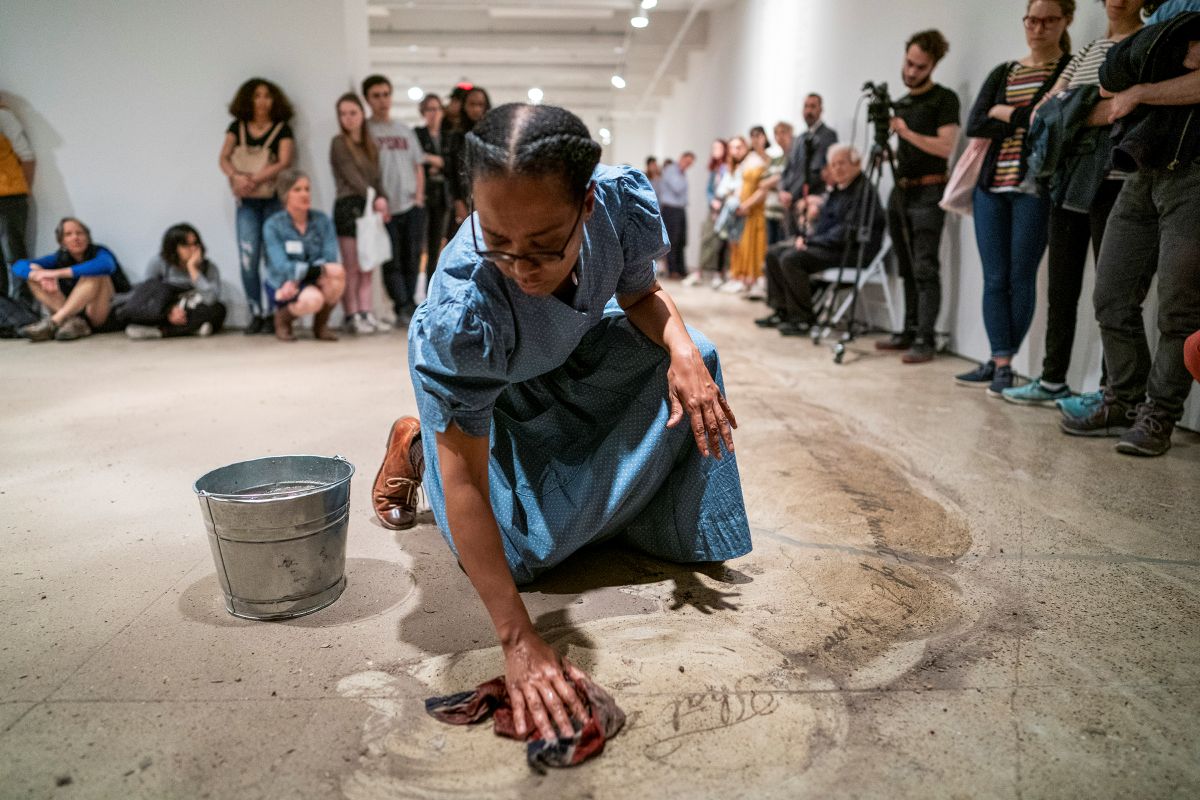
Clark’s work is premised on absence, as the words from the founding document are at first invisible: the dust of time has accumulated and covered over these Revolutionary ideals. In order to effectively stave off the accumulation of dust and grit, the labor of cleaning must be repeated over and over again. As a form of what the performance artist Mierle Laderman Ukeles calls “maintenance art,” Clark’s actions reveal what Douglass described as the “rich inheritance of justice, liberty, prosperity and independence” represented by the Declaration.[32] Clark’s act of cleaning dust evokes ritual acts of mourning. Further, while uncovering the words can be an affirmative act that extends this inheritance to those excluded from the polity of the early US, it also makes evident the unsettled condition of its ideals within the unfolding history of the nation.
Significantly, Clark’s act of cleaning in Reversals does not result in a pristine floor. As she winds her way through the gallery, she only spends as much time on each section as is required to reveal the words beneath the dust. When she stands from her task and exits the space, she leaves behind the lines of the Declaration framed by swirls of mud and puddles of water. Her performance has not cleansed the surface on which she works but rather makes evident the dirty and unsettled disjuncture between Revolutionary philosophy and American history.
Strikingly, the smeared floor evokes in color, texture, and composition the partially prepared and unfinished canvas in West’s Treaty of Paris. While in Treaty of Paris, the blank document visualizes everything that has been left unsaid in the formal record of the Revolution’s purported conclusion, Reversals materializes the messiness that history drags into the present day. The contemporary work completes neither the irresolution of the earlier painting nor the historic event it seeks to commemorate. Instead, when placed in conversation with each other, the two works make manifest the degree to which the Revolution—its ideals as well as its political ends—continue to unfold and reverberate in American political and cultural life.
Emily C. Casey is Hall Assistant Professor of American Art and Culture at the University of Kansas, KS
[1] These commemorations tend to focus on the beginning of the war: The federally-driven “America 250” project takes July 4, 1776 as its starting point of celebration and the “Revolution 250” initiative organized by cultural institutions in New England marks a series of conflicts including the Boston Tea Party and the shots at Lexington and Concord stretching back to 1772. See https://america250.org/americas-250th/ and https://www.revolution250.org/250th-commemorations/250th-anniversary-of-the-boston-tea-party/.
[2] Katherine Binhammer, “Is the Eighteenth Century a Colonizing Temporality?,” Eighteenth-Century Fiction 33, no. 2 (Winter 2020-21): 199-204.
[3] “American Commissioners of the Preliminary Peace Negotiations with Great Britain,” Winterthur Museum, accessed March 25, 2026, http://museumcollection.winterthur.org/print-record.php?srchfld=irn&name=5889&port=40138&output=HTML&version=100; and Heather N. Nicol, The Fence and the Bridge: Geopolitics and Identity Along the Canada-US Border (Wilfrid Laurier University Press, 2015), 40.
[4] For more on West’s plans for a Revolutionary series and his encouragement of Trumbull, see Arthur S. Marks, “Benjamin West and the American Revolution,” The American Art Journal 6, no. 2 (1974): 15-35. On West’s negotiation and exploitation of his Anglo-American identity in pursuit of his artistic ambitions, see Sarah Monks, “The Wolfe Man: Benjamin West’s Anglo-American Accent,” Art History 34, no. 4 (September 2011): 652-73.
[5] Edward Savage’s portrait of the Washington Family (1789-1796), now in the collection of the National Gallery of Art, represents the president, his wife, adopted children, and an enslaved servant at Mount Vernon. A map of the new capital of Washington, D.C. rests on the table. Its incorporation links Washington’s person to the territorial and political development of the nation.
[6] Nicol, The Fence and the Bridge, 40.
[7] Sarah Lea, “Sites of Power: Conflict and Ambition,” in Entangled Pasts 1768-Now: Art, Colonialism and Change, ed. Dorothy C. Price et al. (Royal Academy of Arts, 2024), 66.
[8] Thomas Jefferson, The Papers of Thomas Jefferson, ed. Julian P. Boyd, Mina R. Bryan, L. H. Butterfield, Charles T. Cullen, John Catanzariti, Barbara Oberg, James P. McClure, et al., vol. 4 (Princeton University Press, 1950), 237-38.
[9] Lisa Lowe, The Intimacies of Four Continents (Duke University Press, 2015).
[10] On Woodside’s career, see Lee Ellen Griffith, “John Archibald Woodside Sr.,” Antiques 140 (November 1991): 817-25; Joseph Jackson, “John A. Woodside: Philadelphia’s Glorified Sign-Painter,” The Pennsylvania Magazine of History and Biography 57, no. 1 (1933): 58-65.
[11] David Waldstreicher has demonstrated how nationalist feeling was intentionally cultivated at local and national levels through political performances, such as parades, that incorporated songs and symbols like the flag. In the Midst of Perpetual Fetes: The Making of American Nationalism, 1776-1820 (University of North Carolina Press for the Omohundro Institute of Early American History and Culture, 1997).
[12] Nicole Eustace, 1812: War and the Passions of Patriotism (University of Pennsylvania Press, 2012), 227.
[13] Samantha Seeley, Race, Removal, and the Right to Remain: Migration and the Making of the US (University of North Carolina Press for the Omohundro Institute of Early American History and Culture, 2021), 58, 167.
[14] Seeley, Race, Removal, and the Right to Remain.
[15] Eustace, 1812, 215.
[16] Michael Witgen, An Infinity of Nations: How the Native New World Shaped Early North America (University of Pennsylvania Press, 2012), 16.
[17] Witgen, “Seeing Red: Race, Citizenship, and Indigeneity in the Old Northwest,” Journal of the Early Republic 38, no. 4 (2018): 581.
[18] On this point, see Seeley, Race, Removal, and the Right to Remain, 58.
[19] Evan Joseph Habkirk, Charting Continuation: Understanding Post-Traditional Six Nations Militarism, 1814-1930 (PhD diss., University of Western Ontario, 2018), 4.
[20] Habkirk, Charting Continuation, 40.
[21] Rick Hill, “Choosing Sides: Divided Loyalties in the War of 1812,” American Indian: Magazine of Smithsonian’s National Museum of the American Indian, Issue 13 No. 4 (Winter 2012).
[22] Seeley, Race, Removal, and the Right to Remain, 23.
[23] “Old ’76 and Young ’48,” Walters Art Museum, https://art.thewalters.org/object/37.2370/.
[24] These aesthetic and political conflicts become especially fraught in heightened historic moments. During the January 6, 2021 riot at the US Capitol, these historic paintings were juxtaposed with modern-day violent insurrection, revealing the tension between historic memory and contemporary realities. See Wendy Bellion and Anna O. Marley, eds., “Art and Politics in the US Capitol,” special section, Panorama: Journal of the Association of Historians of American Art 7, no. 1 (Spring 2021). https://journalpanorama.org/article/art-and-politics-in-the-us-capitol/.
[25] The print’s subject can be identified based on an earlier version of the painting titled The Soldier’s Experience, where it is more legible.
[26] Marie-Stephanie Delamaire, “Woodville and International Art World,” in New Eyes on America: The Genius of Richard Caton Woodville, ed. Joy Peterson Heryman (Yale University Press, 2012), 57.
[27] Justin P. Wolff, Richard Caton Woodville: American Painter, Artful Dodger (Princeton University Press, 2002), 109.
[28] Wolff, Richard Caton Woodville, 117.
[29] Frederick Douglass, “Oration, Delivered in Corinthian Hall, Rochester, July 5, 1852,” in The Frederick Douglass Papers, Series One: Speeches Debates, and Interviews. Vol. 2, 1847-54, ed. John W. Blassingame (Yale University Press, 1982), 359-87.
[30] Writers including Saidiya Hartman, Claudia Rankine, and Christina Sharpe have developed the critical concept of Black grief and mourning. Its role in visual culture was explored in the exhibition, Grief and Grievance: Art and Mourning in America, conceptualized by curator Okwui Enwezor and posthumously presented at the New Museum in 2021.
[31] “Sonya Clark,” Fabric Workshop and Museum, https://fabricworkshopandmuseum.org/artist/sonya-clark/.
[32] Mierle Laderman Ukeles, MANIFESTO FOR MAINTENANCE ART, 1969! Proposal for an exhibition: “CARE,” 1969 (Philadelphia, October 1969).
Cite this article as: Emily C. Casey, “Revolution’s Ends: American War, Patriotism, and Culture in a Dilating Eighteenth Century,” Journal18, Issue 21 Revolutions (Spring 2026), https://www.journal18.org/8206.
License: CC BY-NC
Journal18 is published under a Creative Commons CC BY-NC International 4.0 license. Use of any content published in Journal18 must be for non-commercial purposes and appropriate credit must be given to the author of the content. Details for appropriate citation appear above.
