
Phoebe Springstubb
On the shores of Unangam Tanangin (the Aleutian Archipelago), Chaĝnachx̂ilax̂ slipped into his killer whale skin, transforming himself into the North Pacific’s fiercest hunter. Entering the sea with his war party, he commanded: Do not dive to the deepest ocean; do not thrash the rough surface; travel nimbly just below the waves. So, they set out. After a while, as the story goes, they surfaced to breathe. Looking back at their home island, Unalaska, they saw that its volcanic peaks had sunk very low, as if being swallowed. And they knew they had traveled a great distance, yet not far enough. They swam on until the remote islands of Tanax̂-Amix̂ floated before them like a heap of grass-woven mats. The shores were thronged with breeding fur seals and sea lions. Their meat, blubber, skin, and whiskers promised everything from sustenance to clothing, filling all who reached them with desire. Chaĝnachx̂ilax̂ and his party turned themselves back into two-legged men, rising from the submarine world to put on parkas sewn from animal gut. They climbed into their kayaks to paddle to the terrestrial world.[1]
The Tanax̂-Amix̂ islands lie deep in the Bering Sea. They are hundreds of miles north of the Aleutian Archipelago, which Unangax̂ people call home.[2] Yet Chaĝnachx̂ilax̂’s story, here from a retelling by Akutan Elder Isidor Solovyov, is part of a corpus of Unangax̂ stories and songs that speak of a very old history of visiting, and even inhabiting, these remote islands.[3] To reach them in the early eighteenth century, long before the Russian Empire colonized the region, would have required navigating some 240 nautical miles of perilous open ocean. Although detailed knowledge of how this was done has not been preserved, this journey almost certainly drew on the exceptional navigational skills Unangax̂ mariners were taught from boyhood, together with the intricate designs of their watercraft. As the killer whale skin that Chaĝnachx̂ilax̂ wore suggests, Native mariners also borrowed dangerous powers from society’s other-than-human members in their long-distance travel. They honored these relationships in the designs of their curved hunting hats (Fig. 1).[4]
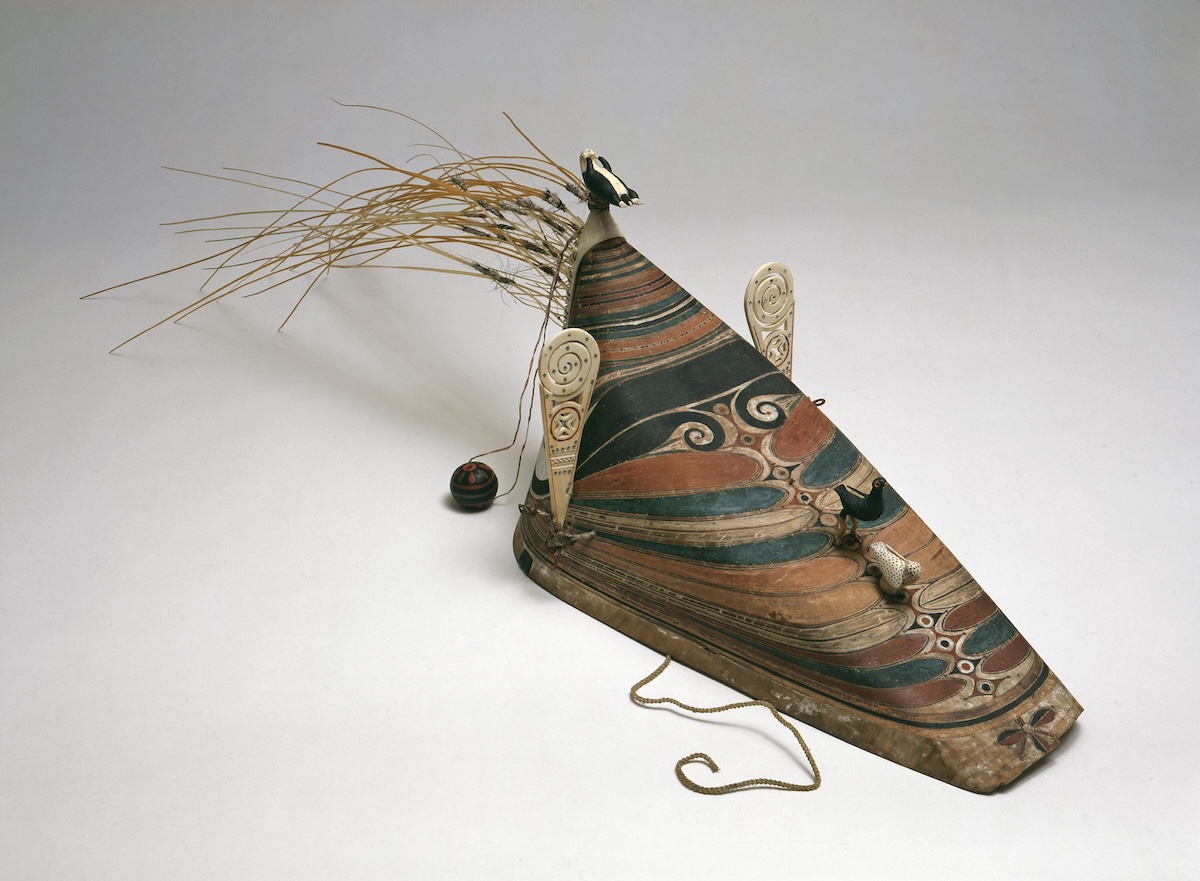
In 1786, Tanax̂-Amix̂ would be “discovered” by Gavriil Pribylov, an old Russian hand with a contract to work in the Americas. He had likely heard stories like Chaĝnachx̂ilax̂’s and absorbed Unangax̂ knowledge of fur seal migration routes.[5] On imperial maps, Tanax̂-Amix̂ became the Pribilof Islands (Ostrova Pribylova), as they are still known. Within two years, hunting operations sponsored and managed by Russian companies killed more than 30,000 fur seals breeding on their shores. They subjected Tanax̂-Amix̂ to the same profligate killing practices that had already been operating in the Aleutian Islands for decades, and which had decimated the region’s sea otters.[6]
The larger history to which this episode belongs is well-known: the Russian Empire’s deadly, more-than-a-century-long projection of itself as a maritime empire in the North Pacific, leading to its seizure of coastal Alaska, the establishment of Russian American colonies, and the attempted genocide of Unangax̂ and other Indigenous communities.[7] Russia’s ocean ambitions were propelled by a rapacious global fur trade whose networks stretched from London to Beijing. Having exhausted fur-bearing mammals across Siberia, Russia exploited the Aleutian Islands to profit from this global market, selling Pacific furs thousands of miles away in Kyakhta, the Russia-China border town.
Within histories of empire, these events are often told as part of the broader story of eighteenth-century globalization and the interconnection of distant places through the exigencies and brutality of market capitalism. Russian expansion in the North Pacific is narrowly framed by how it fits within an otherwise largely continental empire—or by how its “anomalous” Russian American colonies diverged from or conformed to other European overseas colonies.[8] In a parallel approach, scholars recognize the global significance of the North Pacific’s so-called small spaces only when they are incorporated into long-distance commodity chains—even as they consign the places themselves to microhistory.[9] Both approaches risk reducing Indigenous places and peoples to their responses to empire, a limiting framework for historical subjectivity.
Implicit in these histories are assumptions about what it means to be “global”—a category that privileges presentist ideas of global space as inseparable from commodity movements, market growth, and hegemonic power. This paradigm, however, is so bound up with specific economic forms that it limits our ability to see how the globe has been imagined beyond the rise of capitalism.[10] It misses the “epic proportions,” in Epeli Hau‘ofa’s words, by which Pacific communities understood their world.[11] The same is true of the North Pacific. As culture bearers and historians of Indigenous Alaska have vividly described, networks of interconnection long preceded European contact, and even the Columbian Exchange, while oral traditions and art hold entire universes that contradict any notion their authors needed an empire to introduce them to a wider world.[12] To be global is, above all, to cultivate a relation, in thought and action, with the entire world.
The ocean is one site where such distinctive traditions of global thought are especially visible. In a deliberate and willful act of unseeing, Russians would treat the North Pacific as aqua nullius (“nobody’s water”), even as they relied on Indigenous technologies and knowledge.[13] But as Chaĝnachx̂ilax̂’s story suggests, and this article argues, by the eighteenth century, the North Pacific was generative as a space not only of rich legal pluralism and diverse political ecologies, but also of older global imaginations shaped and sustained by Indigenous watercraft. Under conditions of conquest, this historical ocean, stewarded by regional communities, would persist, transform, and endure—as is evident in flourishing contemporary revitalization projects that center Native watercraft.[14] Then as now, at the heart of this Indigenous North Pacific were oceangoing boats, including the qayat, angyaat, niĝilax̂, yaakw, angyapiit, itaomacip, and umiat, with which Yupiit, Sugpiat, Unangax̂, Lingít, Siberian Yupiget, Ainu, Iñupiat, Chukchi, and other peoples traversed their waters and interacted with their neighbors.
This other global ocean can be seen by foregrounding material and oral sources that inscribe these social relations and ambitions—a method innovated by and central to Alaska Native studies.[15] That is, these boats and their associated aquatic technologies were more than the sum of their material designs. Like Chaĝnachx̂ilax̂’s kayak, which was crafted from sea mammal skins sewn and stretched over driftwood in a complex design, they were vehicles that communities mobilized to craft authoritative approaches to the ocean.[16] Piloting ocean currents and nearshore shallows, people participated in what I will call “watercraft”: a mode of engagement and set of practices that collectively constituted a terraqueous political sphere.[17] Just as Indigenous makers crafted their individual boats from composites of animal skins, tusks, and tendons, so too, as they steered these boats across the sea, they crafted views of their historical position and reinscribed ocean space with shared principles for how societies should be organized. Through this dynamic integration of practice and belief, the ocean, rather than a natural water body set apart from culture, was continuously being made.
Inextricably tied to the kayak, watercraft also exceeded it. In what follows, watercraft is examined as both a material practice and an intellectual orientation that empowered people to see themselves as consequential actors and to shape their world. Cultivated through spatial practices and rooted in North Pacific ecologies, watercraft drew its power from an ability to navigate environmental constraints while participating in a more-than-human ocean society. This included both social codes of conduct and ontological transformations, for example, a seal’s incarnation in a kayak. It also produced new spaces. Navigational routes, likely used for thousands of years, ordered marine spaces into travel systems and created rights-bearing territories. In a region where diverse peoples had in common a shared, supreme aquatic mobility, interregional relations pivoted on watercraft.
From the hatch of a kayak, top-down histories of the North Pacific look different. Watercraft illuminates a historical ocean where Unangax̂ and their neighbors, through distinct yet connected practices of watercraft, were more than marine-oriented peoples. Commanding aquatic mobility, they participated in an ocean society full of rights and obligations that stands in sharp contrast to the land-serving “statecraft” of invading empires. The following exploration of watercraft, indebted to vital work in Indigenous studies, seeks to make space for narratives that don’t presume the inevitability of imperial conquest.
The Kayak and the Imperial Map
A Russian map of the Aleutian Archipelago, dated 1775, depicts a man and his kayak riding the sea south of Unimak Island (Fig. 2).[18] Above his feathered hunting visor floats a single word, “Amerikanets” (American). To ward off the sea’s swell and spray, he wears a hooded parka stitched from seal gut and cinches this to a matching spray skirt sewn into the kayak’s cockpit. If the sea, given to storms and riptides, tossed him overboard, these garments became a survival suit and helped him float.[19] Propelling himself forward with a double-bladed paddle, he keeps pace with diving seabirds.[20] His craft’s distinctive split bow skims the surface of the ocean, its sharp, upturned beak cutting through churning water. The frame is an extension of his body, its measurements taken from the rider’s torso, arms, fingers, and hands.[21] As many as 60 small ivory bearings, inserted into the kayak’s joints, rendered it supremely elastic.[22] When the rider was in motion, his boat was too. They bent together over cresting waves, absorbing their roiling energy.
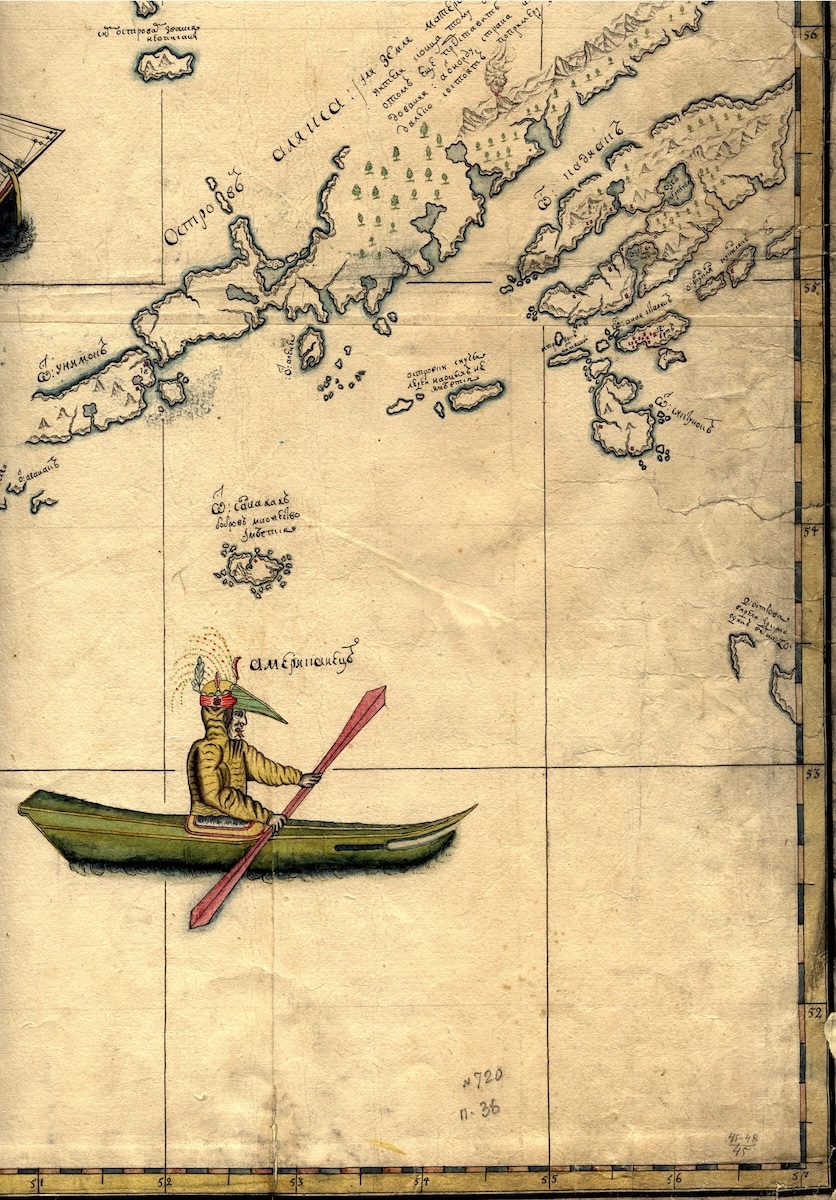
If the painted figure is diminutive, the historical role of the mariners he represents was outsize. The foreigners who began sailing in these Native waters in the 1740s may not have seen the encompassing world in which Unangax̂ traveled, yet they grasped the importance of their streamlined watercraft. On stretches of open ocean, these slender boats and their riders sometimes surprised large, square-rigged Russian ships, matching them at four leagues an hour.[23] Observed a naturalist on board one such ship: “with his light oar in his hand, his weapons in front of him, keeping his balance like a rider [the kayak] flies like an arrow over the moving surface.”[24]
Most of the Russian ships traveling to the Aleutians in the mid-eighteenth century were not elite, well-equipped vessels, but hastily outfitted and jerry-built.[25] Private merchants looking to profit from the Aleutians’ abundance formed associations (obshchestva) to finance ships on a shareholding basis, then sent them out on mercenary two- and three-year hunting trips. Many of the crew, hired hands from different parts of Siberia, saw the ocean for the first time when they embarked from Okhotsk. Because they lacked basic training and the latest navigational technologies, their primary strategy was to never lose sight of the shore. They directed their ships east toward the string of islands stretching to Alaska as if at an arrow pointing at a destination. This method of orientation was known by its idiom, “probirat’sia po za ogorodu,” following the fence or making one’s way along the garden path.[26]
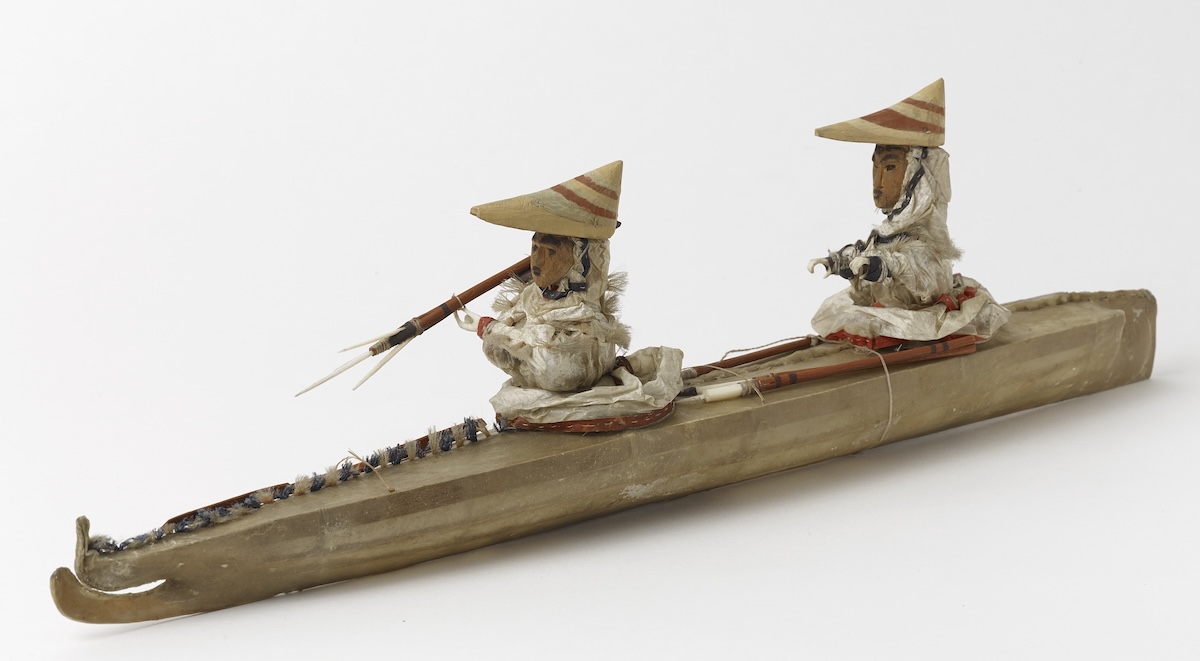
The Unangax̂ kayak’s assured passage across open ocean must have stood in bold contrast to this inexperience. The promise contained in the kayak’s mastery—of a technology and a people’s prowess for navigating these dangerous waters—would travel thousands of miles beyond the North Pacific. Miniature models of kayaks were among early materials brought back to the imperial court from the Americas (Fig. 3). So too was a partial image of the political geography that kayaks and their riders commanded.
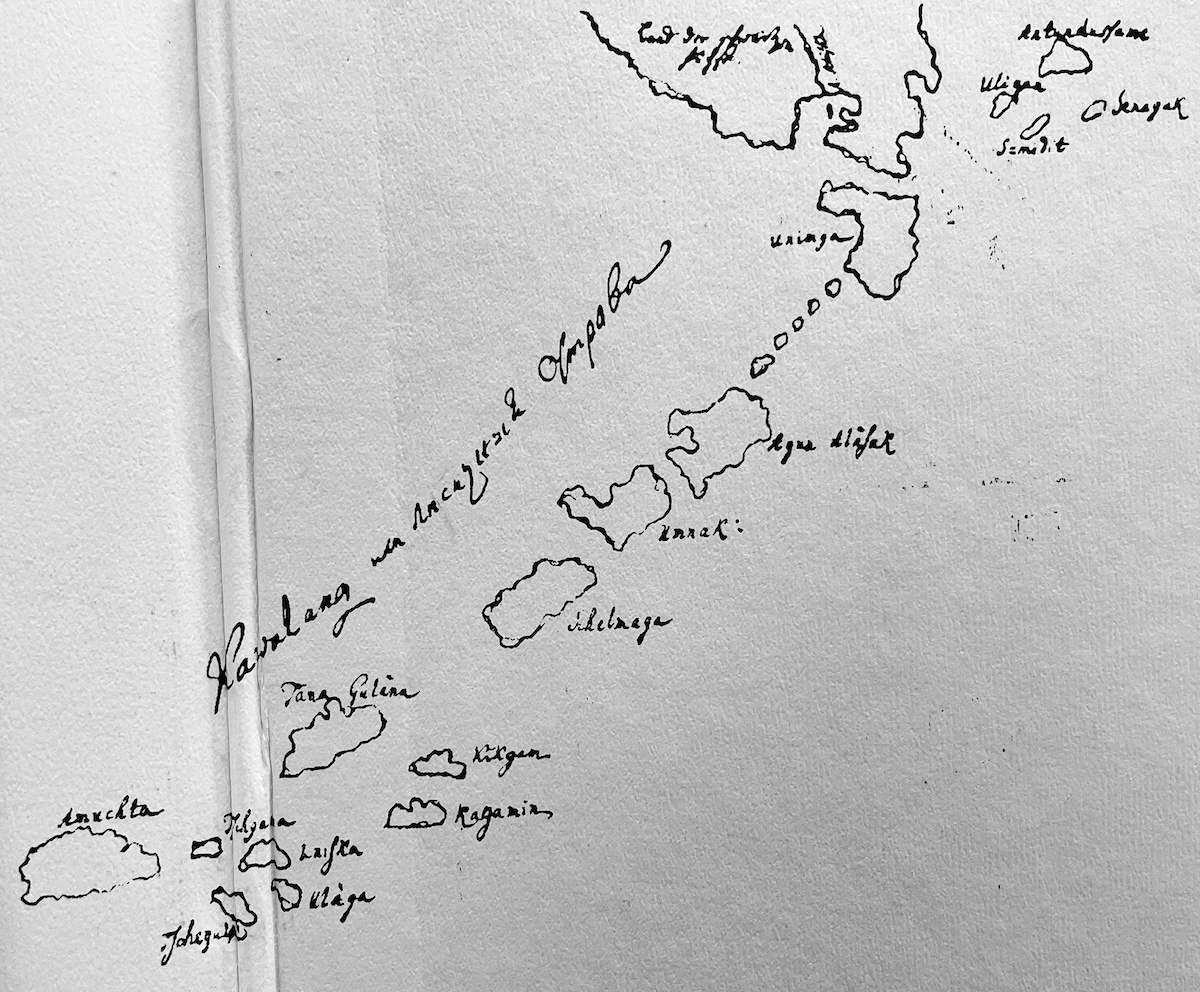
A cartographic sketch from around 1769, made from conversations with “an Aleut chief” at the St. Petersburg Imperial Academy of Sciences, depicts several of the archipelago’s island clusters (Fig. 4). Each island cluster is labeled with its Unangam Tunuu name, transforming mute topography into political geography.[27] The Unalaska, Umnak, and Samalga islands, home to people who lived among twenty-eight settlements, are identified as “Kawalang” (Qawalangin), indicating the political alliances attached to island ecologies. This hidden Unangax̂ social world may have been conveyed by Osip Kuznetsov, a baptized son of an Attu Island tukux̂ (political leader). Around this time, he traveled to St. Petersburg on the instructions of the imperial court, which desired to see one of its North Pacific “subjects.”[28]
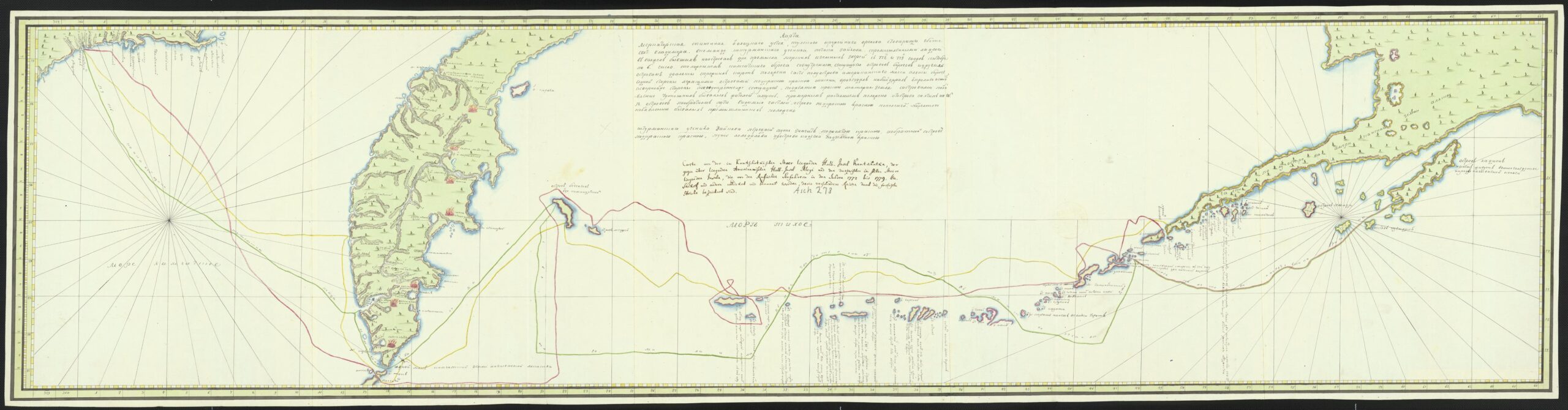
These flickers of an Unangax̂ social world, captured by the sketch, would be absorbed into the Imperial Academy, the court’s foremost center of learning. A vast collecting project, it was also an intellectual engine of expansion. Its translation of Indigenous power into imperial knowledge fed off the state’s physical territorializing in the North Pacific. For half a century, Russian cartographers grasped at the outlines of the Aleutian Islands and their relationship to Alaska’s vast land mass. The archipelago, appearing on maps as a guesswork of broken contours and incomplete topographies, is ensnared by hand-drawn lines that trace the routes of sailing ships (Fig. 5). Their linearity creates an illusion of confident navigation, but their narrowness also expresses a circumscribed view of the ocean.
In the painted sea rider, a different world is glimpsed (see Fig. 2). Indisputably, the 1775 map where he appears is an imperial vision. Made for a government that was reimagining itself as a maritime power, it is a political argument for possession. Yet the kayak’s prominent scale relative to the fragmented islands also tells a counter story to imperial narratives. Vignettes of Unangax̂ kayaks embellish an unusual number of early Russian cartographic documents. They command the sea and eclipse the land.[29] They express a reality that imperial maps could not repress: the ocean belonged to Native watercraft.
Terraqueous Territory in the Aleutian Archipelago
If Russian ships saw isolated and fragmentary islands, communities looking out from Aleutian shores saw an expansive world. Encompassing sixty-nine islands and hundreds more islets, the archipelago arcs some 1,200 miles from mainland Alaska toward the tip of Kamchatka, north of Japan. Its island chain, the volcanic creation of tectonic earthshaking at the seafloor, is a natural threshold between the deep waters of the North Pacific and the descending polar currents of the Bering Sea. The islands are treeless and mountainous. Exposed to fierce winds, their interiors are carved out with grottos and ravines difficult to access. Life instead orients toward the ocean and its extraordinary biomass. In this corner of the world, it is the sea, rather than the land, that “becomes more and more peopled,” as a Franco-German naturalist later observed. It surged with microscopic “Medusæ and Zoophytes … gigantic swimming mammalia, whales, physeters, dolphins, morse and seals.” Seabirds clustered so densely on the ocean’s surface they resembled “floating islands.”[30]
Before the mid-eighteenth century, the entire Aleutian Archipelago was divided into many small polities, each of which had their own names for themselves, spoke distinct languages, and maintained territories through kinship systems.[31] Marked on land by small settlements, their territories stretched across clusters of islands and extended deep into the ocean. Aquatic territories were volumetric and non-contiguous. They may have included animal breeding sites and ocean upwellings—places frequented by sea mammals and other marine life for their nutrient-rich waters.[32] People exercised sovereignty at such sites not through possessive rights of ownership but by managing reciprocal relations with other beings. The kayak was central to ocean sovereignty: its travel along known routes and paths, preserved over generations, continually reinscribed its dimensions in space.
Evidence of terraqueous territory is also imprinted in place names. Among linguistic knowledge compiled with Elders in the 1950s on the islands of Atka and Attu, the largest group of place names represents precolonial knowledge, evident from the absence of Orthodox Christian names and Russian loanwords.[33] Language was an early aspect of invasion. Even before Orthodox clergy arrived in the Americas, promyshlenniki (fur traders) carried out lay baptisms, which erased Native names with Russian surnames and patronymics. Unangax̂, moreover, were quickly fluent in Russian. Yet precolonial forms of tenure, as they were shaped by kayaks, persist in language. Shores are named for their capacity to be good kayak landing sites and by the qualities of their sand. The place name Qmalgitur indicated “a large white dry beach.” Other names alerted navigators to dangerous sunken reefs, or to the character of ocean currents. Macilar Bay’s name warned of “‘jams all around’ (so that one gets stuck).” Place names also quantified material abundances, especially driftwood, that was essential for kayak-building. The bay Yagarir, rich in sea wrack, announced: “Has driftwood.”[34]
To build a frame for an iqyax̂, a single-hatch kayak, could take up to a year, including gathering driftwood from spaces where the ocean cast it ashore. Driftwood, brought by the ocean and returned as a kayak, was central to watercraft’s terraqueous dimensions. Most of the wood reaching the Aleutians originated in boreal forests deep in the Alaska interior and Eurasia. Fallen trees, pushed to sea by massive river systems, circulated in ocean currents before spinning south. Essential for marine and coastal ecosystems, where it formed reef-like structures and stabilized shorelines, driftwood entered human law and spiritual practice as it came ashore.[35]
Within the wider region knit together by different forms of Indigenous watercraft, driftwood was a shared preoccupation. To bring seasonal harvests, Yupiit in coastal Alaska sang, “Yuugiiyamaa [my spirit], look toward the upper Yukon River up there / It is getting piled with driftwood.”[36] In the eastern Aleutians, kayak builders prized the “fine whitish yellow” wood the sea threw up. Far to the west, the people of the islands Medny and Bering knew strong winds brought Japanese woods and fragrant camphor.[37]
On shore, knowledge of how weather systems and ocean currents directed driftwood’s movements was translated into rules guiding the material’s harvesting and distribution at proprietary sites. Tukus, leaders of Unangax̂ communities, held rights to part of everything valuable the sea cast up. This could be translated into political and spiritual influence. In a story of the Umnak Island people, a founding ancestor exercised his authority by punishing kin who violated another band’s driftwood-gathering territory.[38]
If driftwood embedded kayak-building in traditions of tenure that spanned ocean and land, a rider and his kayak together produced space. They regularly called terraqueous territory into being. Approaching a shore in fog, a rider hollered at the land to reflect his voice, then listened “to hear the echo as a landmark, sulg-a tutal,” returned by a coastal bight or ricocheted from a fjord. These sonic landmarks encircled ocean spaces, binding them to people’s lands, as did an Amlia Island fjord that was a “great resounder” in storms.[39]
Shores were also spaces for conducting diplomacy with cross-island communities. Traveling by kayak fleets or large open-deck watercraft like the niĝilax̂, neighboring polities in the Aleutians and more distant communities from the Kodiak Archipelago and Gulf of Alaska interacted at one another’s shores. This is also where conflicts, sometimes war, unfolded. Narratives tell of disarming adversaries as they slept by tying together their kayaks and sending them out to sea.[40] Alternately, when invited guests arrived, hosts waded out “up to their knees in the sea.”[41] After securing paddles and gripping the gunwales, they carried their guests ashore still seated in their kayaks. This show of respect recognized the difficulty of disembarking in pounding surf.
The Indigenous power embedded in shores and their shallows became more essential in the face of Russian invasion. People fiercely defended them. In the 1760s, an “old voyager,” Prokopii Lisenkov, reported that the Qax̂un, people of the Rat Islands, did not permit anyone “on shore”: “All around this island it is all a cliff, when in need of landing [it] can be made only by baidara [deckless boat].”[42] In the same period, Russian naval officers on state-sponsored expeditions formulated instructions for how to approach Aleutian shores, acknowledging their vulnerability in shallow waters not accessible to heavy ships.[43] The same shallows provided refuge for Unangax̂: home to kelp forests that ring the islands, a sea rider could grab hold of a strong frond and pull himself and his kayak out of sight from hostile fleets.[44]
Unique regional features also favored the maneuverability of paddle-propelled kayaks over wind-dependent ships. This was especially true of the unusually narrow passes between islands. Created by the archipelago’s proximities, they act as funnels for powerful north-moving currents. An incredible volume of water surges through them daily, sweeping invertebrates, plankton, and a churn of ocean nutrients along with it. This regular upturning of ocean depths attracts feeding seabirds, mammals, and fish, making the passes ecologically fertile spaces for islanders. Yet they were deadly for top-heavy Russian vessels. When fast-moving currents collided, they caused the sea to boil, producing rip tides (suloi) that spun ships, inundated cabins, and snapped masts in “a fearsome spectacle.”[45] Across the Russian colonial period, these difficult topographies would remain beyond imperial control.
Renewal and the Sea Hunt
Secured to both the interior and exterior of the kayak, small sea otter figures, carved from ivory and no more than a couple of inches tall, embody one of watercraft’s defining social relations, the experience of hunting sea mammals, which transformed both hunter and hunted (Fig. 6). Expressive and detailed, the figures hold their paws up to their faces, as otters do when floating supine to shield themselves from sunlight and conserve energy. Their bellies are incised and rubbed with dark pigment, evoking ribs and spine. Females hold pups. Similarly scaled animal figures were often attached to the plaques and crowns of a hunter’s specialized headgear. The otters, though, seem to hold a special relationship to the kayak’s supple body, and to the integrity of its joints and seams. Tethered to the vertical spacers in the kayak hull, or kept in hunting bags as amulets, the figures also served as cleats on kayak decks. They secured the lines holding weapons and equipment.[46] Their tying and tethering work is both physical and ontological.[47] They bind the kayak and its hunter to other living beings, tying their movements and actions on the water to the ocean’s larger social universe.
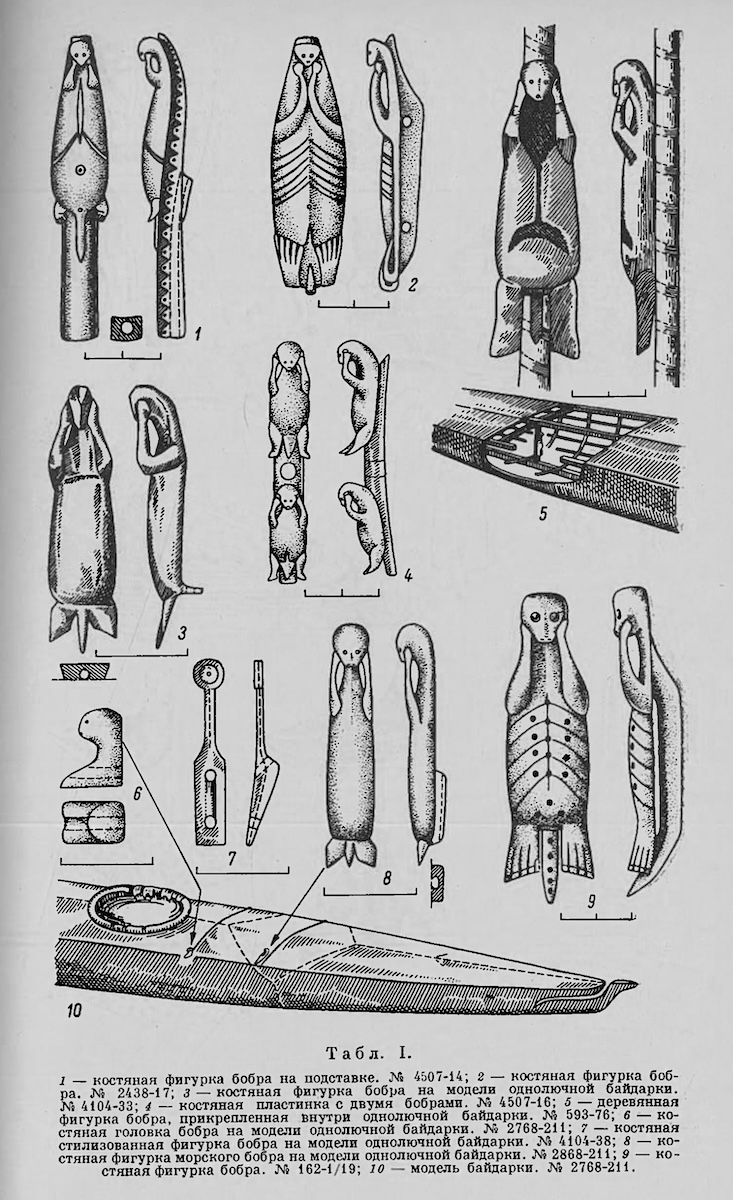
Unangax̂ understood all sea mammals to possess personhood and to act with intention. A hunter’s obligation to each was governed by discrete social codes. The sea otter, recognized as a transformed human, held an important place. Otters responded to beauty, and hunters wore their best clothes and embellished their kayaks to attract them. Seamstresses threaded the seams with feathers, hair, and, later, colored beads. Such was the animal’s subjective power that the hunter shaped his conduct accordingly. The sea otter saw and judged a hunter who treated his wife untowardly or whose kin violated social norms. If approached at sea in the supplication of the hunt, they mocked him, cavorting about his kayak and never letting him strike them. To redress such wrongs, hunters were obliged to adjust their behavior, for example, by not spitting in waters where otters swam.[48]
The ethical force of hunting reverberated beyond the sea. Its human-animal relations belonged to a larger constellation of social codes, laws, and protocols by which Unangax̂ communities managed their territories and collectively established strategies for how to live with one another and the more-than-human world—an ethical framework that continues to inform present-day practices.[49] On land, the ocean’s material abundance was essential for people’s survival and sustenance; its influence on social order reached even further. The ocean came ashore most vividly in institutions dedicated to renewing its productivity through acts of reciprocation, religious observance, and commemoration.
One such social institution was the winter festival cycle. Practiced in the eastern part of the archipelago—as well as, in distinct forms, within the wider region—this series of interlinked celebrations was likely held from the end of fall seal-hunting season until migrating whales reappeared in the spring. While only so much is known about their precolonial history, cycles included preparing a festival house, carving new masks for dancers to wear, and inviting in neighboring settlements. At the center of these multi-day events were demonstrations of respect for sea mammals and appeals for their rebirth.[50]
Festivals had deep spiritual and religious significance, much of which is privileged knowledge that belongs to descendant communities and relates to their ongoing cultural practices. Yet eighteenth-century festival cycles might also be seen as relating to a framework of beliefs and practices that supported marine management. Centered on renewal, festivals were meant to ensure next year’s hunting plenty. These celebrations connected to other ocean-oriented practices that helped perpetuate culturally important species, from protocols for approaching otters at sea, to the careful work of seamstresses in honoring animals’ gifts by turning their bodies into clothing and objects.[51]
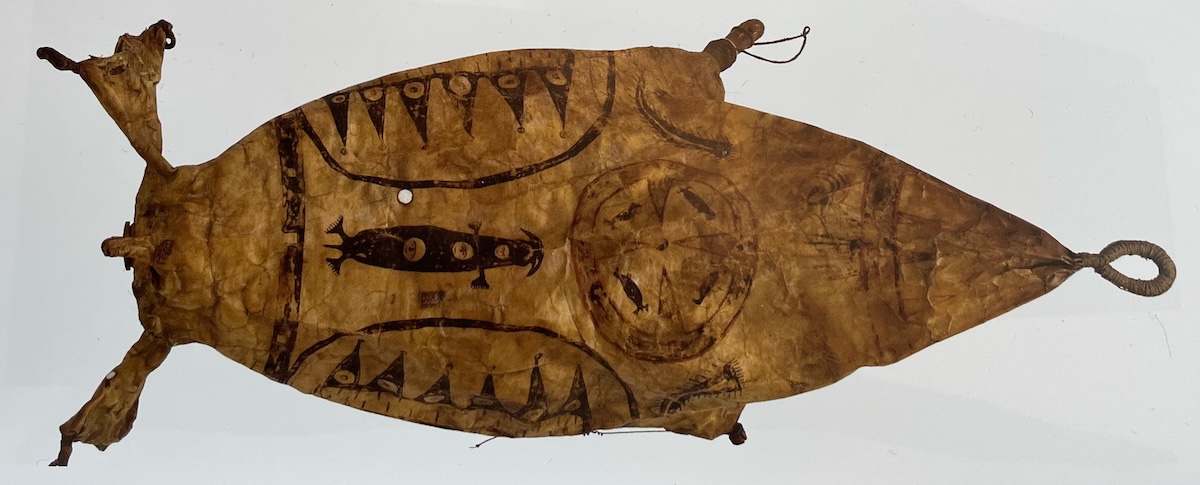
Festival materials doubled the ocean world. Performers wore special hunting hats and clothing. They enacted sea hunts using ornamented paddles. They performed harpooning whales and acted out the hunter’s quick retreat. An elaborately painted festival float, made from a whole sealskin, doubles one of the kayak’s indispensable technologies (Fig. 7). Made on the Alaska Peninsula, where distinct Native communities from the Aleutian Islands, Bering Sea, and Gulf of Alaska long interacted, the float is of uncertain origin.[52] But its watercraft technology was widely employed in the eighteenth century and much earlier, including by Unangax̂ communities. Stowed directly behind a sea hunter’s cockpit, such floats could be inflated and attached to a harpoon to create drag on a struck whale. They could also be turned into decoys for luring seals. If a kayak capsized, the float became a life-saving technology.[53]
On the festival float, a double-banded circle, painted just below the seal’s head, evokes a cosmogram, or image of the world. Four prongs divide a central realm where silhouetted seals swim about a smaller figure who may be a juvenile or pup. Nearby is a being with pinniped flippers and a mouth full of teeth. Three faces peer from its belly, evoking its interiority and a personhood shared by all beings.[54] In regional belief systems, concentric circles painted, carved, or stitched into a range of materials described a cosmic layering of worlds.[55] The circular scenes of the float, thus, allude to spiritual transit but also to the object’s material transformations. Before taking a seal, hunters waited for her to fill her lungs so that when she gave herself, she wouldn’t sink. Making a seal into a kayak float was itself ontologically generative. Her life evacuated, the seal’s body was filled with new breath—a word in Unangam Tunuu with linguistic connotations of both life and spirit.[56]
At festivals practiced in the eastern Aleutians, floats painted in Unangax̂ traditions appeared in agility contests. Unangax̂ cycles were staged in an ulax̂ (or barabara, as it was called by Russians): a post-and-beam architecture clad in sod and living grass that was entered through an opening in the roof. During festivals, hosts replaced the solid entry ladder with a special one made from inflated animal floats and bladders. They dangled smaller bladders filled with rattling objects from its rungs. Guests made their entrance by unsteadily descending these bulbous, breath-filled forms, to the delight of their hosts and to the accompaniment of singing and drumming.[57]
A Vaster Ocean Society
The earliest-known European drawing of an Unangax̂ kayak, from 1741, depicts a mariner holding aloft a staff topped with the feathers or body of a falcon (aaĝuliix) or related bird (Fig. 8). Such feathered staffs may have designated the offices of political leaders, tukus, or other higher-status individuals. Among the several hundred species of seabirds and shore birds of the Aleutians, falcons were often used in interacting with outsiders.[58] Appearing in a cartouche above an early map, the individual depicted had paddled out to negotiate with the Russian ship, Sv. Petr, near the Shumagin Islands in the eastern archipelago.
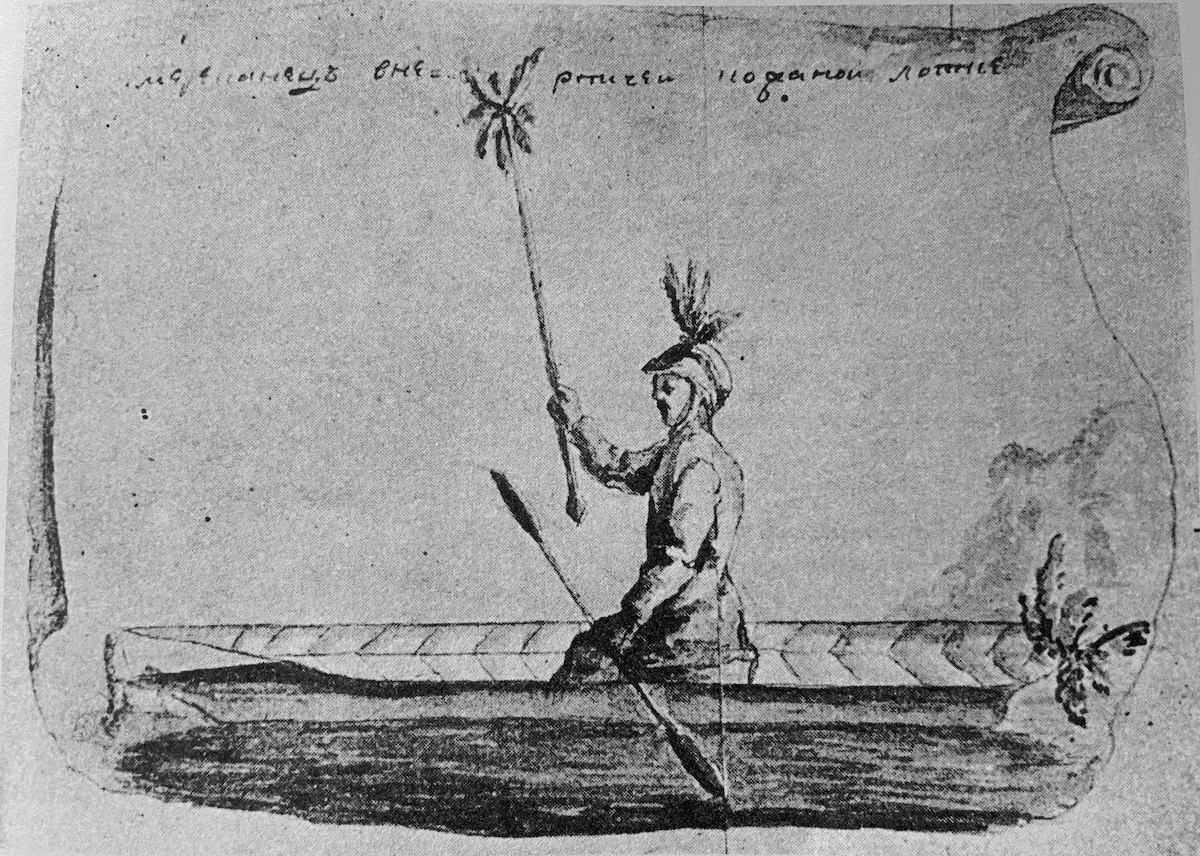
To read this image narrowly would be to see it through a land-bound, human-centric politics that was practiced by eighteenth-century Russians, for whom animals were not only separate from people (or at least, from propertied ethnic Russians) but also considered government property de facto owned by the state.[59] But as the feathered staff and festival float testify, the world in which the Unangax̂ mariner and his kayak were engaged was much more expansive than land-based legal regimes. Like the festival float’s concentric circles, eighteenth-century Aleutian Islanders knew and understood themselves to be at the center of worlds of extraordinary movement that extended far beyond their shores.
Vast numbers of sea mammals, fish, and birds pass through or stop over in the archipelago as they travel north and south along migratory routes. The year was divided by their presence and absence. The period “Chnǵu likh,” for instance, was marked “when mammals shed their pelage” for “new hair.”[60] Unangax̂ kept ornithological categories of birds who migrated to parts unknown.[61] Hunters incorporated avian knowledge into weather forecasts: when bad weather was on its way, eagles ascended to lofty heights.
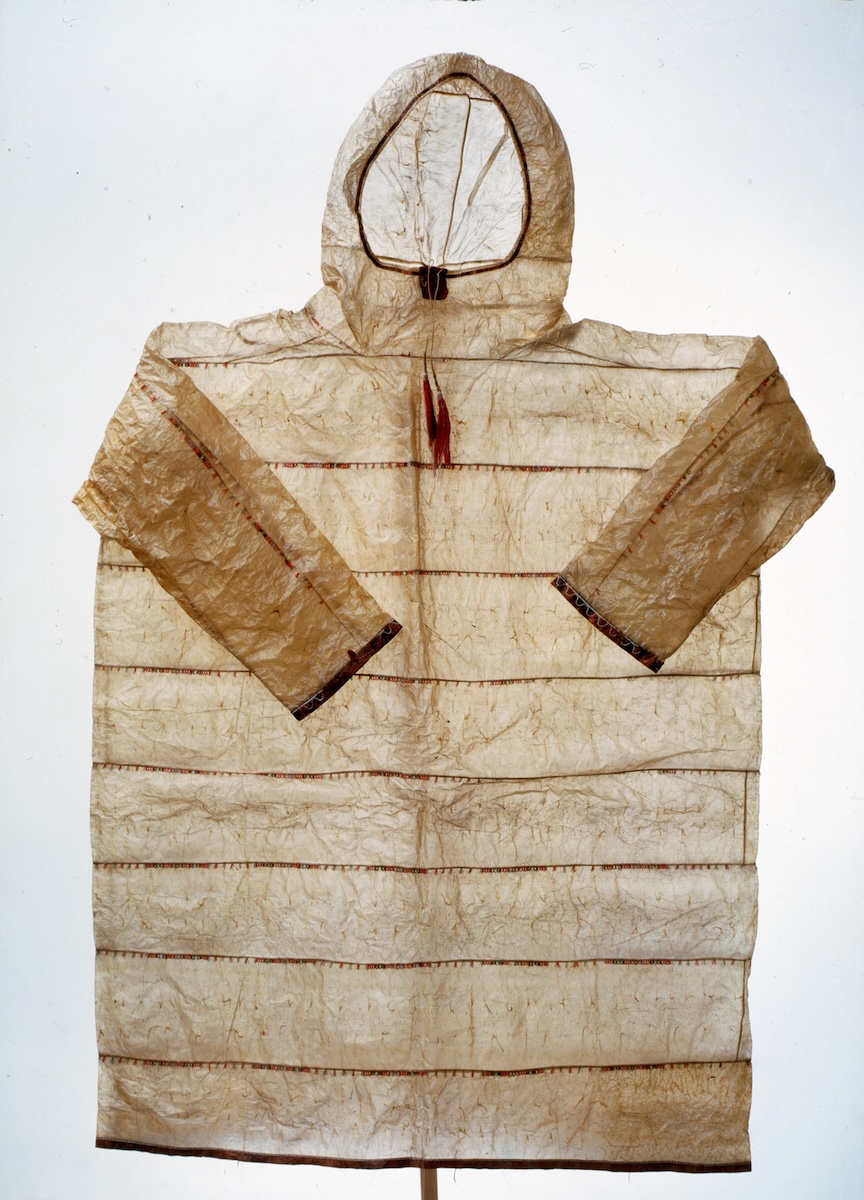
Not only did people keenly observe the animals that commanded the sea and sky, but they also incorporated animal capacities into material culture. People carried bits of spiritually powerful bird down to protect themselves. Seamstresses stitched the sea lion’s muscular digestive tubes into translucent waterproof suits (Fig. 9). They sewed the feathers and skins of cormorants, puffins, and murres into avian parkas. Made up of the thousands of tiny interlocking barbs that gift birds flight, these feathered garments enrobed human wearers in iridescent plumage that had once winged the sky.
This intersection between animal migratory cycles and human-kept cycles, like winter festivals and the calendar, most clearly reveals the ambitious, global dimensions of the North Pacific cosmologies cultivated through watercraft. The movements of whales, seabirds, and other animals were not just observed but understood to be the actions of beings with intention and agency. Thus, the full scope of the social world in which Unangax̂ participated was vast. It extended to ocean reaches far beyond human sight and the kayak’s travel. The potential authority and influence for those who understood its workings was great, as were the consequences for those who disregarded its rules.
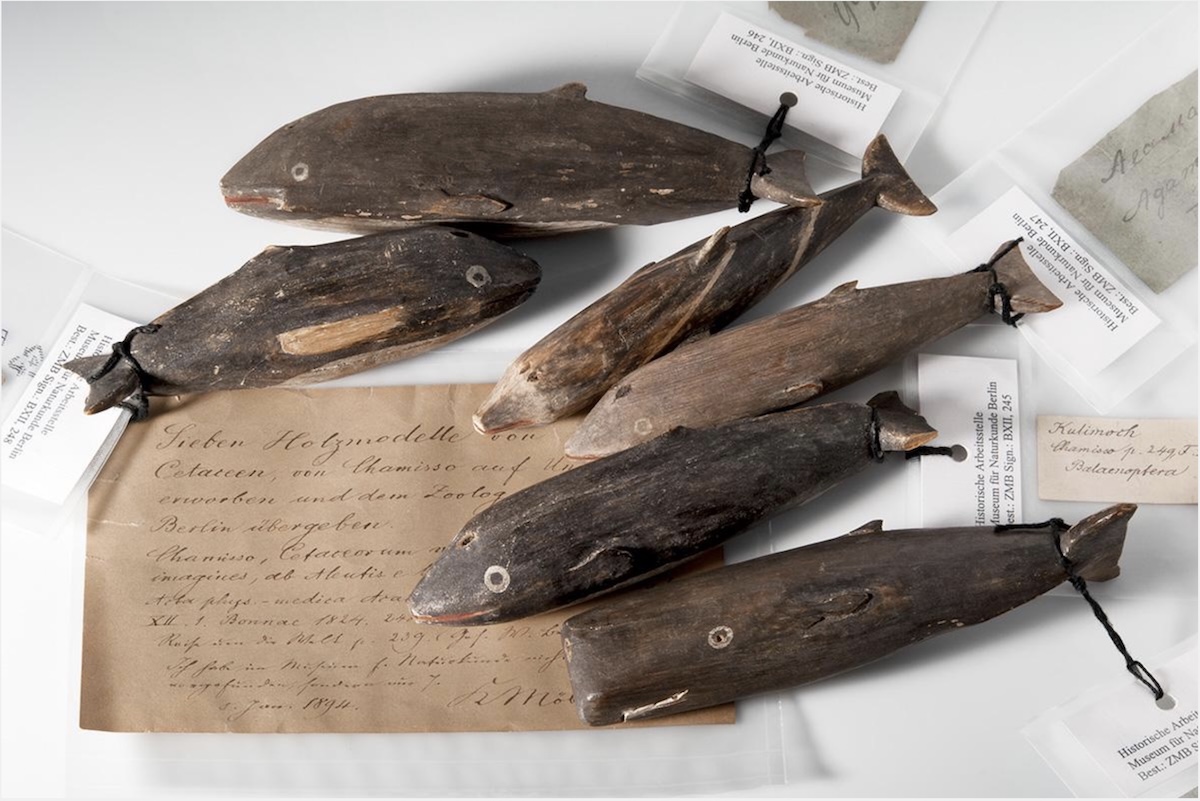
Whales, for instance, were members of society possessing potent power. Hunting them, a necessary though infrequent act, required addressing the ethical dimensions of killing intelligent and sentient animals. This responsibility was borne by individual whalers, who lived shortened, often violent lives.[62] At the same time, this social compact, if upheld, conferred the ability to intimately know the whale, as suggested by a set of miniature whale models made by a carver in Unalaska decades into the Russian occupation (Fig. 10).[63] Depicting six distinct species, the models detail each anatomical feature, from fluke to blowhole. To evoke the baleen whale’s ventral pleats, the fleshy throat tissue she balloons to gulp water and krill, the carver carefully grooved the model’s underbelly.
In the same period, Russians still considered whales “monstrous” and knew very little about them.[64] In the North Pacific, they relied on Unangax̂ information. The empire’s premier zoological compendium, Zoographia Rosso-Asiatica, cataloged the region’s whales using Unangam Tunuu names. The text noted, for example, that a species of baleen whale known to Unangax̂ as “Aggamachschik” had unsuitable intestines for sewing chigdax̂, the waterproof garments every Native mariner wore to sea.[65] This privileged knowledge, acquired by Unangax̂ mariners through honoring a social compact with the whale, would soon be contravened.
Russian Colonialism and Watercraft’s Endurance
From the hatch of a kayak, empire’s arrival in the North Pacific, rather than ordering a supposed wild ocean into a space of law, was distinctly unruly, disordering, and lawless. From the earliest incursions by sea-inexperienced promyshlenniki, different imperial actors in the Aleutians and the larger region transgressed watercraft’s social compacts and aquatic territories. At the shoreline, for instance, Russians violated protocols for collectively managing drift materials, including whales. Where once rights to the whale’s bountiful oil and meat belonged to the community to which it came ashore, now colonial administrators mandated that half go to Russian companies. Often, more was taken, including the fat, “all the sinew and three parts of the intestines.”[66] Sugpiaq whalers in the Kodiak Archipelago had to register the signs carved into their stone darts, with which they marked whales as theirs, at the district colonial office. If a whale washed ashore and no one claimed it, the office took it in its entirety.
The Russian occupation, which stretched from the Aleutians and the neighboring Kodiak Archipelago to the coasts of mainland Alaska, insinuated itself into nearly every aspect of society. The period’s violence is evident in voices like Anshiges’s, an Unalaska woman who testified to harrowing abuse in the 1780s, and in the Unangam Tunuu names recorded in early Russian reports belonging to individuals, often children, who were taken hostage.[67] Colonialism also violated Native territorial boundaries and coercively moved large numbers of people. Unangax̂ men from the Aleutians and their neighbors, Sugpiat from the Kodiak Archipelago, were the primary workforce of Russian hunting operations. Organized collectively into large hunting fleets, they were forced to travel as far south as California, displaced from their homes and kin for months—and sometimes years—at a time.
At the center of these operations was the Indigenous kayak, piloted by extraordinarily skilled and knowledgeable hunters. It alone was suited to open-ocean hunting and to navigating a uniquely challenging seascape. Initially mercenary fur traders and later state-sponsored Russian companies came to rely entirely on Indigenous labor and kayak technologies, which they stole from the distinct watercraft traditions of both Unangax̂ and Sugpiaq communities. They also appropriated regional design variations to further the colonial project. One such example was the three-hatch kayak, which may have been innovated in the far western Aleutians and was exported to distant parts of the colonies to transport colonial administrators and Orthodox priests.[68] By the late eighteenth century, a single company managed Russian America, acting essentially as the empire’s personal contractor.[69] Baidarshchiki (managers), consolidating earlier coercive tactics, organized Native kayak fleets in every colonial district, while the company engineered the killing of sea mammals in unsustainable numbers for profit.
In parallel, Russians tried to seize control of kayak-building. Unangax̂ and Sugpiaq men who hunted for the company were forced to purchase, at extortionate prices and often on credit, the kayak’s essential elements, from the skins for its covers to the protective gut parkas, which Russians called kamleiki.[70] When the company extirpated animals in one area, they shipped supplies from another. To supply one year’s worth of company kayaks, Native hunters had to produce “1,500 pieces of lavtaki,” the dehaired animal skins used for covers, and “12,000 fathoms of [animal] intestines” for sewing hooded kamleiki.[71] Seamstresses provided the skills and labor. To keep pace with the company’s hunting apparatus, they were often kept apart from their families and restricted from providing for them.
Company-managed kayak-building paid little attention to material ecologies. The skins used in kayak covers had limited lifespans. Even if regularly greased and carefully mended, they had to be replaced every couple of years due to seawater’s corrosive effects. This time-intensive maintenance was ill-suited to a company at ease with excessive waste. One year, company managers tossed hundreds of thousands of skins into the ocean to artificially maintain global fur market prices.[72]
Efforts to control kayak-building were part of a larger claim, on paper, to Russia’s total ownership of Alaska’s lands and waters. In the 1780s, the state took a more explicitly territorial interest in Russian America, in part due to perceived competition with other Anglo-European imperial powers. They tried to impose an imperial property regime over and atop existing Indigenous territories. The most direct expressions of this territoriality were aggressively staged ceremonies for taking possession of Indigenous land.[73]
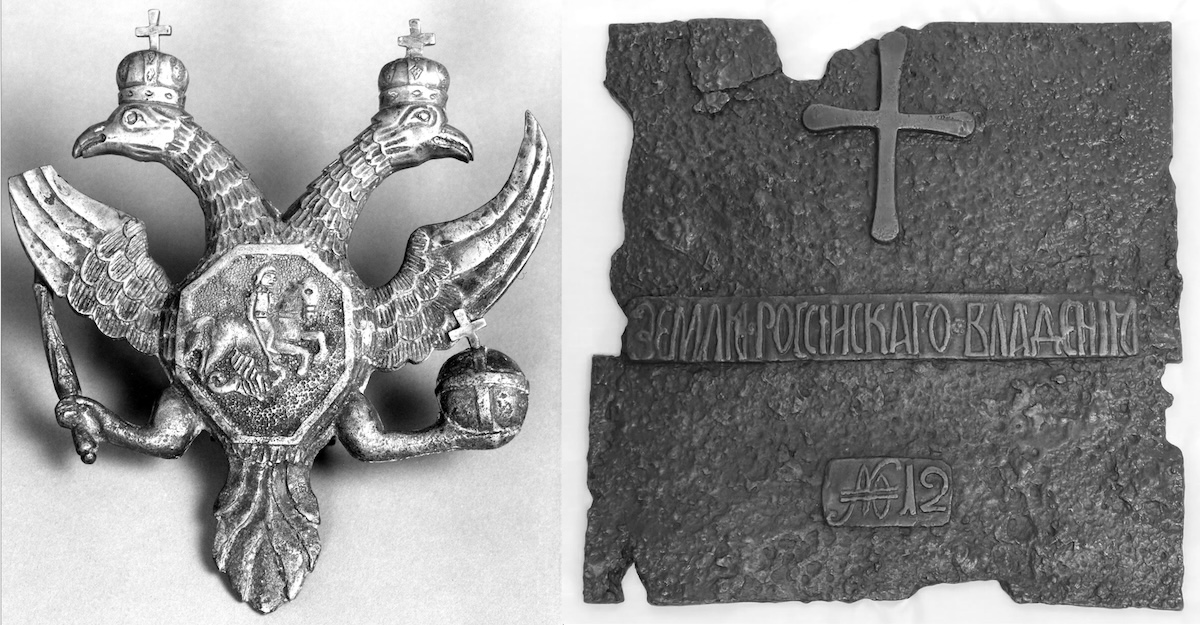
Supplying merchants and navigators with imperial crests and possession plates, the state charged them with physically marking the “new” land with possession. They mounted the crest, with its conspicuous double-headed eagle clutching the sovereign’s scepter and orb, atop poles, and buried possession plates beneath Alaska’s shores—and eventually, all the way to California (Fig. 11). If unearthed, the plates’ inscriptions declared ancient Russian rights to the land.[74] This pageantry augmented older practices of handing out medals meant to signify the crown’s “special benevolence.”
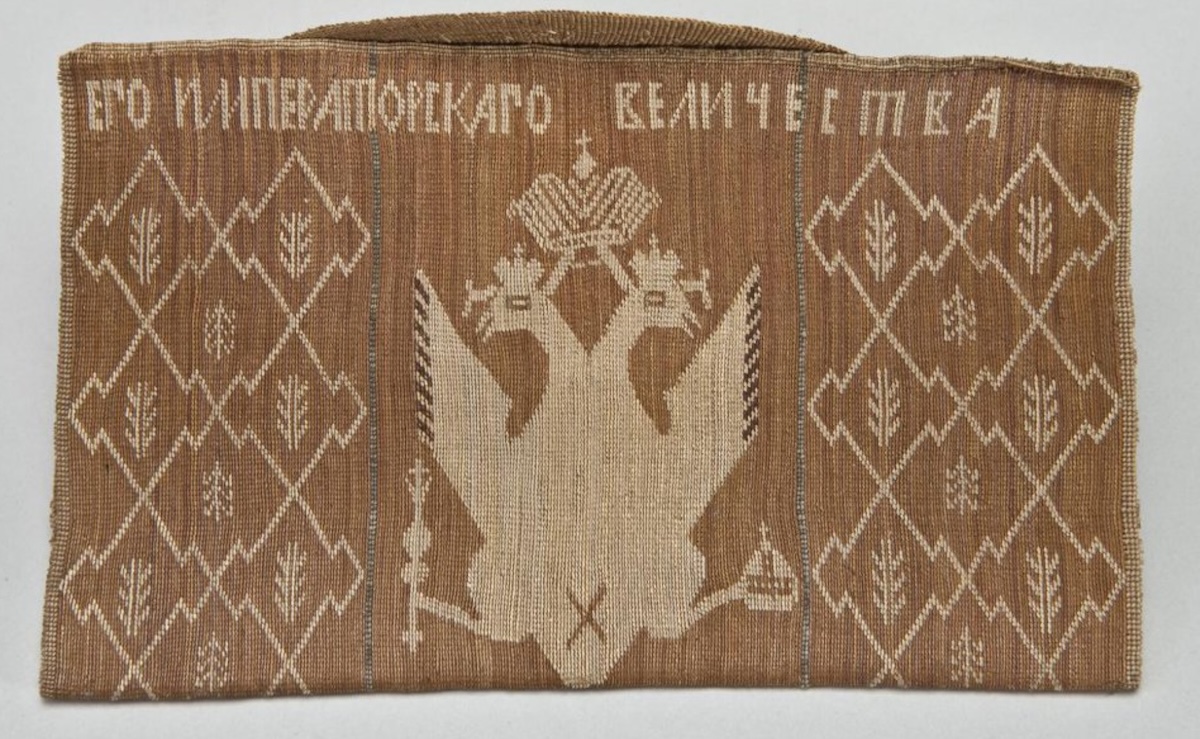
But such traffic in symbols was not one-directional. On a diminutive grass-woven bag from the same period, an Unangax̂ seamstress embroidered her own version of the imperial crest (Fig. 12). The bag, which resembles a sewing bag or a transformation of a European-style wallet, may have been commissioned by a Russian officer. Directly above the eagle, across grass so finely woven it approaches hundreds of stitches per inch, the seamstress spells out, in Russian, “of his imperial majesty.” Why would the seamstress embroider her own version of the imperial crest? The image and message—a repetition of a phrase commonly affixed to official state decrees and legal documents—are perhaps the bluntest expressions of imperial possession.
Yet to read the seamstress’s work as such would be to take the symbols at face value and to assume their meaning translated unchanged. Native Alaska, though, already abounded in its own crests and richly symbolic imagery. Such imagery held private meanings internal to communities and acted as political messaging between nations. Birds, especially eagles and other raptors, were central to this visually charged world. Within Unangax̂ polities, they had spiritual connections to power and status, as exemplified by the falcon-topped staff of the 1741 cartouche. In the wider region, proprietary imagery was closely linked to watercraft. Borne on kayak bodies or displayed on ocean-facing architecture, this imagery informed political and trade networks that had existed long before Russians arrived.
On the northern Alaska Peninsula and lower Nushagak River, where Unangax̂, Sugpiat, and Yupiit interacted for centuries, bald eagles (metervik), their curved talons silhouetted in black, were among the proprietary figures Yupiit painted across their kayaks, coaming stanchions, and paddles. Further south, on the shores of Lingít Aaní, where Russia would later expand, ravens and eagles, dazzlingly elaborated across the fronts of Lingít clan houses, kept watch over travelers arriving by water. Appearing alongside other zoomorphic and supernatural figures, and unfurling across canoes and other objects, these crests were living beings and forms of collectively held sacred property.[75] Their living sovereignty contrasts starkly with the Russian imperial crest’s inertness and property theft. It was within this already brimming and potent visual seascape that the Unangax̂ seamstress worked.
Moreover, from the perspective of Indigenous watercraft, the distance between imperial claims and material reality was vast. Overwhelmingly, across the lived geographies of the North Pacific, colonial authorities had to navigate ocean spaces by relying on Indigenous knowledge, labor, and kayaks. Then too, certain places remained outside any imperial control, like the narrow passes between islands, where Unangax̂ expertise, forged in relation to specific topographies, created spaces never assimilated by Russians. Regardless of the imperial crest’s symbolic claims, at the waterline, Russian power was sharply curtailed. Indigenous watercraft endured.
Indeed, many of the Russians working in the Americas, from contract laborers to clergymen, retained a deep unease with the sea. When a ferocious tide inundated the shores of Nalik Island, an Orthodox monk brandished the icon of Mary (Bozhiia Mater’), calling on the sea to advance no further.[76] Like the biblical desert of Christian tradition, the North Pacific’s terraqueous environments were fashioned as dangerous proving grounds. Above all, the sea was to be contained, its unpredictable waters relinquished to Indigenous expertise.
In this context, perhaps what is most significant about the Unangax̂ seamstress’s bag is not the dominant eagle but the grass, or qiigax̂, into which it is embroidered. Connected to a sovereignty with deeper roots in the Aleutians, such rye grass (Leymus mollis) grows abundantly on Aleutian beaches. The seamstress may have climbed a ridge to gather it away from saltwater, where it was not too thick or coarse. Cutting and curing the stalks to an even yellow, she used her fingernails to split each blade into warp and weft strands as fine as silk.[77]
Her weaving, then, has a critical relationship to the shore—just as the possession plates buried by the Russian Empire do. Yet unlike their imperial boundary-drawing, where power was imagined as exclusive ownership over fixed terrestrial land, grass-weaving dynamically linked land to ocean. Both a technique and social relation kept by generations of women, weaving transformed grass into mats that lined kayak floors, divided house interiors, and wrapped the bodies of the dead. It also tended to the shoreline; grass-gathering helped maintain the meadows protecting beaches from erosion. Understood within a larger framework of watercraft, grass-weaving, like the kayak, contributed to the reproduction and endurance of the shore as a terraqueous political space. Its living practice of sovereignty interlaced life on land with the ocean’s formidable aliveness.
Even as the Russian Empire went to sea, relying on Indigenous watercraft, its extractive regime was powered by land-serving imaginations meant to shore up terrestrial institutions and to buttress terra firma. It consumed and eventually exhausted ocean life for anthropocentric ends that contravened watercraft’s nonhierarchical relations. Such imperial statecraft offered no social compact with the ocean but was directed instead toward the domination of life. In contrast, like the seamstress’s recrafting of the imperial eagle within an Unangax̂ epistemology of weaving, watercraft brought a human and more-than-human society into complex ocean-spanning relations of rights and obligations.
Conclusion: Embarking
The shore where the grass grows, finally, is also the site from which the kayak embarks. It is, in this sense, both a physical and metaphysical place that has sustained ambitious, even global understandings of the world. From the hatch of a kayak, it is the place from which Unangax̂ continually situated themselves within global geographies of their own creation.[78] Long before outsiders arrived from the west, Unangax̂ paddled to Yup’ik country on mainland Alaska, east to Sugpiaq homelands in the neighboring Kodiak Archipelago, and north to Tanax̂-Amix̂, as Chaĝnachx̂ilax̂ did. Within their own island chain, people made voyages of nearly 1,000 miles, from Unalaska to Attu in the west, preserving these trips in narratives. Mariners in their nimble boats may even have ventured into the Sea of Okhotsk to trade with Ainu.[79]
After the Russian invasion, Native mariners continued to widen their horizons. Under colonial conditions, travel was frequently propelled by extreme violence, including kidnapping and hostage-taking. Yet as diplomat-spokesmen, apprentices, and petitioners, Native people also sailed to Kamchatka chancellery courts and traveled across Siberia’s vastness to St. Petersburg. Working for Russian companies, they traveled south to Alta and Baja California. Some sailed on to the Kingdom of Hawai‘i.[80] Later, when the Russian American Company began operating in the Kuril Islands, Unangax̂ and Sugpiaq hunters paddled the contested waters of Tokugawa Japan.
That is, even under conditions of enormous duress, people asserted their aquatic mobility. By any measure, they traveled vast distances. Yet perhaps of greater significance, they also voyaged expansively, cultivating global imaginations with which they created possibilities for themselves under circumstances of unfreedom—and into the present day. As a Native storyteller recalled in 1804, his ancestors once sent out two young men and their kayaks to seek the ends of the earth. Years later they paddled back to their home shores having failed to reach it. Now old men in the sunset of their lives, they understood the world “has no end, it is round.”[81]
Phoebe Springstubb is an Assistant Professor at the University of Michigan and a Postdoctoral Fellow in the Michigan Society of Fellows
Acknowledgments: I am grateful to the reviewers and editors for their thoughtful and incisive comments. My thanks to Chelsea Spencer, Erin Freedman, Yara Saqfalhait, and Roxanne Goldberg for their always attentive reading of my drafts. I am grateful to the community of the Michigan Society of Fellows for the opportunity to present this research. While any errors are entirely my own, my understanding of Alaska and its history is indebted to the generosity of the people and places who have welcomed me as a guest and student.
[1] Waldemar Jochelson, comp., Unangam Ungiikangin Kayux Tunusangin, Unangam Uniikangis Ama Tunuzangis: Aleut Tales and Narratives, ed. Knut Bergsland and Moses L. Dirks (Alaska Native Language Center, 1990), 107–15. Tanax̂-Amix̂ may have referred to St. Paul Island alone or to the entire Pribilof Island group. Chaĝnachx̂ilax̂ means “the Splitter (of trees).” Knut Bergsland, ed., Ancient Aleut Personal Names, Kadaangim Asangin / Asangis (Alaska Native Language Center, 1998), 200.
[2] Unangax̂ serves as both the singular and the collective, dialect-neutral plural; the plural forms differ by regional dialect: Unangan in the Eastern dialect and Unangas in the Western dialect. Before colonization, Unangax̂ communities in the Aleutian Archipelago formed distinct polities, each with its own name: Sasignan, Qax̂un, Naahmiĝus, Niiĝuĝis, Akuuĝun, Qawalangin, Qigiiĝun, and Qagaan Tayaĝungin. Historical records, however, are deeply uneven. Russian documents, for instance, refer to all Unangax̂ polities and their Sugpiat neighbors as “Aleuts.” I therefore use “Unangax̂” where the specific polity cannot be recovered. For Unangam Tunuu, I follow Knut Bergsland, comp., Aleut Dictionary / Unangam Tunudgusii (Alaska Native Language Center, 1994), and the guidelines of the Alaska Native Language Center at the University of Alaska Fairbanks. Additionally, following their respective linguistic conventions, I use Yup’ik and Sugpiaq as singular forms and Yupiit and Sugpiat as plural forms.
[3] Chaĝnachx̂ilax̂’s story is adapted from a 1909 retelling by Isidor Solovyov (1849–1912). Solovyov, who was born in Akutan Village, spoke an eastern subdialect of Eastern Unangam Tunuu. His narrative, relayed in speech and possibly song, was transcribed and translated by Leontiy Ivanovich Sivtsov (1872–1919), an Unangax̂ psalomshchik of the Unalaska Orthodox Church who was literate in Russian, English, and Unangam Tunuu. Jochelson, Aleut Tales, 11–12, 107–15.
[4] Lydia Black, Glory Remembered: Wooden Headgear of Alaska Sea Hunters (Friends of the Alaska State Museum, 1991), 32–34.
[5] I. Veniaminov, Zapiski ob ostrovakh Unalashkinskago otdiela, chast’ 1 (Sankt-Peterburg, 1840), 270, 271.
[6] Ryan Tucker Jones, Empire of Extinction: Russians and the North Pacific’s Strange Beasts of the Sea, 1741–1867 (Oxford University Press, 2014), 94.
[7] One account estimates that at least 80 percent of the population of the Aleutian Archipelago perished during the first two generations of the Russian occupation. Margaret Lantis, “The Aleut Social System, 1750 to 1810, from Early Historical Sources,” in Ethnohistory in Southwestern Alaska and the Southern Yukon: Method and Content, ed. Margaret Lantis (University Press of Kentucky, 1970), 179.
[8] See Ilya Vinkovetsky, Russian America: An Overseas Colony of a Continental Empire, 1804–1867 (Oxford University Press, 2011); Martina Winkler, “Another America: Russian Mental Discoveries of the North-West Pacific Region in the Eighteenth and Early Nineteenth Centuries,” Journal of Global History 7, no. 1 (2012): 27–51.
[9] For example, Maxine Berg, “Sea Otters and Iron: A Global Microhistory of Value and Exchange at Nootka Sound, 1774–1792,” Past & Present 242, suppl. 14 (2019): 50–82. On the “global” ocean, see Nathan Perl-Rosenthal and Lauren Benton, “Introduction: Making Maritime History Global,” in A World at Sea: Maritime Practices and Global History, ed. Lauren Benton and Nathan Perl-Rosenthal (University of Pennsylvania Press, 2020), 1–14.
[10] See Caroline Dodds Pennock and Amanda Power, “Globalizing Cosmologies,” Past & Present 238, suppl. 13 (2018): 88–115. For a multispecies perspective of the global North Pacific, see Ryan Tucker Jones, “Running into Whales: The History of the North Pacific from Below the Waves,” American Historical Review 118, no. 2(2013): 349–77. The emphasis here is on Indigenous systems of thought, without suggesting a binary between Indigenous and other forms of global thought. See, for example, Philip Deloria, “Preface,” in The Routledge Handbook of North American Indigenous Modernisms, ed. Kirby Brown et al. (Routledge, 2023), xvii–xix.
[11] Epeli Hau‘ofa, “Our Sea of Islands,” The Contemporary Pacific 6, no. 1 (Spring 1994): 152. See also David Chang, The World and All the Things upon It: Native Hawaiian Geographies of Exploration (University of Minnesota Press, 2016); David Hanlon, “Losing Oceania to the Pacific and the World,” The Contemporary Pacific 29, no. 2 (2017): 286–318.
[12] Recent work includes Amy Steffian et al., eds., Kal’unek—From Karluk: Kodiak Alutiiq History and the Archaeology of the Karluk One Village Site (University of Alaska Press, 2015); Jen Rose Smith, “‘Exceeding Beringia’: Upending Universal Human Events and Wayward Transits in Arctic Spaces,” Environment and Planning D: Society and Space 39, no. 1 (2021): 158–75; Thomas Michael Swensen, “The Strong Current and Alutiiq Cultural History,” English Language Notes 54, no. 2 (2016): 33–40; Bathsheba Demuth, Floating Coast: An Environmental History of the Bering Strait (W. W. Norton, 2019); Bart Pushaw, “Incising the Future in Early Colonial Alaska,” Eighteenth-Century Life 50, no. 1 (2026): 80–104; Colton Brandau, “‘It Was Not a Whale, but a Strange Monster’: Qikertarmiut Storytelling and Seasonal Relations through Early Russian Invasions,” Arctic Anthropology 58, no. 2 (2023): 105–24.
[13] Virginia Marshall, Overturning Aqua Nullius: Securing Aboriginal Water Rights (Aboriginal Studies Press, 2017).
[14] Many revitalization projects—too many to list here—are connected to youth culture camps. These include the angyaaq and qayaq workshops at the Akhiok Kids Camp, organized in collaboration with Sven Haakanson Jr. (Alutiiq/Sugpiaq) and artist Alfred Naumoff (Alutiiq/Sugpiaq); the niĝilax̂ workshops at Camp Qungaayux̂, organized by the Qawalangin Tribe of Unalaska; the qayaq workshops of the Qayanek Qayaq Preservation Center in Kwigillingok, southwestern Alaska, which follow the traditions of artist Frank Andrew Sr. (Yup’ik); and the dugouts built and pulled by artist Wayne Price (Lingít) and the North Tide Canoe Kwáan in southeast Alaska. In the larger region, annual Intertribal Canoe Journeys continue the tradition of the 1989 “Paddle to Seattle,” established by Emmett Oliver (Quinault).
[15] For example, Nadia Jackinsky-Sethi, “Alaska Native Artistic Reclamation and the Persistence of Indigenous Aesthetics,” in The Routledge Companion to Indigenous Art Histories in the United States and Canada, ed. Heather Igloliorte and Carla Taunton(Routledge, 2022), 381–88; Holly Miowak Guise, Alaska Native Resilience: Voices From World War II (University of Washington Press, 2024); Pushaw, “Incising the Future”; Evguenia Anichtchenko, “Open Skin Boats of the Aleutians, Kodiak Island, and Prince William Sound,” Études/Inuit/Studies 36, no. 1 (2012): 157–81; Megan Smetzer, Painful Beauty: Tlingit Women, Beadwork, and the Art of Resilience (University of Washington Press, 2021); Shari Huhndorf, Native Lands: Culture and Gender in Indigenous Territorial Claims (University of California Press, 2024); Lauren M. Ayagakuchax̂ Peters, Sophia’s Return: A Journey of Alaska Native Rematriation (University of Washington Press, forthcoming).
[16] The kayak is an Indigenous technology. The English word “kayak” derives from “qayaq,” a term with related forms in Iñupiaq, Central Yup’ik, Cup’ik, Siberian Yupik, and Sugpiaq languages. Among Unangax̂, iqyax̂ refers to a single-hatch kayak; ulux̂taadax̂ or ulux̂tax̂ describes a two-hatch kayak; and qaankun ulux̂tax̂, ulux̂taagamax, ulux̂talgux̂, iqyaag(a)magix̂, and iyĝasugaayax̂ have historically referred to three-hatch kayaks. Although eighteenth-century Russians recognized differences among kayak designs, they referred indiscriminately to Unangax̂ and Sugpiaq kayaks as baidarkas, appropriating both watercraft. Recognizing these complexities, I use both kayak and iqyax̂. The singular “Unangax̂ kayak” is a simplification: historically, each boat was crafted to an individual’s dimensions. During the precolonial period, when Unangax̂ had established communities across the entire Aleutian Archipelago, kayak-building traditions also likely varied locally. As Elder William Dirks Sr. explained, different communities had their own designs. The Naahmiĝus of the Delarof Islands, for example, not only spoke a different dialect from their neighbors, the Niiĝuĝis of the Andreanof Islands, but they also had distinctive kayaks. Bergsland, Aleut Dictionary, xxx, 210, 437.
[17] My conception of watercraft is indebted to recent literature in Indigenous and Black studies, including Joshua Reid, The Sea Is My Country: The Maritime World of the Makahs (Yale University Press, 2015), and Kevin Dawson, Undercurrents of Power: Aquatic Culture in the African Diaspora (University of Pennsylvania Press, 2018).
[18] Arkhiv vneshnei politiki Rossiiskoi Imperii (AVPRI), fond Geograficheskie karty, op. 2, d. 720, l. 1. Although signed by Timofei Shmalev, the map was likely compiled by multiple hands.
[19] Alice Petrivelli, “Preface,” in Aleut Art / Unangam Aguqaadangin, by Lydia Black, 2nd ed.(Aleutian/Pribilof Islands Association, 2003), 7–8.
[20] Veniaminov, Zapiski, chast’ 2, 220.
[21] Joëlle Robert-Lamblin, “Le kayak aléoute – vu par son constructeur et utilisateur – et la chasse à la loutre de mer,” Objets et mondes 20, no. 1 (1980): 8.
[22] Veniaminov, Zapiski, chast’ 2, 221; Georg Heinrich von Langsdorff, Voyages and Travels in Various Parts of the World During the Years 1803, 1804, 1805, 1806, and 1807, pt. 2 (London, 1814), 24.
[23] G. A. Sarychev, Puteshestvie flota kapitana Sarycheva po Sieverovostochnoi chasti Sibiri, Ledovitomu moriu i Vostochnomu okeanu, chast’ 2 (Sankt-Peterburg, 1802), 161.
[24] Adelbert von Chamisso, Adelbert von Chamisso’s Werke, 4th ed., vol. 1 (Berlin, 1856), 117.
[25] G. I. Davydov, Dvukratnoe puteshestvie v Ameriku morskikh ofitserov Khvostova i Davydova, chast’ 1 (Sankt-Peterburg, 1810), 154–58.
[26] Davydov, Dvukratnoe puteshestvie v Ameriku, chast’ 1, 156.
[27] Lydia Black, Atka: An Ethnohistory of the Western Aleutians (Limestone Press, 1984), 50.
[28] A. I. Alekseev, Brat’ia Shmalevy: Istoricheskii ocherk (Magadanskoe knizhnoe izdatel’stvo, 1958), 40–42.
[29] See A. V. Efimov, ed., Atlas geograficheskikh otkrytii v Sibiri i v Severo-Zapadnoi Amerike XVII–XVIII vv. (Izdatel’stvo “Nauka,” 1964).
[30] Adelbert von Chamisso, “Remarks and Opinions of the Naturalist of the Expedition, Continued,” in A Voyage of Discovery Into the South Sea and Beering’s Straits, by Otto von Kotzebue, vol. 3 (London, 1821), 306–7.
[31] The names of the polities were Sasignan, Qax̂un, Naahmiĝus, Niiĝuĝis, Akuuĝun, Qawalangin, Qigiiĝun, and Qagaan Tayaĝungin.
[32] For example, Caroline Funk et al., “Unangax Complexity in the Rat Islands,” in Fisher-Hunter-Gatherer Complexity in North America, ed. Christina Perry Sampson (University Press of Florida, 2023), 86–114; Caroline Funk and Bobbi Hornbeck, “Aleut Travel Paths,” poster presented at the Society for American Archaeology Annual Meeting, Austin, Texas, April 23–27, 2014.
[33] Knut Bergsland, “Aleut Dialects of Atka and Attu,” Transactions of the American Philosophical Society 49, no. 3 (1959): 17–18.
[34] Bergsland, “Aleut Dialects,” 30, 31, 32.
[35] Natalie Kramer and Ellen Wohl, “Driftcretions: The Legacy Impacts of Driftwood on Shoreline Morphology,” Geophysical Research Letters 42, no. 14 (2015): 5855–64.
[36] Ann Fienup-Riordan, Yuungnaqpiallerput / The Way We Genuinely Live (University of Washington Press, 2007), 332.
[37] Materialy dlia istorii russkikh zaselenii po beregam Vostochnago okeana, no. 1 (Sankt-Peterburg, 1861), 170; K. T. Khlebnikov, Notes on Russian America, Parts II–V, trans. Marina Ramsay(Limestone Press, 1994), 233; F. P. Litke, A Voyage Around the World, 1826–1829, vol. 1 (Limestone Press, 1987), 184.
[38] Veniaminov, Zapiski, chast’ 2, 279–90.
[39] Knut Bergsland, “Aleut Kayak Terminology,” in Contributions to Kayak Studies, ed. E. Y. Arima et al. (Canadian Museum of Civilization, 1991), 156; Bergsland, “Aleut Dialects,” 23.
[40] Cedor L. Snigaroff, Niiĝuĝis Maqax̂tazaqangis / Atkan Historical Traditions (Alaska Native Language Center, 1986), 18–33.
[41] Jochelson, Aleut Tales, 173.
[42] “Podannoe Prokop’em Lisenkovym opisanie nakhodiashchimsia po akiianu-moriu ot Kamchatki ostrovam (1766 g.),” in Russkaia Tikhookeanskaia epopeia, ed. V. A. Divin (Khabarovskoe knizhnoe izdatel’stvo, 1979), 345–46.
[43] “1768 g. avgusta 22.—Instruktsiia P. K. Krenitsyna shturmanu praporshchich’ego ranga A. A. Dubinu-Bol’shomu o printsipakh vzaimootnoshenii s mestnym naseleniem Aleutskikh ostrovov i p-ova Aliaska,” in Russkie ekspeditsii po izucheniiu severnoi chasti Tikhogo okeana vo vtoroi XVIII v. Sbornik dokumentov, ed. A. I. Alekseev (Izdatel’stvo “Nauka,” 1989), 122–23.
[44] Jochelson, Aleut Tales, 341.
[45] “Sil’nyi suloi predstavliaet otmennoe zrelishche.” Davydov, Dvukratnoe puteshestvie v Ameriku, chast’ 1, 178–79.
[46] R. G. Liapunova, “Zoomorfnaia skul’ptura aleutov,” Sbornik Muzeia antropologii i etnografii 24 (1967): 38–54. For otters in Sugpiaq art, see Pushaw, “Incising the Future.”
[47] See Debra Corbett and Diane Hanson, Culture and Archaeology of the Ancestral Unangax̂/Aleut of the Aleutian Islands, Alaska (Springer International Publishing, 2023), 366.
[48] Veniaminov, Zapiski, chast’ 2, 134–35, 341.
[49] Haliehana Alaĝum Ayagaa Stepetin, “Unangax Subsistence Performances and Sustainability Protocols: Interventions to the Ongoing Climate Crisis,” Sage Video, 2024, 37 min., 54 sec., https://doi.org/10.4135/9781529695885. Kanesia Chiiguyaakax McGlashan-Price, “Restoring Stewardship / Unangam Maqax̂singis suuĝutakus,” Polar Impact, accessed July 9, 2026, https://polarimpactnetwork.org/lf-restoring-stewardship. For more on Indigenous law, see Val Napoleon, What Is Indigenous Law? A Small Discussion (Indigenous Law Research Unit, University of Victoria, 2016).
[50] See William Coxe, Account of the Russian Discoveries Between Asia and America (London, 1780), 170–72; C. H. Merck, Siberia and Northwestern America, 1788–1792: The Journal of Carl Heinrich Merck, trans. Fritz Jaensch (Limestone Press, 1980), 206–7; Sarychev, Puteshestvie flota kapitana Sarycheva, chast’ 2, 134–38; J. G. Georgi, Russia; or, A Compleat Historical Account, vol. 3 (London, 1780), 235–36. For Sugpiaq festivals, see Sven Haakanson Jr. and Amy Steffian, eds., Giinaquq: Sugpiaq Masks of the Kodiak Archipelago (University of Alaska Press, 2009), 7–9; Aron Crowell et al., eds., Looking Both Ways: Heritage and Identity of the Alutiiq People (University of Alaska Press, 2001), 199–204.
[51] Stepetin, “Unangax Subsistence Performances and Sustainability Protocols.” See also Darcy Mathews and Nancy Turner, “Ocean Cultures: Northwest Coast Ecosystems and Indigenous Management Systems,” in Conservation for the Anthropocene Ocean: Interdisciplinary Science in Support of Nature and People, ed. Phillip S. Levin and Melissa R. Poe (Academic Press, 2017), 169–206.
[52] On the historical borderlands of the Alaska Peninsula, see, for example, Steffian et al., Kal’unek—From Karluk, 267–71. By the 1790s, Russian fur companies had also forcibly moved Unangax̂ men from Unalaska and other Aleutian communities to distant sites, including the Alaska Peninsula, to labor in colonial hunting operations.
[53] William Laughlin, Aleuts: Survivors of the Bering Land Bridge (Wadsworth Thomson Learning, 2002), 40.
[54] Crowell et al., Looking Both Ways, 191–92.
[55] For concentric circles in Sugpiaq thought, see Alisha Drabek, “Liitukut Sugpiat’stun (We Are Learning How to Be Real People): Exploring Kodiak Alutiiq Literature through Core Values” (PhD diss., University of Alaska Fairbanks, 2012), 125–26, 143–44, 186. For Yup’ik thought, see Ann Fienup-Riordan, Boundaries and Passages: Rule and Ritual in Yup’ik Eskimo Oral Tradition (University of Oklahoma Press, 1994), 259–65.
[56] Corbett and Hanson, Culture and Archaeology, 264, 310.
[57] Veniaminov, Zapiski, chast’ 2, 88–89; Merck, Siberia and Northwestern America, 70–71.
[58] Caroline Funk, “Ethno-Ornithology in the Rat Islands,” Journal of Anthropological Archaeology 51 (2018): 150; G. F. Müller, Sammlung russischer Geschichte, vol. 3 (St. Petersburg, 1758), 221.
[59] Jones, Empire of Extinction, 66.
[60] Lucien M. Turner, An Aleutian Ethnography, ed. Raymond Hudson (University of Alaska Press, 2008),191.
[61] “1762 g. sentiabria 12.—Raport kazaka S. T. Ponomareva i peredovshchika S. G. Glotova v Bol’sheretskuiu kantseliariiu,” in Alekseev, Russkie ekspeditsii, 63.
[62] Lydia Black, “The Nature of Evil: Of Whales and Sea Otters,” in Indians, Animals, and the Fur Trade: A Critique of Keepers of the Game, ed. Shepard Krech III (University of Georgia Press, 1981), 128–30; Turner, Aleutian Ethnography, 104–5.
[63] See Adelbert von Chamisso, “Cetaceorum maris Kamtschatici imagines, ab aleutis e ligno fictas, adumbravit recensuitque Adelbertus de Chamisso,” Nova acta physico-medica Academiae Caesareae Leopoldino-Carolinae naturae curiosorum 12, pt. 1 (1824): 249–62.
[64] Ryan Tucker Jones, Red Leviathan: The Secret History of Soviet Whaling (University of Chicago Press, 2022), 9.
[65] Peter Simon Pallas, Zoographia Rosso-Asiatica: Sistens omnium animalium in extenso Imperio Rossico, et adjacentibus maribus observatorum recensionem, domicilia, mores et descriptiones, anatomen atque icones plurimorum, vol. 1 (St. Petersburg, 1831), 289.
[66] Davydov, Dvukratnoe puteshestvie v Ameriku, chast’ 1 (1810), 238; chast’ 2 (1812), 128.
[67] For example, “Complaints Made by Natives of the Unalaska District,” box 2, folder 23, Yudin Collection, Manuscript Division, Library of Congress.
[68] Corbett and Hanson, Culture and Archaeology, 223. The origins of the three-hatch kayak remain uncertain. During the Russian colonial period, these craft were widely used to transport colonial administrators and Russian Orthodox priests, who rode in the middle hatch.
[69] Vinkovetsky, “Contractor of Empire,” in Russian America, 52–72.
[70] For example, R. G. Liapunova, Aleuty: Ocherki etnicheskoi istorii (Izdatel’stvo “Nauka,” 1987), 105, 112–13; Hieromonk Gideon, The Round the World Voyage of Hieromonk Gideon, 1803–1809 (Limestone Press, 1989), 62–64.
[71] “Es werden auf der Insel jährlich an 1,500 Stück Lawtaki (Lavtaki) d. h. zum Ueberziehen der Baidaren bestimmte Felle und an 12,000 Sashen Gedärme zu Kamlei’s, bereitet. Alles wird in der Kolonie selbst consumirt.” Ferdinand von Wrangell, Statistische und ethnographische Nachrichten über die russischen Besitzungen an der Nordwestküste von Amerika (St. Petersburg, 1839), 51.
[72] Litke, Voyage Around the World, 1:111.
[73] Martina Winkler, “From Ruling People to Owning Land: Russian Concepts of Imperial Possession in the North Pacific, 18th and Early 19th Centuries,” Jahrbücher für Geschichte Osteuropas 59, no. 3 (2011): 321–53. Imperial crests were also often repurposed or destroyed by their recipients.
[74] The inscription “zemlia rossiiskago vladennia” translates as “land of Russian possession.”
[75] The Crests of Tlingit Clans, ed. Chuck Smythe (Sealaska Heritage Institute, 2022); Matthew Spellberg, “Art and Aliveness on the Northwest Coast,” Res 73/74 (2020): 203–20.
[76] The Russian Orthodox Religious Mission in America, 1794–1837, ed. Richard Pierce (Limestone Press, 1978), 69, 102–3. Although beyond the scope of this article, relations between the Orthodox Church and Unangax̂ communities differed from those between the Russian American Company and Unangax̂. In the 1820s, for example, Unangax̂ individuals working with the Orthodox priest Ivan Veniaminov developed an Unangam Tunuu orthography and the earliest church translations.
[77] Anfesia T. Shapsnikoff and Raymond L. Hudson, “Aleut Basketry,” Anthropological Papers of the University of Alaska 16, no. 2 (1974): 41–69.
[78] By “global geographies,” I draw on and paraphrase Chang, World and All the Things upon It, vii. See also Caroline Dodds Pennock, On Savage Shores: How Indigenous Americans Discovered Europe (Knopf, 2023).
[79] Theodore Bank II, “Aleut–Koniag Voyages to Kamchatka and the Kuriles in Historical Times,” paper presented at the Alaskan Science Conference, Juneau, September 1956, Historical Collections, Alaska State Library.
[80] “L. A. Hagemeister to Ivan Kuskov, Jan. 28, 1818,” in Russia’s Hawaiian Adventure, 1815–1817, ed. Richard Pierce (University of California Press, 1965), 146.
[81] Gideon, The Round the World Voyage, 59.
Cite this article as: Phoebe Springstubb, “The Kayak and the Sea: Watercraft in the Indigenous North Pacific,” Journal18, Issue 22 Archipelago (Fall 2026), https://www.journal18.org/8384.
License: CC BY-NC
Journal18 is published under a Creative Commons CC BY-NC International 4.0 license. Use of any content published in Journal18 must be for non-commercial purposes and appropriate credit must be given to the author of the content. Details for appropriate citation appear above.
