
Daniella Berman
A cacophonous, celebratory scene marks the historic event of 16 Pluviôse Year II (4 February 1794), when the French National Convention abolished slavery in the French colonies. A lively pen, ink, and wash drawing in the collection of the Musée Carnavalet in Paris attempts to convey the monumentality of the declaration and the jubilation that greeted it (Fig. 1). Under banners labeled Constitution and Droit de l’Homme (Rights of Man), a Black man climbs up to the tribunal, his arms open to embrace a white counterpart with sharp, angular features that suggest those of Marc-Guillaume Alexis Vadier, whose term as president of the temporary governing body ended on that day.[1] The outstretched Black and white arms mirror each other, creating a sense of anticipation. Throughout the composition, Black men and women, many in Antillean dress, rejoice by embracing each other, white figures, or Black children, whose presence reminds the viewer of the proclamation’s intergenerational implications.
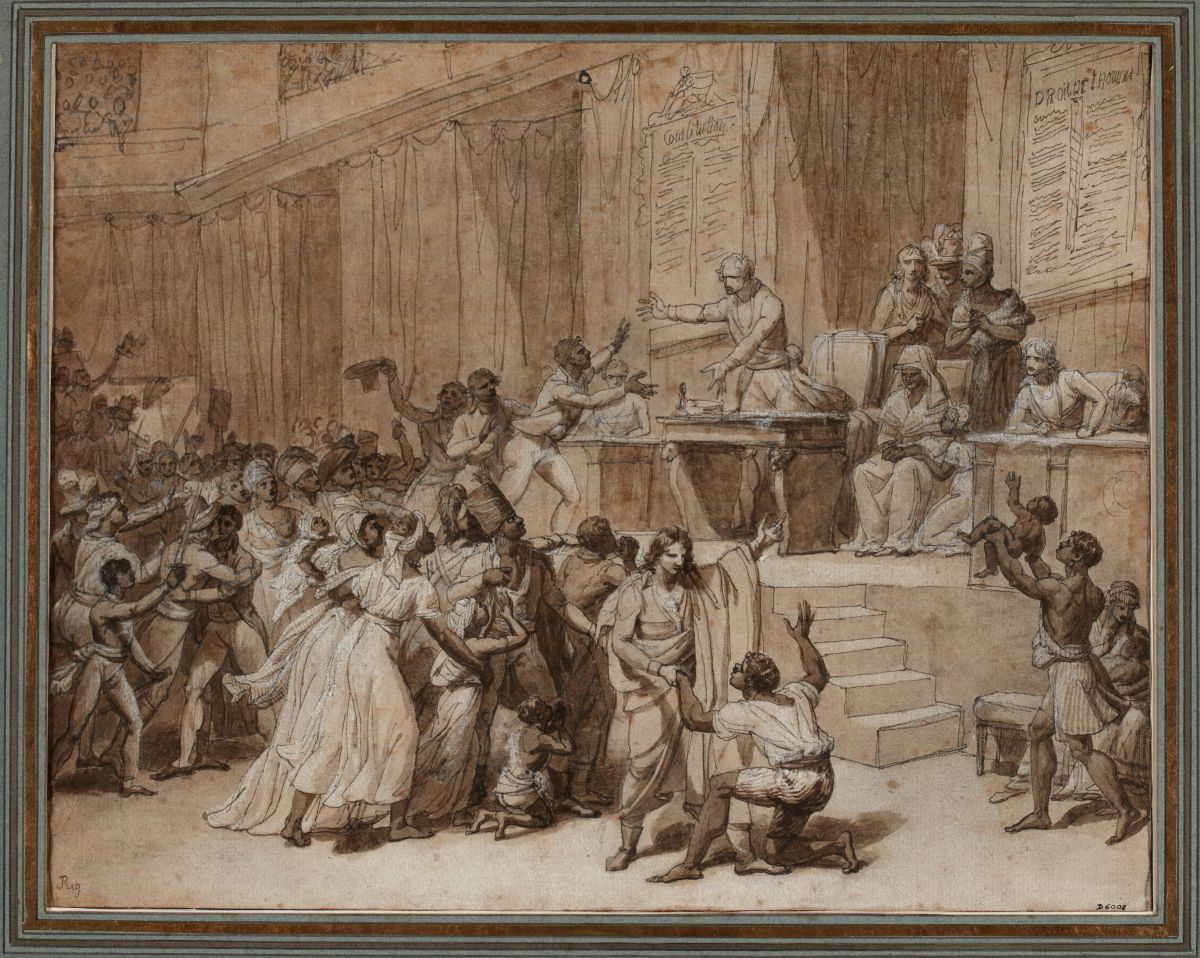
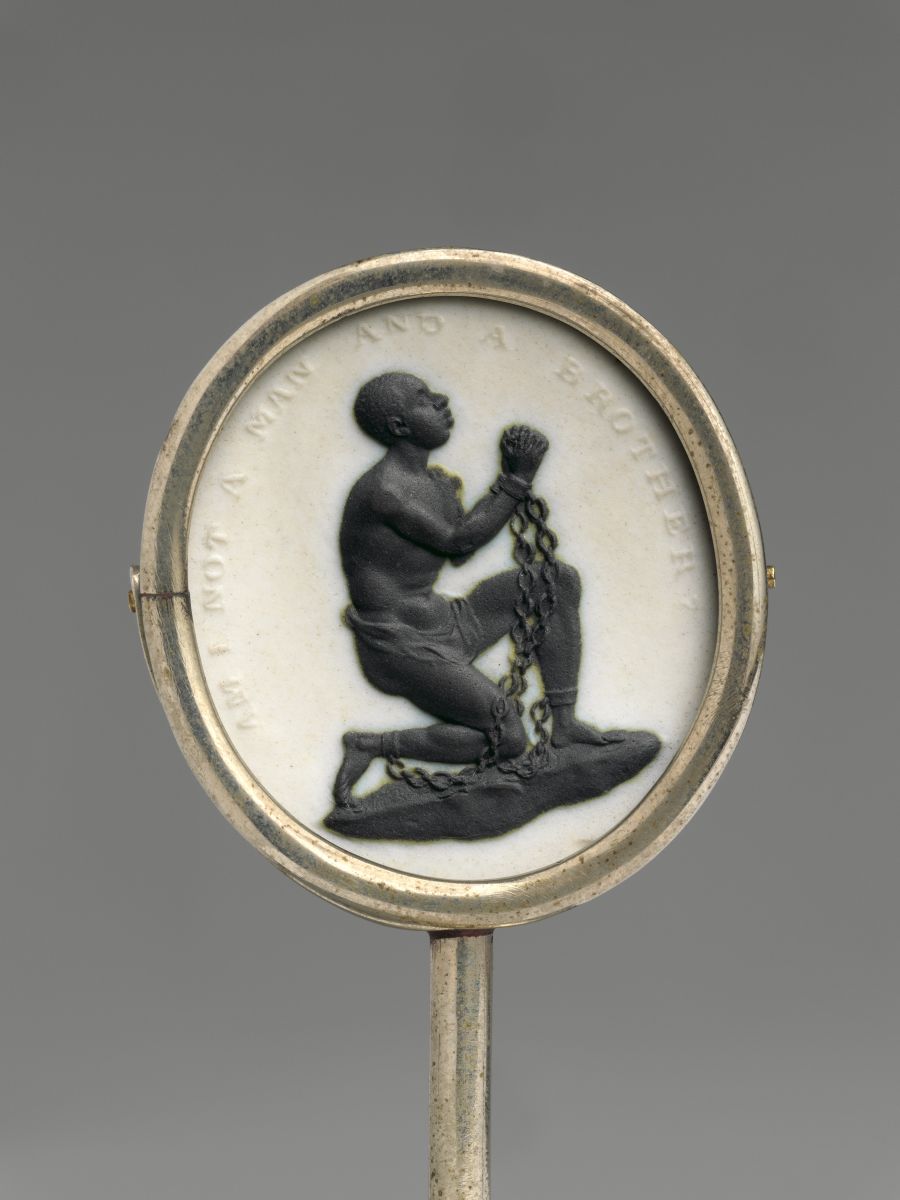
In the foreground, a white man dressed in a costume of a deputy of the Convention lifts a Black man from his knees.[2] This inclusion deliberately quotes and updates the famous Josiah Wedgwood antislavery medallion featuring an imploring figure surrounded by the inscription, “Am I not a man and brother?” (Fig. 2).[3] The implication is that the age of such degradation has come to an end, even as other figures, notably a man directly behind the white deputy, and a child at his feet, clasp their hands in supplication. At right, a Black man lifts a Black baby as though presenting him to the Revolutionary Tribunal as an offering, perhaps to freedom or to the cause of the Revolution, or to bear witness to the significant event.[4]
The drawing’s high degree of finish suggests that the composition was intended for widespread consumption as a large-scale history painting, a broadly circulating engraving, or both. Yet, like the decree, the project of depicting it remained aspirational, halted in a state of irresolution. No painting or print was produced.
What little scholarship exists on the drawing has focused on attribution to Nicolas-André Monsiau (or Monsiaux, 1754-1837) or Charles Thévenin (1764-1838).[5] Both trained as Neoclassical history painters, the former a student of Jean-François Pierre Peyron who was in Rome with Jacques-Louis David, and the latter a student of François Vincent. Both Monsiau and Thévenin were involved in the Société populaire et républicaine des Arts, the leading arts organization of the Revolutionary period. Its journal Aux Armes et aux Arts!, which explicitly intended to trace and reinforce the link between arts and politics, was announced on 6 Pluviôse, Year II (25 January 1794).[6] Both artists were likely present at a Société meeting a week after the February 4 proclamation to hear an appeal for artistic commemoration of the abolition, a call to which the Carnavalet drawing seems to respond.[7]
The Carnavalet drawing makes visible the challenges faced by artists navigating a rapidly shifting socio-political landscape. The temporal commitment of grand-scale history painting, or indeed any large-scale project, proved to be a liability during the turbulence of the Revolution. And where traditional history paintings traded in ethical certainties, the long-term ramifications of contemporary events could not always be immediately discerned. Eschewing allegory, the Carnavalet drawing takes on a loftier goal: that of telling the story of the French Revolution through art and, through those depictions, creating its history. By focusing on those most directly impacted by the 1794 proclamation and imagining their joyous reactions, the artist repositioned the collective moral compass from what abolition would mean to the white French citizen to recenter on the newly emancipated individuals, albeit represented as types.
The scene depicted in the Carnavalet drawing is a fiction: an aspirational rather than factual account of events.[8] The composition includes individuals of different races, representing the “different ethnic communities of the colonies,” as Anne Lafont has noted.[9] The historical record, however, shows that only three deputies from Saint-Domingue were at the National Convention to plead the case of the enslaved: Jean-Baptiste Mills, Louis-Pierre Dufay, and Jean-Baptiste Belley, the Convention’s first Black member, who would be immortalized in Anne-Louis Girodet’s life-size portrait just a few years later.[10]
The Carnavalet drawing therefore engages in a mode of contingent truthfulness, representing the spirit of the decree rather than its particulars. The artist conflates multiple events, recent and imagined, in his depiction of the February 4 proclamation. For example, to the left of the president of the Convention, an elderly woman with a young woman kneeling at her feet occupies the seat of honor. She can be identified as the 114-year-old Jeanne Odo, who headed a deputation of citizens of color to the Jacobin Club on 3 June 1793.[11] The following day, her group was received by the Convention, to whom they offered a tricolor flag depicting “a white, a mulatto, and a black … shown standing, armed with a pike crowned with a liberty cap.”[12] Appropriating the newly-adopted red, white, and blue flag of the Revolution—with the Black figure on the blue background, the white figure on the white background, and the mixed-race figure on the red background—this flag bore an inscription: “Our union shall be our strength.”[13] This imagery carried a double meaning, signifying both the unity of different peoples of Saint-Domingue (Black, white, and mixed race), and abolition as inextricable from the goals of the Revolution. The issue of slavery highlighted the unequal application of the “Rights of Man,” thereby undermining the Revolution’s potential by maintaining a form of aristocracy, an “aristocracy of the skin.”[14]
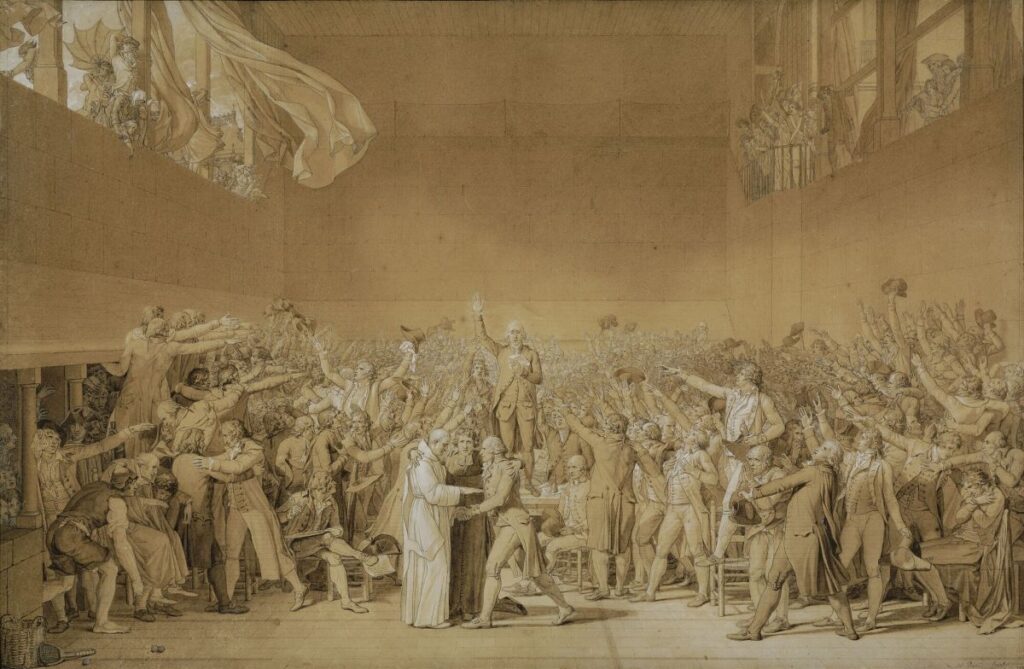
The Carnavalet drawing further references the June 1793 events through the inclusion of a trio, standing just behind the president of the Convention, that alludes not only to the tricolor flag, but more specifically to the “flag of skin equality” by Odo.[15] These figures evoke the unity of the races with one white, one mixed-race, and one Black figure. Although it is tempting to read these as a reference to the three deputies from Saint-Domingue present at the Convention on 16 Pluviôse Year II (4 February 1794)—Belley (Black), Mills (mixed race), and Dufay (white)—the Carnavalet drawing shows the Black individual as a woman. The fraternal embrace of 1793 is here displaced from Jeanne Odo to the individual who approaches the President from the right, possibly Belley. This clasp of “interracial fraternity” is repeated in the crowd of figures at the foot of the podium just to the left of a figure evoking Marianne, the personification of the French Republic, with her bare breast and Phrygian cap. These symbolic embraces recall the unifying gesture of the three religious figures in the foreground of Jacques-Louis David’s The Oath of the Tennis Court (Fig. 3). Indeed, as Lafont has recognized, the Carnavalet drawing’s composition in general references other interpretations of the Revolution, inaugurated by David and pursued by François Gérard in his The 10th of August 1792, which commemorates the violent storming of the Tuileries palace (Fig. 4).[16] However, Gérard’s drawing was submitted for the so-called concours de l’an II, a competition that sought to inspire moral regeneration through art, on 11 Prairial (30 May 1794), and was thus probably made after the Carnavalet drawing.

The drawings by David, Gérard, and Monsiau/Thévénin are all characterized by a temporal hybridity that can be described as contingent truthfulness or circumstantial accuracy.[17] To elevate contemporary events from the realm of “mere” reportage, each artist introduced historical inaccuracies that ennobled their subjects for future generations, in alignment with their training in the grand genre of history painting. They imbued their scenes with the knowledge of what came before and after. In The Oath of the Tennis Court, in the upper register of onlookers at right, David includes the journalist Jean-Paul Marat, reporting on 20 June 1789 for L’Ami du Peuple, a Revolutionary-era journal that Marat did not launch until September of that year.[18] Gérard’s depiction of the 1792 event is imbued with the hindsight of 1794; the royal family is seen cowering behind bars in the background. Similarly, in the Carnavalet drawing the artist conflates the incremental, symbolic steps that brought about the abolition of slavery with the representation of the proclamation itself. This composition does not integrate the aftermath of the proclamation—neither the festivities that immediately followed, nor the slower disintegration of the decree’s promise and ultimate reversal. These omissions suggest the drawing dates to soon after the February 4 declaration, when the erosion of its potential and eventual failure could not be anticipated.
The contingent truthfulness of this and other representations of Revolutionary-era events was intended to mitigate the unforeseen, and unforeseeable, reversals of an event’s implications. Instead, the period’s contingency has left its mark on the visual realm in the fragmented compositions and unfinished projects, with static representations being unable to keep up with the dynamic events of the Revolution. In its negotiation of fact and fiction, the Carnavalet sheet shares the problematics of contingent truthfulness or circumstantial accuracy with David’s unfinished and unfinishable precedent, The Oath of the Tennis Court. The goal was not to create a hybrid representation, but a fiction that passed as, and subsequently became, truth. For the artist of the Carnavalet sheet, the stakes were even more complicated.
Abolition remained controversial even on the eve of the decree. Despite the privileges outlined in the 1789/1790 Declaration of the Rights of Man and of the Citizen, the process by which they were granted to all citizens was slow and haphazard.[19] That the proclamation of abolition had dubious staying power in the eyes of artists is suggested by the event’s conspicuous absence as a subject from the projects that sought to visually codify the major events of the Revolution, such as the multi-edition Tableaux historiques de la Révolution française (1789-1802/1817).[20] Artworks inspired by the abolition, such as the oft-illustrated Moi Libre Aussi engravings by Louis Darcis after Louis-Simon Boizot, turned instead to allegory, which elevated the scene from momentarily relevant reportage. It offered artists a mode of protection—a cover for the rapid changes of political favor that often undermined the depiction of contemporary subjects, many of which, it turned out, lacked staying power.
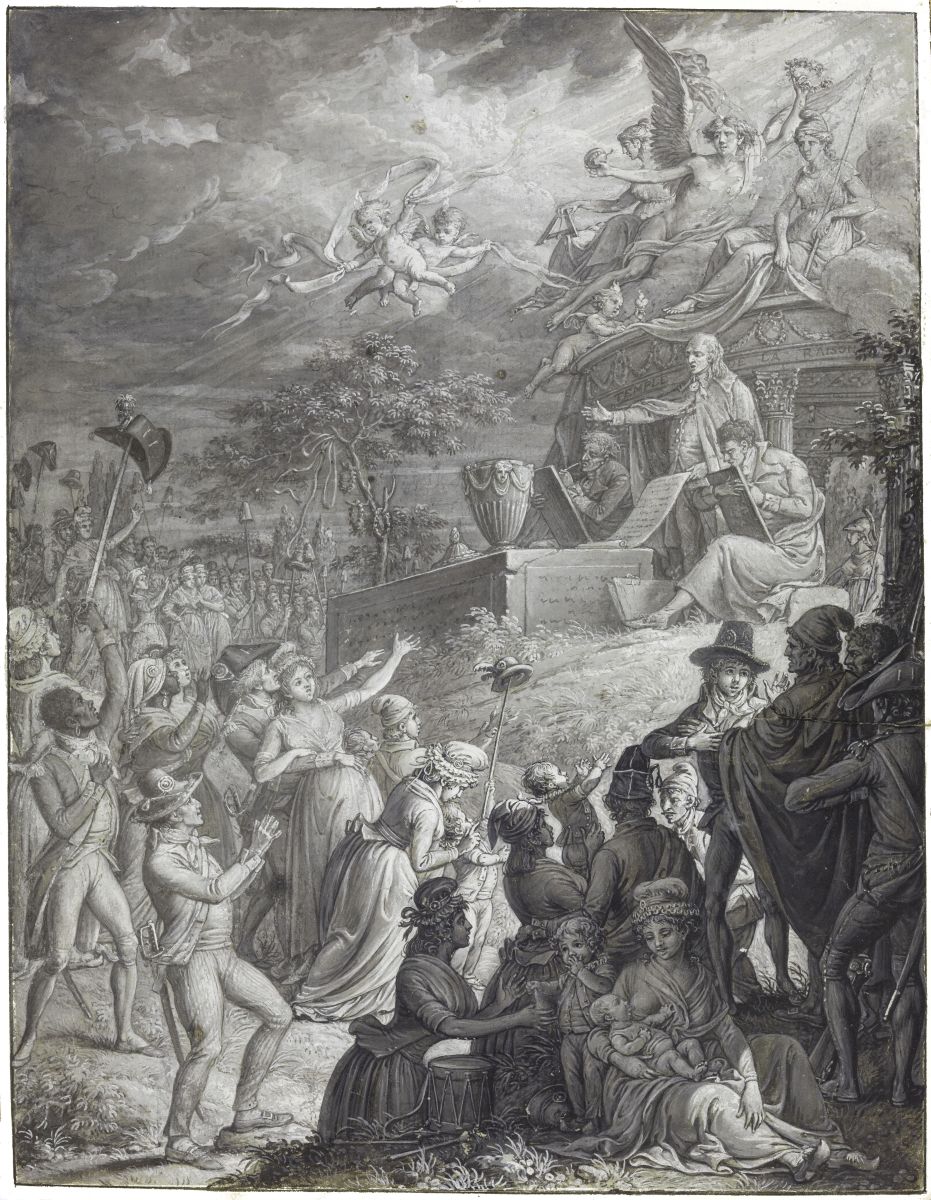
Nicolas Lejeune’s Rejoicing at the Announcement of the Abolition of Slavery 30 Pluviôse Year II / 18 February 1794 is the only other depiction that evokes the decree as a contemporary event (Fig. 5). However, it represents the public celebration organized by the Commune de Paris rather than the proclamation. The inclusion of allegorical figures transforms the scene into a more timeless subject, freeing Lejeune from having to offer a realistic transcription. Lejeune includes only two Black figures: Belley, in military uniform, and Lucidor Corbin, the Creole republican who gave a speech at the event.[21] The relative absence of Black figures in Lejeune’s composition inadvertently underscores that much of the Convention’s discourse about the importance of abolition focused less on the plight of the enslaved, but on the need for abolition to fully realize the potential of the French Revolution.
The Carnavalet drawing deliberately centers those freed by the 1794 proclamation. It is thus an attempt—like the decree itself—to give space and dignity to those who had fought so fervently for their liberty. Offering a vision of the event as History of the Revolution, the artist seized on a subject that might, in turn, inscribe him in the canon of great painters depicting great events. Amid rhetoric about the vital role of art in regenerating France, many artists—Thévenin and Monsiau among them—sought to insert themselves into the politically-charged project of not just transcribing but also crafting history through its representation. In this way, artists participated in the project of creating a new society by visualizing a shared history, even if those depictions were constructions of their own making.
Daniella Berman is a New York-based art historian specializing in the visual culture of eighteenth- and nineteenth-century Europe, and Director of Partnerships and Programs at The Drawing Foundation
[1] Deputies of the National Convention (1792-1795) rotated through the presidency in periods of roughly two weeks.
[2] Philippe Bordes in Perrin Stein et al., Jacques Louis David: Radical Draftsman (The Metropolitan Museum of Art, 2022), 197-99.
[3] Andrea Feeser, “When Blue and White Obscure Black and Red: Conditions of Wedgwood’s 1787 Antislavery Medallion,” Journal18, Issue 17 Color (Spring 2024), https://www.journal18.org/7244.
[4] Florence Gauthier, “The Role of the Saint-Domingue Deputation in the Abolition of Slavery,” in The Abolition of Slavery: From Léger Félicité Sonthonax to Victor Schoelcher, ed. Marcel Dorigny (Berghahn Books, 2003), 172.
[5] Pascal de La Vaissière in La Révolution française, le Premier Empire: Dessins du Musée Carnavalet (Les Amis du Musée Carnavalet, 1988), 101-2. The Musée Carnavalet online catalogue entry lists attributions to both Monsiau and Thévenin, although their most recent publication attributes the drawing solely to the latter. Frédéric Régent, “Abolition,” in Paris 1793-1794: Une année révolutionnaire (Paris Musées, 2024), 42-44.
[6] Claudette Hould, “Aux armes et aux Arts! La société populaire et républicaine des arts et le Journal de Détournelle,” Man and Nature / L’homme et la nature, 10 (1991): 47-56, https://doi.org/10.7202/1012622ar; Philippe Bordes et al., Aux armes & aux arts!: Les arts de la Révolution, 1789-1799 (A. Biro, 1988).
[7] Madeleine Pinault-Sørensen, “Le regard de quelques membres de l’Académie de Rouen sur les Noirs au temps des Lumières,” Les cahiers de l’histoire de des mémoires de la traité négrière, de l’esclavage et de leurs abolitions en Normandie, no. 2 (2009): 89.
[8] The public festival on February 18, 1794 celebrating the decree was not held at the National Convention. Caroline Crouin, “Étude scénographique des fêtes en faveur de l’abolition de l’esclavage en France (février – juillet 1794),” Annales historiques de la Révolution française 339 (January – March 2005), https://doi.org/10.4000/ahrf.2123
[9] Anne Lafont, L’art et la race: l’Africain (tout) contre l’oeil des Lumières (Les Presses du réel, 2019), 283.
[10] Darcy Grimaldo Grigsby, Extremities: Painting Empire in Post-Revolutionary France (Yale University Press, 2002), especially chap. 1; Lafont, Girodet (RMN, 2005); Sylvain Bellenger, ed., Girodet, 1767-1824 (Musée du Louvre éditions, 2005).
[11] The Republican calendar (often referred to as the Revolutionary calendar) was adopted until 5 October 1793.
[12] Gauthier, “The Role of the Saint-Domingue Deputation,” 169; Grigsby, Extremities, 21-22.
[13] “Notre union fera notre force.” Journal des débats, no. 260, 51, reproduced in Archives parlementaires, vol. 66, 56. This red, white, blue tricolor was approved by the Constituent Assembly on 24 October 1790; the order of the colors was reversed to blue, white, red, by a resolution on 27 Pluviôse Year II (15 February 1794).
[14] Shanti Marie Singham, “Betwixt Cattle and Men: Jews, Blacks, and Women, and the Declaration of the Rights of Man,” The French Idea of Freedom: The Old Regime and the Declaration of Rights of 1789, ed. Dale Van Kley (Stanford University Press, 1995), https://doi.org/10.1515/9780804788168-008; and Journal des débats, no. 260, 51. Abbé Grégoire used the terms “aristocratie de la peau” or “aristocratie de la couleur” (“aristocracy of color”). Gauthier uses “pigmentational aristocracy.” Gauthier, “The Role of the Saint-Domingue Deputation,” 169.
[15] Grigsby, Extremities, 14.
[16] Lafont, L’art et la race, 283-86. See Philippe Bordes, Répresenter la Révolution: les “Dix-Août” de Jacques Bertaux et de François Gérard (Fage, 2010).
[17] Daniella Berman, “The Aesthetics of Contingency: History and the Unrealized Paintings of the French Revolution” (Ph.D. diss., Institute of Fine Arts, New York University, 2023).
[18] Marat first used the title L’Ami du Peuple on September 16, 1789. On The Oath of the Tennis Court drawing, see Berman in Stein et al., Jacques Louis David, 182-90; Berman, “The Aesthetics of Contingency.”
[19] Singham, “Betwixt Cattle and Men,” 114-53.
[20] Claudette Hould, La Révolution par le dessin: les dessins préparatoires aux gravures des Tableaux historiques de la Révolution française (1789–1802) (RMN, 2008).
[21] Lucidor R. Corbin, Discours de la citoyenne Lucidor F. Corbin, créole, républicaine, prononcée [sic] par elle-même au Temple de la Raison, l’an 2e de la liberté (Coutubrier, 1793-1794), https://gallica.bnf.fr/ark:/12148/bpt6k566859.
Cite this article as: Daniella Berman, “Contingent Truths of the French Revolution: Representing the Abolition of Slavery of 1794,” Journal18, Issue 21 Revolutions (Spring 2026), https://www.journal18.org/8145.
License: CC BY-NC
Journal18 is published under a Creative Commons CC BY-NC International 4.0 license. Use of any content published in Journal18 must be for non-commercial purposes and appropriate credit must be given to the author of the content. Details for appropriate citation appear above.
