J. Cabelle Ahn
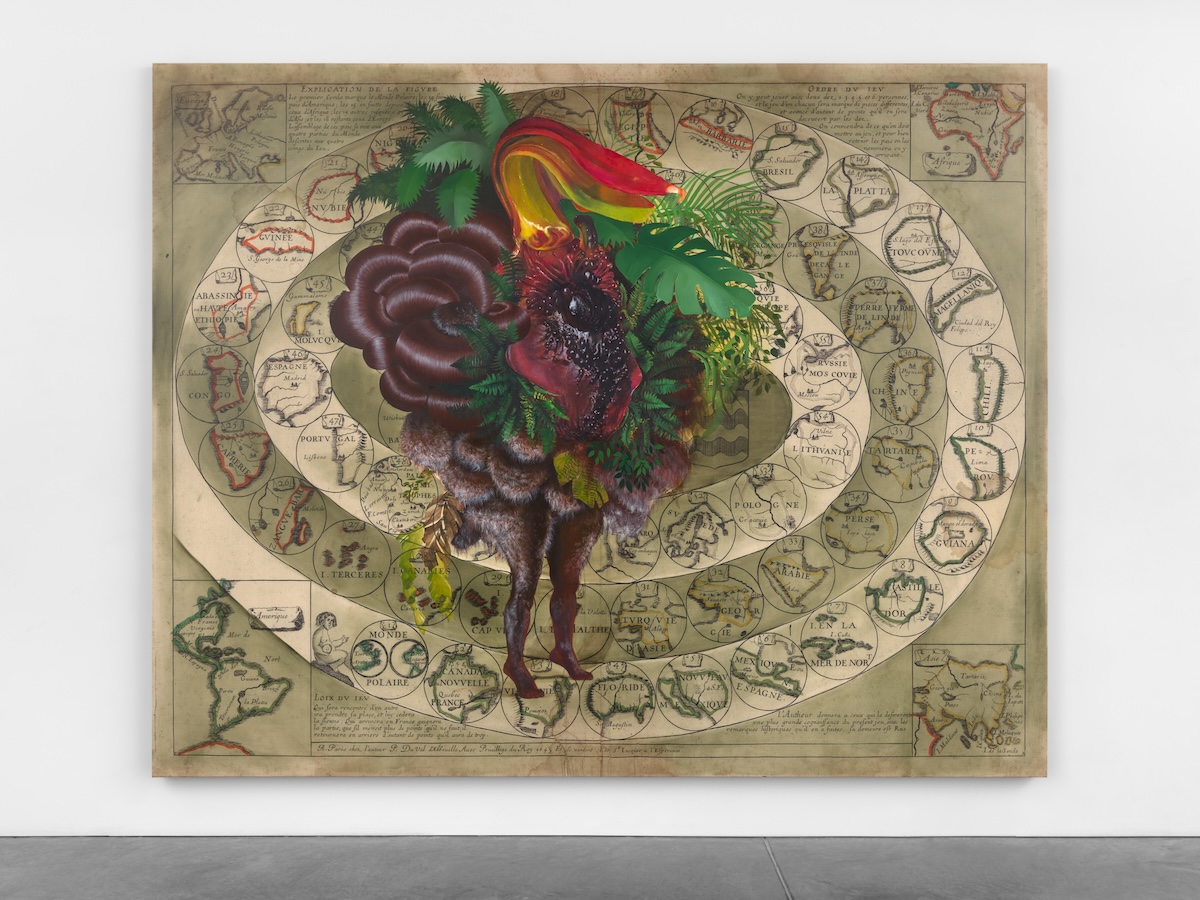
Firelei Báez is a New York–based artist of Dominican and Haitian descent whose practice excavates the ideological histories and material legacies that shape the Afro-Caribbean diaspora. Her paintings layer hand-painted, enlarged versions of seventeenth- and eighteenth-century British and French geographic games, maps, and charts—artefacts of the European Enlightenment that were themselves reliant on the exploitation of resources, lands, and peoples (Figs. 1-2).[1] Yet in her works, these colonial artefacts become secondary as colorful ciguapas (figures from Hispaniolan folklore) and exaggerated tignons (headwraps once required for Free Creole women under eighteenth-century Spanish rule) unfold across the maps.[2] These interventions recenter Caribbean oral traditions that, in turn, spotlight new modes of archiving historically underrepresented narratives.
Many of Báez’s works engage directly with the Haitian Revolution (1791–1804).[3] A Drexciyan Chronocommons (To win the war you fought it sideways) (2019, James Cohan gallery, New York) spotlit imagined portraits of Haitian Vodou priestesses whose revolutionary heroisms have been effaced from history. The installation incorporated a tarp overhang that referenced the night sky on the eve of the Haitian Revolution, projecting the terrestrial revolution into the celestial sphere.[4] Another series of installations at the Berlin Bienniale (2018), the ICA Boston (2021), and Art Basel (2023) reimagined the Haitian Palace of Sans-Souci (1806–13) as a weathered ruin (Figs. 3-4). Built by King Henry I Christophe—a leading general in the Haitian Revolution, and later King of the newly independent country—Sans-Souci combined tenets of classical design, neoclassical architectural idioms, and African cultural referents. Báez’s multimedia installations, in turn, reimagined a section of the palace in polystyrene foam, plywood, and resin, overlaying patterns drawn from West African indigo printing and Caribbean marine life to amplify the palace’s archipelagic memory.[5]
In a conversation with J. Cabelle Ahn for Journal18, Báez discusses her wide-ranging inspirations and how her practice engages the aftershocks of the Haitian Revolution across Hispaniola and the broader Caribbean diaspora.

The interview was conducted on Zoom on June 20, 2025. It has been condensed and edited for clarity.
J. Cabelle Ahn: Your work often incorporates historic maps and prints (Fig. 2). How do you see the relationship between these archival documents and the counter‑narratives imagined through your work?
Firelei Báez: I really want to articulate foundational spaces of meeting. As the [exhibition] Africa & Byzantium at the Met showed, we had a very interwoven globe—ideas, goods, and people moving between Asia, Africa, and Europe.[6]
My starting point was Saint‑Domingue, where I was born—and how that was such a global nexus. We’re so used to thinking of it as either a site of distress or a place for pleasurable escape. I wanted to counter that projected gaze with a different lived experience.
So the main use of historical documents is that they present themselves as fact, but they’re always projecting desire. My interventions project back what has been erased—the things that are missing from them to begin with.
JCA: Could you expand on the spatial aspect of revolutions, including the Haitian revolution, in your work?
FB: I like to remember that history is an artefact of the environment. They had this one riverbank in the Czech Republic that kept flooding.[7] They had done about a decade’s worth of city planning to create a dam. Then this set of beavers came and created the perfect dam in two days: flooding solved.
We’re so used to thinking of revolutions as breakdowns, but sometimes it creates the solution that you need to notice—like this stream that is technically following its memory, because water has memory. It’s about noticing that memory and how we can be in better alignment.
JCA: Édouard Glissant has written about water’s central role in Afro‑Caribbean memory, and his writings seem to influence your practice.
FB: Absolutely. Glissant and [The Epic of ] Gilgamesh are such throughlines for me. The Gilgamesh is so much about the flood, and acknowledging that, at a cellular level, we are made of this water. Glissant takes in the entire globe to say that the ocean that we often think of as [an] isolating factor is actually our connector—our throughline.[8]

JCA: What inspired the installation based on the Sans‑Souci Palace (Figs. 3-4)?
FB: I grew up in Dajabón, a short bus ride from Cap‑Français (now Cap‑Haïtien) where Sans‑Souci is. It’s a beautiful UNESCO World Heritage site that people rarely get to see.
The naming of the palace [“Sans-Souci,” or “Carefree] was such a declaration—an even stronger revolutionary act than the fortress’s hyper‑alertness. It was a place of new beginning, a place of acculturation, where they had printing presses. I was also appreciative that it was primarily a woman’s space: for [Queen] Marie-Louise and her two daughters.[9] A place of, if anything, enlightenment and carefreeness—Sans Souci.

JCA: You additionally chose to depict the women of Sans-Souci—Améthyste and Athénaïre Christophe—as silhouettes (Fig. 4).[10]
FB: Portraiture and access to portraiture are such fascinating things. The painter [Richard Evans] who painted George IV was commissioned by King Henri Christophe for a portrait of himself and his son [Prince Jacques-Victor-Henri]. But there were no portraits of Marie Louise and her daughters. There’s this absence that marks itself—a historic silhouette is already there.
It would also be facetious to paint an “accurate” portrait of them, so I was hoping to invoke the nuance of their interior selves. I love this one tapestry series in the Vatican where the eyes of the central figure, Jesus, follows you everywhere. I incorporated eyes into the portraits in such a way that they follow you no matter where you stand in the room.
In a way, when we look at portraits, they become a place of consumption— the viewer is ravenously looking and consuming the bodies. I wanted a space of active engagement—a “regarding back”—actively just as they were active in history.
Part of the reason why I use silhouettes is because of Casta painting in Latin America where every part of the body is articulated to place you within a caste and culture. As someone existing between cultures, you have to negotiate both: a hyper-articulated self and the psychic violence of an essentialized self. What’s a Venn diagram that lets you escape from both? And I thought focusing on that interiority was one escape route.
JCA: What about scale? To me, your work notably shifts scales—from one-to-one translations of historic prints to wall-sized paintings.

FB: I was originally interested in a very physical transformation of history. Wherever I visited a city, I would visit used bookstores because they would be repositories of whatever was divested by institutions. Usually these might take you to very fraught places, from eugenics to different industries that would have dehumanized whole lineages. I would mark that act of divestment into an act of realignment by making seductive marks to bring the viewer closer. In that act of close regard, they would leave a bit of their breath, physically transforming that book page, map, or indexical object. That depositing of breath, for me, was the actual work (Fig. 5). Irrespective of where you were coming from, you could then anchor yourself from one place and connect to another.
I then thought of exploring that global look in a singular frame. I was always fascinated by wall-sized maps in tactical war rooms or places like the Royal Palace or the Vatican to project desire onto a territory.[11] I wanted to engage on the same terms, so I would choose one of the documents and reproduce it at large scale. I would then place them on the floor and pour pigment, salt, and water, almost like an ablution.
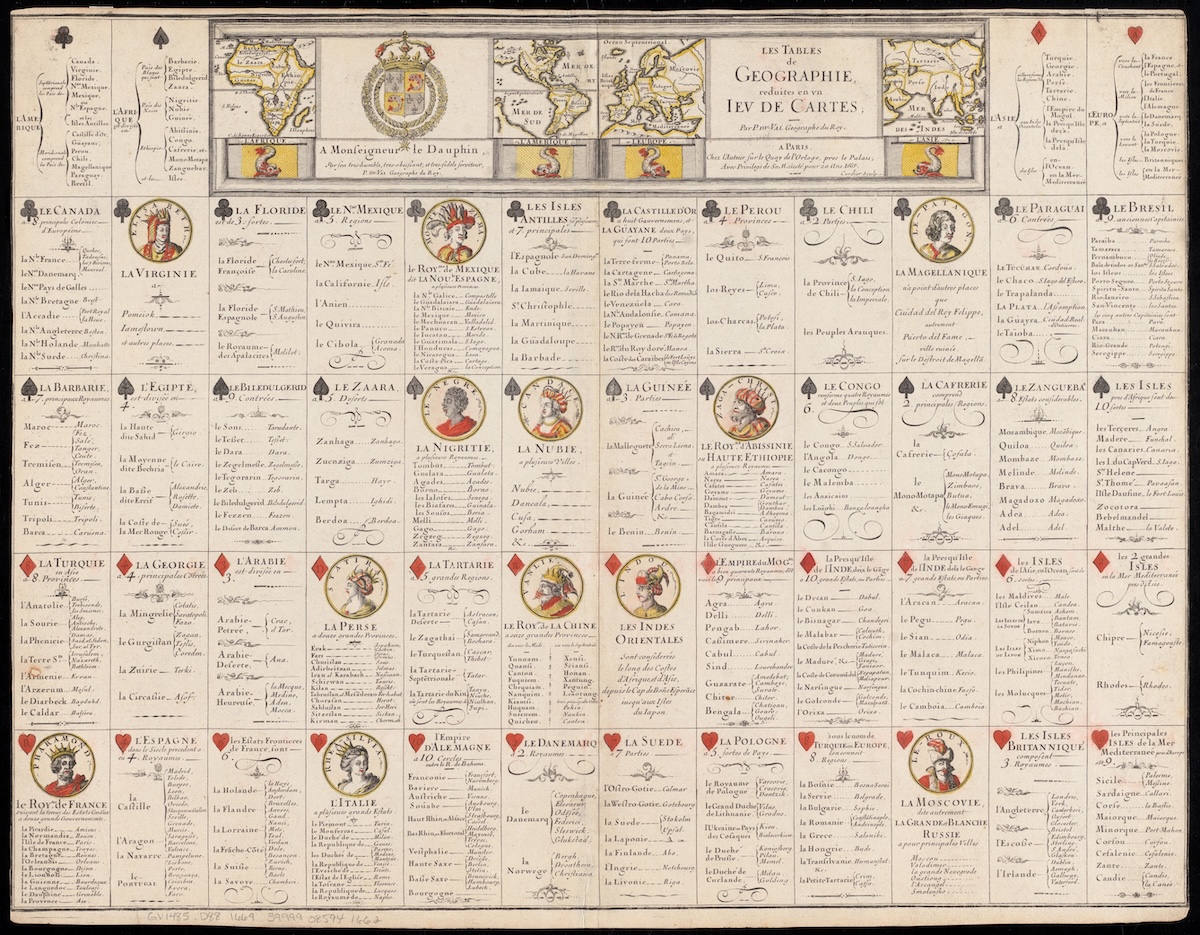
One favorite was a deck of cards created for the Dauphin of France, to learn geography, but also to play at colonization (Fig. 6).[12] I was at a residency at the American Academy in Rome, where you saw every horse from Augustus to Caravaggio, that were always bridled, controlled by human intervention. When I poured [the paint] on that diagram at the academy, I saw at least a hundred unbridled horses (Fig. 7). That was something I could never have planned.
And because paint takes a while to dry, I would leave my windows open and dragonflies would come… it’s almost like an archeological artefact and if you look closely, you’ll find all kinds of flora and fauna from Rome at that time.

JCA: I want to end with essentializing tendencies in the art world, such as terms like Chinoiserie or “the tropics” that can flatten an entire geography into a typology.[13] What strategies can push back against this urge to generalize?
FB: One way that I tend to respond is to become hyper interior and to allow the viewer in on their assumptions and have those assumptions be completely dismantled the closer they look. Not an anchorless void, but a place of navigation and connection.
A thing that to comes to mind is that what happens to the least of us happens to all of us. In this idea of creating a “least,” you’re also reducing the capacity for the “most.” Aimé Césaire and Suzanne Césaire spoke of a more articulated way of being that is more generous and more capacious than this need for control.
Sometimes control is like a map that provides so many blind spots. Instead of limiting ourselves to this idea of an essentialized and flattened mode of navigating, we can make a more sensuous and capacious way of being in the world that’s more generous to all of us.
The exhibition Firelei Báez is on view at Museum of Contemporary Art Chicago through May 31, 2026. She will additionally have a solo show at Hauser & Wirth, New York from May 12–July 31, 2026.
J. Cabelle Ahn, PhD, is a New York–based independent art historian and writer focusing on seventeenth- and eighteenth-century French art and contemporary artists inspired by the old masters
[1] For more on maps, geography, and imperialism, see David Buisseret, Monarchs, Ministers, and Maps: The Emergence of Cartography as a Tool of Government in Early Modern Europe (University of Chicago Press, 1992); J. Cabelle Ahn, “Geography,” in Dare to Know: Prints and Drawings in the Age of Enlightenment, ed. Edouard Kopp, Elizabeth Rudy, and Kristel Smentek (Yale University Press, 2022), 78-84; Stephen J. Hornsby and Hope Stege, Surveyors of Empire: Samuel Holland, J.W.F. Des Barres, and the Making of the Atlantic Neptune (McGill-Queen’s University Press, 2011).
[2] Katy Siegel, “A Space for Reassessing the Present,” in Firelei Báez, ed. Eva Respini (DelMonico Books, 2024), 17-25.
[3] See also Michel-Rolph Trouillot, Silencing the Past: Power and the Production of History (Beacon Press, 1995); David P. Geggus, The Impact of the Haitian Revolution in the Atlantic World (University of South Carolina, 2001); Marlene L. Daut, The First and Last King of Haiti: The Rise and Fall of Henry Christophe (Knopf, 2025).
[4] Daniella Rose King, “An Otherwise World Order: A Drexcyen chronocommons (To win the war you fought it sideways),” in Respini, Firelei Báez, 113-117.
[5] The name of the palace has been debated: once compared to Frederick the Great’s palace at Potsdam (since debunked by Peter Minosh, Cameron Monroe, and Louis P. Nelson), it has also been read as a reference to Jean-Baptiste Sans-Souci, one of Christophe’s rivals during the Haitian Revolution, or simply as a nod to the site’s bucolic setting. Gauvin A. Bailey, The Palace of Sans-Souci in Milot, Haiti (ca. 1806-1813): The Untold Story of the Potsdam of the Rainforest (Deutscher Kunstverlag, 2017), 75-79, 119-137; Louis P. Nelson, “Neoclassicism, Race, and Statecraft across the Atlantic World,” Journal of the Society of Architectural Historians (2024) 83 (3): 332-334, 339n76.
[6] Andrea Myers Achi, ed., Africa and Byzantium (The Metropolitan Museum of Art, 2023).
[7] Livia Albeck-Ripka, “Czech Dam Project was Stalled by Bureaucracy. Beavers Built Their Own,” New York Times, February 12, 2025, www.nytimes.com/2025/02/12/world/europe/beavers-prague-czech-republic-dam.html (accessed February 5, 2026).
[8] Édouard Glissant, Poetics of Relation, trans. Betsy Wing (University of Michigan Press, 1997). Báez’s exhibition, “The fact that it amazes me does not mean I relinquish it” at Hauser & Wirth LA (September 13, 2024–January 5, 2025) took its title from Glissant’s Poetics of Relation, and the show explored Glissant’s concept of opacity.
[9] Firelei Báez, “2. Marie Louise Christophe” in Women and Migration(S) II, ed. Kalia Brooks, Cheryl Finley, Ellyn Toscano, and Deborah Willis (OpenBook Publishers, 2022), 19-23.
[10] For Báez’s previous discussion of silhouettes, see Maria Elena Ortiz, “A Future Yet to be Unfolded,” in Firelei Báez: Bloodlines, ed. Maria Elena Ortiz (Pérez Art Museum Miami, 2015), 11-19; Asma Naeem, ed., Black Out: Silhouettes Then and Now (Princeton University Press, 2018).
[11] On wall maps see Francesca Fiorani, The Marvel of Maps: Art, Cartography and Politics in Renaissance Italy (Yale University Press, 2005).
[12] On geographical games, see Diane Dillon, “Consuming Maps,” in Maps: Finding Our Place in the World, ed. James R. Akerman and Robert W. Karrow (University of Chicago Press, 2007), 289-343; Adrian Seville, Thierry Depaulis, and Geert H. Bekkering, Playing with Maps: Cartographic Games in Western Culture (Brill, 2023).
[13] See Naima J. Keith and Firelei Báez, “Firelei Báez, In Conversation with Naima J. Keith,” in Firelei Báez: Bloodlines, 24-25.
Cite this article as: J. Cabelle Ahn, “My interventions project back what has been erased”: Firelei Báez in Conversation with J. Cabelle Ahn,” Journal18, Issue 21 Revolutions (Spring 2026), https://www.journal18.org/8094.
License: CC BY-NC
Journal18 is published under a Creative Commons CC BY-NC International 4.0 license. Use of any content published in Journal18 must be for non-commercial purposes and appropriate credit must be given to the author of the content. Details for appropriate citation appear above.
