Thomas Crow
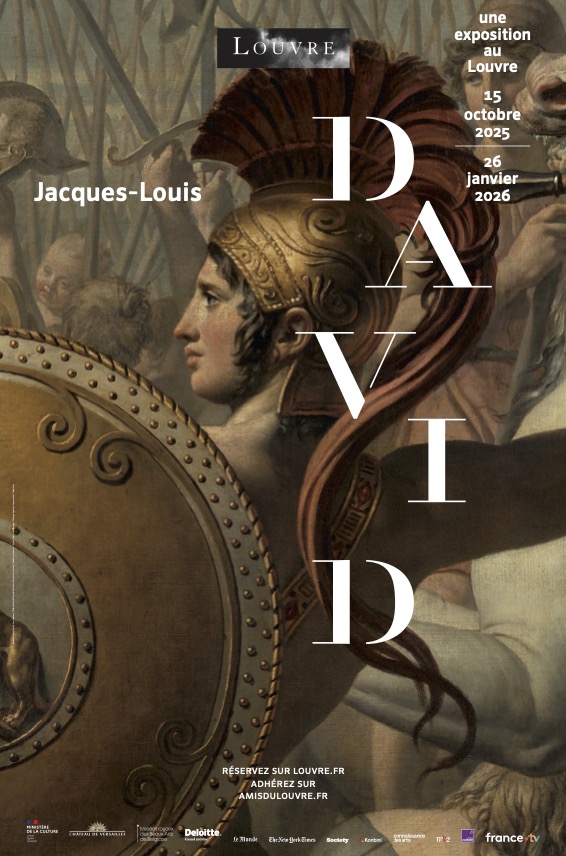
Jacques-Louis David, sous la direction de Sébastien Allard (Paris, musée du Louvre), 15 October 2025-26 January 2026
Retrospective exhibitions devoted to Jacques-Louis David (1748-1825) have recurred at the Louvre on a roughly regular pattern. The modern cycle commenced in 1948 on the bicentennial of the artist’s birth, just four years after the Liberation of Paris. Even amid the colossal demands of recovery and reconstruction, the tribute unfurled itself across multiple venues encompassing both Paris and Versailles.[1] At that juncture, suffused with national pride in the Resistance, historical memory of the Great Revolution as indeed great prevailed without serious contestation. Morgane Weinling writes in the catalogue of this latest retrospective, “David was the subject of a militant rehabilitation on the part of communist artists and intellectuals at the time when the French Communist Party had become the leading party in the legislative elections of 1946.”[2] Realist painter André Fougeron joined Agnès Humbert, art historian and former member of the resistance network in the musée de l’Homme, in publicly demanding “Justice pour Louis David.”
No such ringing rhetoric, however, attended the next David retrospective, mounted in 1989 amid the national commemoration of the two-hundredth anniversary of the Bastille’s fall and the defiant declaration of the Rights of Man and Citizen by the delegates of the Third Estate.[3] The resurgent political Right of the 1980s, heralded abroad by Thatcher and Reagan, proved ready and waiting to sully the occasion. One reactionary current flowed through Revolutionary historiography, as retooled Cold-War antagonism toward once-dominant Marxist scholars authorized disparaging liberty, equality, and fraternity as little more than alibis for murderous infighting and vengeance. In the very year of that great Revolutionary anniversary, of course, the Berlin Wall fell as decisively as the battlements of the Bastille once had done, upending for the moment the automatic equation of the Left with totalitarianism. A splendid multi-day symposium aptly titled David contre David, overseen by Régis Michel with his customary acumen, successfully enlarged the parameters of discussion while allowing an emergent, international generation of art historians to be heard in the Louvre.[4]
That cohort too has by now reached retirement age, another thirty-six years having elapsed until last year’s bicentenary of David’s death offered the occasion for another gathering together of David’s actual legacy. It may be coincidence or some underlying historical rhythm that aligns the present retrospective with another political inflection point driven by a resurgent political Right. But this appears not to have cast David under the sort of ambivalent suspicion that prevailed in 1989.
Why not? Firstly, the new rightists of our time seem less enamored by laissez-faire capitalism and more drawn themselves to violent insurgency, against which the Left is taking to the streets in self-defense. If one searches for a contemporary reign of terror, no need to look further than the streets of Minneapolis as I write these words. Advocates for universal rights in France are mounting parallel protests against deaths of oppressed immigrants at the hands of the authorities, further undermining the precarious stability of Macron’s regime.
Their cause finds its closest Revolutionary analogy in the often overlooked “petite terreur” that unfolded during the summer of 1791. Ordinary citizens, 50,000 strong, had gathered on the Champ de Mars to sign a petition against the reinstatement of the King after his treacherous attempt to flee France, only for them to be fired upon and ridden down by National Guard cavalry under Lafayette’s command. Anyone afterwards overheard disparaging the Guard was in danger of arrest; the future leaders Danton and Desmoulins, who had promoted the petition, found themselves forced into hiding. In this instance, it was the republicans on the receiving end of fierce retribution from the partisans of monarchy. What was more, the offending demonstrations had begun on the second anniversary of 14 July 1789.
This landmark Louvre exhibition, years in the making, would hardly have leaned into such correspondences, any more than it would have abrogated norms of institutional decorum where anything topical is concerned. Nor will there be a stock-taking symposium on the order of David contra David to pick up the slack, a void for which the museum’s straitened finances and recent mishaps may be responsible. But the exhibition offered the compensation of clarity in apprehension of those works it could fit into the temporary exhibition space on the Louvre’s ground level. To see major paintings in good light and revealing proximity, set apart from the river of humanity that courses upstairs through their customary galleries, encouraged fresh thoughts and feelings about them.
And it seemed remarkable just how much could fit into the available space. One thinks of the foundational Oath of the Horatii (1785) as immense in its dimensions, but it nestled comfortably into its assigned place, as did the even larger Intervention of the Sabine Women (1799), the titanic realization of the artist’s prison meditations (Fig. 1). These two landmark works anchored diagonal corners of the galleries’ H-shaped footprint, the opposite axis joining at opposite ends a rare exposure of the one large, unfinished panel of the Oath of the Tennis Court (1790-91) with David’s over-ingratiating swansong from Brussels, Mars Disarmed by Venus (1821).

Each corner had its distinct story to tell, with the zone around the Horatii advancing a paradoxical thesis at the outset. Perhaps the most remote word prompted by that stern canvas would be tenderness. Yet the repositioned painting tugs at that emotion while altering the gender economy reflexively adduced in every exegesis, i.e., that the tautly alert male figures commandingly set themselves off from the subordinated, overcome women in the lower right; the limbs of the men extend themselves across the canvas in stark graphic outline, while their female counterparts collapse into a compressed mass. But the standard inference of enforced gender hierarchy did not entirely hold up here. The fact that one could so closely approach the figures of the Alban Sabina, wife to the leading brother Publius, and his sister Camilla, betrothed to one of Alba’s champions, lent them a fully commensurable presence. And thus it was with their implicit claims for peace, kinship, and affective bonds, the last personified in the children sheltered by their nurse, who fill the wedge between the women and the men.
It can nonetheless be said that David’s painting wants to have it both ways. He pursued the hard alternative in two related drawings, one showing Publius Horatius, lone survivor of the six combatants, murdering his bereaved sister Camilla for the offense of mourning her slain fiancé; in a second sheet, their father defends the crime before the assembled Roman crowd, the perpetrator brazenly defiant behind him. But the Horatii hung amid an entourage of no less than four treatments of Belisarius Begging Alms, two of them earlier versions by David’s chief rivals Peyron and Vincent, an iconographic wave cresting as he prepared the most imposing interpretation of the subject to serve as his moreau d’agrément of 1781. Belisarius, having been the premier general in service to the conquering emperor Justinian, is brought low by envious intrigues at court, blinded and condemned to an impoverished, mendicant exile. Thus the boy who guides him becomes master to the once triumphant commander, the natural generosity of a grateful old soldier or kind female passerby figuring a superior basis for human thriving through natural sympathies that cross social boundaries and repair injustices. That canvas occupied a wall adjacent to the Horatii, its implicit allegory a riposte to any unforgiving warrior ethos.
David himself, having regularly been excoriated as a prop to tyranny, takes on an analogous identity in this retrospective as devotee of family and friends. The abundance of portraits in the exhibition testify to his rich array of familial ties and friendship networks (Fig. 2). Arriving at the opposite corner of the H-shaped plan, the visitor encountered in the Intervention of the Sabine Women a contrary anticipation of the story in the Horatii. The latter’s tight dyad of kinship and combat between intermarried, symmetrical families (each has triplet sons) had been preceded by the struggle for survival between whole male populations, Roman and Sabine, with the women playing a double part as wives for both in turn. Precariously sheltered by the interlaced female bodies at the center of David’s composition, naked children find protection and nurture amid the battle. Thus the exhibition itinerary tracks from the male triumph and human ruin of the Horatii to the foundational, enduring reconciliation between antagonists, without which (in legend) Rome would not have come to be.

The visitor at that point will have passed David’s own myth-making applied to the formation of a unified French polity: his disparate iterations of the Oath of the Tennis Court, the occasion in June 1789 when the deputies of the Third Estate, by far the most populous but least privileged order, staked their claim to represent the whole of the nation, subsuming the nobility and clergy under their egalitarian aegis. They pledged not to disband until they had achieved a constitution for the “kingdom,” this polity still imagined as requiring a monarch. The attempted flight of the royal family exactly two years later, followed by the Little Terror of the Champ de Mars, put paid to that assumption. So it would irredeemably divide the mass of deputies whom David had so intricately and meticulously assembled in his presentation drawing of the subject. He would embark on the impossible effort to scale up the sheet to figures of life size on a joined array of canvases; but had barely gotten underway when turncoats and apostates began revealing themselves, such that he gave up on even the one panel, abandoned as isolated portrait heads floating over an armature of ghostly nude outlines.
As that affecting relic normally lives in the rarely accessible attic of Versailles, it was revelatory and entirely germane to see it mark the major intervening station in the exhibition plan. One followed the trail of personal likenesses that filled out David’s world to be brought up short at that grand amalgam of historical scope and private personality, the artist playing with spirit at both ends of the scale. The one example chosen from the sittings arranged for individual deputies was the deft profile in oil of military man Dubois-Crancé. Whether intentional or not, the marked presence of this figure bears an important link to the heart of the retrospective, in that Dubois-Crancé was one of the few deputies of the Convention, joining David himself, who cultivated and enjoyed the company of Jean-Paul Marat.
*
The dimensions of Marat at His Last Breath, David’s renowned memorial canvas of 1793, are unremarkable, such that it can seem retiring in its home gallery at the Brussels Royal Museum. But various stratagems by the Louvre had the assassinated Friend of the People looming as large or larger than any other work in the show. At the exhibition entrance, slot-like windows allowed tantalizing glimpses of the Marat image hung against dark walls. But one landed in the bright exhibition concourse just described, so that fulfilling one’s initial glimpse came only after a certain preparation and delay. And that initial sight turned out to have been something of a feint, as the visible images were two contemporaneous replicas by pupils held in the French museum system, the better one from Versailles, the second belonging to the Louvre itself. The centralized, incomparable original faced inward toward its progeny. That was a great deal of space to expend on copies in a tight hang that entailed significant omissions elsewhere (the caprice drawings from Brussels being the most serious omission, while incorporating the Brutus would not have been impossible). It seemed as if the unassertive size of the martyr portrait prompted its multiplication in such a way that a viewer in the center of the room would never not be confronted by a Marat.
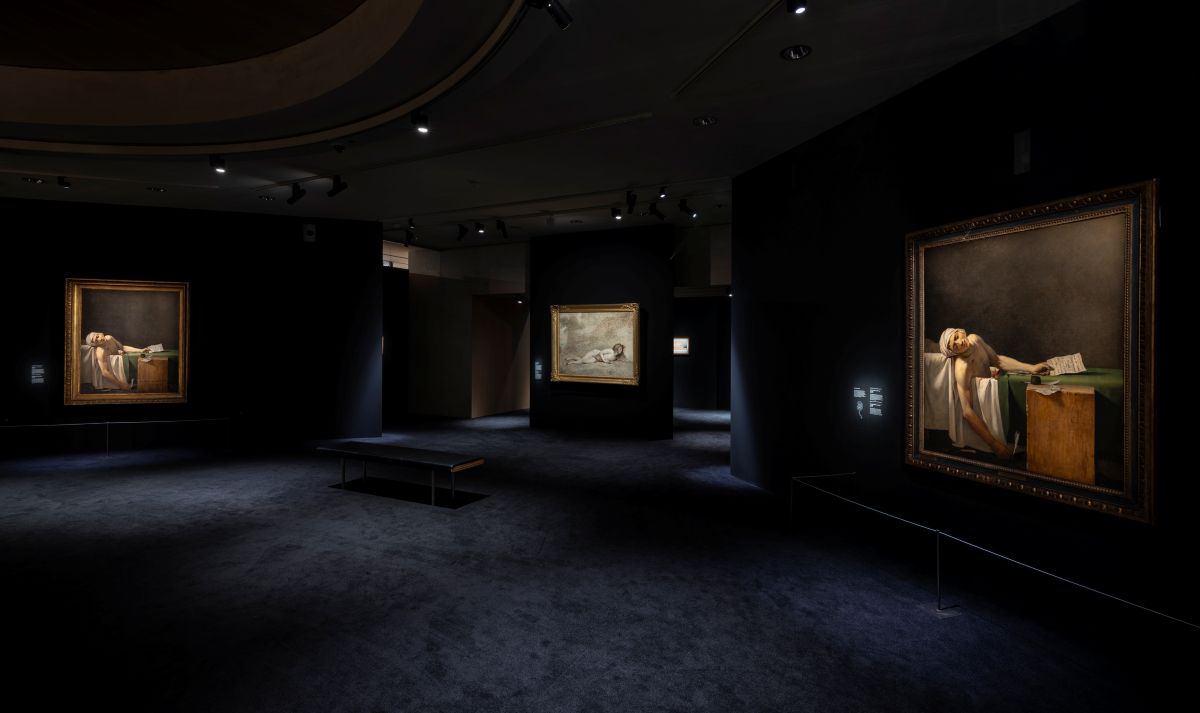
On reaching this inner shrine, intimations of ritual progress in the outside galleries became almost cult-like. The dark, crypt-like enclosure incorporated another murder portrait: the figure of Joseph Bara, boy-martyr from the civil conflict in the Vendée, twists horizontally in naked, prone distress in a way that closed the circuit of revolutionary sacrifices (Fig. 3). And it was here that the organizers chose to present David, the man, via two flanking self-portraits. Entering from one side, visitors came face to face with the artist’s guise in the fraught year 1791 via the self-portrait from the Uffizi. Its pose and dress befitting a confident man of the world comes partly undone in the fixated gaze and flyaway powdered hair, the complexion mottled and muted by grey underpainting. The porous scumbling around his bust-length likeness moreover anticipates the tissue of non-descriptive marks that seem to press down on the head and shoulders of the moribund Marat. By the other portal hung the famous self-portrait painted during the artist’s initial imprisonment post-Thermidor, in which he paradoxically appears to have grown younger, endowed with ruddy cheeks and thick russet locks, his body enveloped in the outsized greatcoat required for warmth that autumn (Fig. 4). The staging of this inner sanctum thus served to join the identities of the artist and his most charismatic portrait subject.

So pointedly to insist on Marat as the effective centerpiece of the exhibition happened to converge with the publication of much the most serious biography in English, Keith Baker’s impressive Jean-Paul Marat: Prophet of Terror, weighing in at 930 pages. Baker’s approach is not quite the life-and-times that one might expect, at least after 1789 closes his Swiss-born subject’s peripatetic career in science and medicine across multiple European centers. Then commences Marat’s storied vocation as a (if not the) journalist of the Revolution, publishing his intransigent sheet L’Ami du Peuple nearly every day, building on the views propounded in his polemical 1774 treatise, Chains of Slavery. Reviled and regularly proscribed as criminally inflammatory, his running commentary on the unfolding of events takes on a revelatory lucidity in Baker’s close-grained account. And one comes away with an appreciation for just how often his subject was right.
Few apart from Marat, for example, were so trenchantly insightful as to how the preservation of Louis XVI’s role as sovereign by the first National Assembly would negate anything resembling popular sovereignty. Nor was that outcome inadvertent, as was demonstrated when attempts to put such sovereignty into practice on the Champ de Mars led to slaughter of the petitioners. The least surprised person in Paris would have been Marat. In keeping with that prescience, the following year saw him emerge as the most unwavering opponent of the war party in the Assembly. Baker’s content hews closely to parliamentary proceedings and Marat’s running commentaries, before and after he was himself elected to the Convention following the downfall of the King in August 1792. But the amalgam of the two adds up to a survey history of the period that makes others seem hasty and over-generalized. And that comes down in part to trust in the acuity of his chief informant, Marat himself.
This granular narrative can only proceed, of course, so long as its chief informant is alive. Baker brings the book to a rather abrupt close after his protagonist’s death in July 1793 at the hands of the assassin Charlotte Corday. Which brings the present essay to the point where its author must switch to the first person and acknowledge his own part in this Marat-centric moment. Not two weeks before the publication of Marat: Prophet of Terror, my own much slighter volume appeared under the title, Murder in the Rue Marat: A Case of Art in Revolution, which dilates on the moment that brings Baker’s account to its close. Journal18’s editors kindly invited me to reflect on the book in relation to the Louvre retrospective. And one of its themes is indeed the pattern of David’s undying portrait of the martyr periodically making itself felt at conjunctures like the one that has seemingly just coalesced, evidenced in the hypertrophy of multiplied Marats in the Louvre exhibition coinciding with Baker issuing a biography on the epic scale and quality that its subject has always demanded. While the Louvre curators and Baker’s publisher may have been aiming at 2025, however, that could hardly have been the case for my contribution, as its origins lay decades before in the wake of a much earlier dramatic surfacing of the Marat imago.
*
The catalyst and centerpiece of that Marat moment lay in Peter Weiss’s 1964 drama, The Persecution and Assassination of Jean-Paul Marat as Performed by the Inmates of the Asylum of Charenton under the Direction of the Marquis de Sade (habitually abbreviated as Marat/Sade). Sade indeed wrote and staged plays while confined in that asylum, with Weiss taking full advantage of the fact that well-off Parisians were invited to witness these productions. The scenario supplies such an audience, complacent at the start only to be overwhelmed in panic at the end as the inmates, aroused by Sade’s exhortations to “Revolution … Copulation,” break through the proscenium and must be suppressed by the attendants in a violent melee. By way of Peter Brook’s direction of the London production and subsequent 1967 film, that call for valorizing every medicalized mental condition landed in the counterculture with a galvanizing impact largely forgotten today. One London writer declared that Brook’s staging “launched the fringe and alternative theatre in this country, representing an intersection between European theory and new British radicalism,” going so far as to claim, “It changed the lives of most people who saw it.”[5]
Its message and affect flowed directly into the generalized rebellion that erupted over the course of 1968. It was my good fortune to have been in Paris as a young student when the May events broke out, but it was one coincident, unseen activity that would have an outsized impact on my future. Roland Barthes had convened a seminar devoted to the painstaking breakdown and analysis of a single story by Balzac, his Sarrasine of 1830, set in the milieu of the French Academy in Rome during the eighteenth century. That the tale revolves around castration, cross-dressing, and sexualized murder aligned its themes with the core concerns of the leading semiotic and psychoanalytic theoreticians of the day, which Barthes and his students put to the service of dethroning hidebound literary authority. And they were doing so while meeting throughout the May événements.
The outcome of their deliberations appeared in 1970 as a concise volume enigmatically titled S/Z, which became the template, so I imagined when still in graduate school, for evading the decrepit, unreflective procedures that still defined the discipline I was trying to enter.[6] Why not address a single work, one just as compressed and symbolically dense as the story Barthes had chosen? Marat at His Last Breath more or less appeared before me of its own accord. While I had seen the painting in the course of my undergraduate travels, its apparition as the answer to my procedural query surely had most to do with Marat/Sade and its multiple repercussions through the channels of the counterculture. I then possessed small comprehension of the moral complications at the heart of Marat’s historical existence, which Weiss and Brook had so well understood. I saw mainly the orderly simplicity of its structure constraining its core of gendered violence. The spare parsimony in every aspect of its dignified arrangement seemed to call out for dismantling and re-arrangement as a way of breaking its silence.
Barthes’ seminar had reconfigured Balzac’s linear narrative into simultaneous, tabular order, every phrase classified and grouped according to the particular ideological codes by which it is governed. But how to unbundle and reconfigure an already atemporal array of signifiers that make up a painting? My thought, then and now, was that a pictorial work of art conversely needs breaking down into a linear sequence of partial versions, each clearly manifesting a particular coded operation normally obscured by the overriding effect of pictorial unity. The outcome would be a series or gallery of incomplete tableaux, each to be completed by launching a line of verbal inquiry into its historical, aesthetic, even philosophical implications. I went so far as to propose this endeavor as my doctoral dissertation, but was sensibly urged by my advisors first to inform myself about eighteenth-century French art, a lifelong task that saw the Marat project fall by the wayside, that is, until some long-delayed conjuncture of circumstances again brought it forcibly back to mind. Framed by the perennial Marat, another telling of the French Revolution emerged, as each portion of code in the painting pointed toward an excursion into one more interwoven strand of historical events. While there are narrative histories of the Revolution beyond counting, this one at least differs from the rest by allowing David’s painting, which was made from the Revolution, to disclose in the present at least a portion of what it captured and preserved from the living experience of 1793.
Thomas Crow is Rosalie Solow Professor of Modern Art at the Institute of Fine Arts in New York, NY
[1] David: exposition en l’honneur du deuxième centenaire de sa naissance, ed. Michel Florisoone (Éditions des musées nationaux, 1948).
[2] Morgane Weinling, “David après David, 1825-2025,” in Jacques-Louis David, ed. Sébastien Allard (Musée du Louvre: Éditions Hazan, 2025), 337.
[3] Jacques-Louis David, ed. Antoine Schnapper, Arlette Sérullaz, and Elisabeth Agius-d’Yvoire (Éditions de la Réunion des musées nationaux, 1989).
[4] David contre David: actes du colloque organisé au Musée du Louvre par le Service culturel du 6 au 10 décembre 1989, ed. Régis Michel (Documentation française, 1993).
[5] Michael Coveney, “Marat/Sade: The play that began a stage revolution,” The Independent, 3 October 2011 (accessed February 12, 2026).
[6] Roland Barthes, S/Z (Éditions du Seuil, 1970).
Cite this article as: Thomas Crow, “Jacques-Louis David at the Louvre with Keith Michael Baker, Jean-Paul Marat: Prophet of Terror: A Review,” Journal18, Issue 21 Revolutions (Spring 2026), https://www.journal18.org/8144.
License: CC BY-NC
Journal18 is published under a Creative Commons CC BY-NC International 4.0 license. Use of any content published in Journal18 must be for non-commercial purposes and appropriate credit must be given to the author of the content. Details for appropriate citation appear above.
