Robert Horvath’s Room for the Lost Paradise forms part of a larger exhibition at the Indianapolis Museum of Art titled Resplendent Dreams: Reawakening the Rococo, which showcases the work of three contemporary queer artists who take inspiration from early 18th-century European art. Also featured is Arkansas-based multidisciplinary artist Anthony Sonnenberg,…
Reflections on Mai, Joshua Reynolds, and Eighteenth-Century Art — A Roundtable
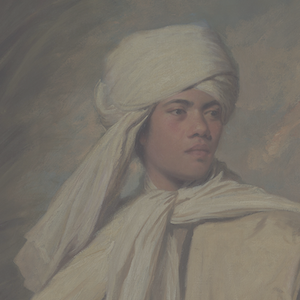
Roundtable Participants: Kate Fullagar, Miriama Bono, Pauline Reynolds, Jocelyn Hackforth-Jones, Peter McNeil, Monica Anke Hahn, Carl Vail, Peter Brunt. In March 2023, the longstanding battle for ownership of Sir Joshua Reynolds’s Portrait of Mai (c. 1776) was resolved (Fig. 1). After more than two decades of struggle to retain in public…
Colonial Crossings: A Review–by Juan Manuel Ramírez Velázquez
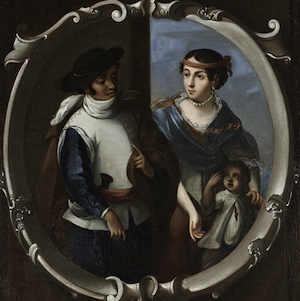
Colonial Crossings: Art, Identity, and Belief in the Spanish Americas (The Herbert F. Johnson Museum of Art, Cornell University, July-December 2024) To welcome visitors, the exhibition Colonial Crossings: Art, Identity, and Belief in the Spanish Americas (July-December 2024) created a large-scale map illustrating transoceanic routes across the Atlantic, the Caribbean,…
Between Europe and Africa: A Gift of Prestige in the Era of the Trade in Enslaved Africans
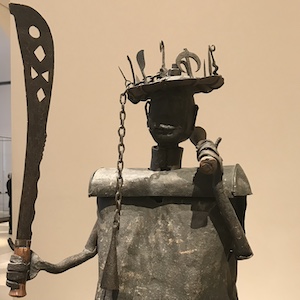
Ana Lucia Araujo Historians and art historians have increasingly explored the role of material culture and gift exchanges in the context of the transatlantic slave trade.[1] A number of these studies have paid particular attention to the role of prestige gifts in the commercial and cultural exchanges between Africans and…
From Harar to Diu: Circulation and Reception of a Qur’anic Manuscript across the Indian Ocean
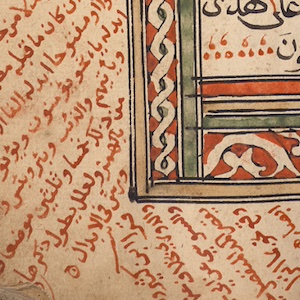
Sana Mirza A Qur’anic manuscript in the collection of Princeton University Library (PUL) reveals a fascinating history of the interconnections between commercial and artistic centers within the eighteenth-century Indian Ocean, and the complexity of identities and regional styles of manuscript production during a period of increasing transoceanic empires and networks.…
The Indian Madras Cloth and Elite Self-Fashioning in the Bight of Biafra
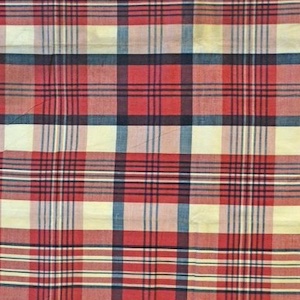
Eguono Lucia Edafioka Ukpon a tue re do omo.[1][It is the cloth one wears to which we will give the salute of chieftaincy.] On a December morning in 1842, King Eyo Honesty of Old Calabar penned a letter to Commodore Raymond of the British Navy. In the letter, the King…
Forging Swahili Muslim Style: Material Culture from Pate Island (ca. 1750-ca. 1850)
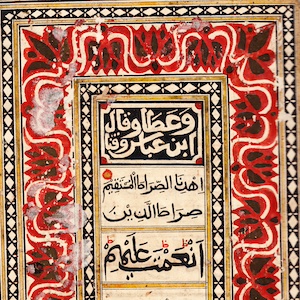
Zulfikar Hirji The ousting of the Portuguese from coastal East Africa in 1729 ushered in an era of cultural efflorescence in the Swahili Muslim city-states of Pate, Siyu, and Faza on Pate Island in the Lamu Archipelago.[1] At this time, each city-state had a population ranging in size from ten…
The Ujumbe of Mutsamudu, an Eighteenth-Century Swahili Stone House in the Comoros
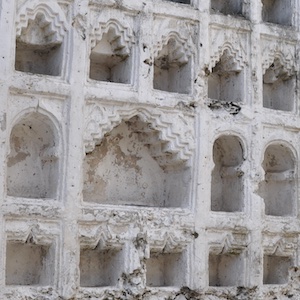
Stéphane Pradines and Olivier Onezime The Swahili Coast is a stretch of land extending from Mogadishu in Somalia to the Bay of Sofala in present-day Mozambique. Etymologically speaking, wa-swahili means the people of the sahel, the Arabic word for “shore.” This appellation dates to the colonial period and the nineteenth…
Arts of the Maghreb: North African Textiles and Jewelry – Curatorial Reflections
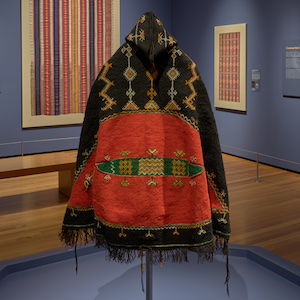
Helina Gebremedhen In November 2024, the Cleveland Museum of Art (CMA) inaugurated the exhibition Arts of the Maghreb: North African Textiles and Jewelry. The exhibition, on view through October 2025, highlights the rich artistic traditions of Morocco, Algeria, and Tunisia in the late 19th and early 20th centuries, showcasing intricate…