Agnieszka Anna Ficek
In the State Library of New South Wales is a carefully rendered ca. 1798 drawing of the Eora man and colonial intermediary Woollarawarre Bennelong (ca. 1764–1813) by William Waterhouse (ca. 1752–1822) (Fig. 1).[1] Rendered in profile and dressed as a late eighteenth-century English gentleman in a jacket, spotted waistcoat, and ruffled cravat, Bennelong gazes forward with dark curls falling to his shoulders. The sketch shows similarities to the contemporaneous print by Samuel Neele that circulated throughout the British Empire. Published in Thomas Bankes’s Modern and Authentic System of Universal Geography (1788), Neele’s engraving presents Bennelong in the same attire as Waterhouse’s portrait but framed by Aboriginal shields, spears, and a feathered headdress, a well-worn symbol of indigeneity in the Americas that had been translated to Australia.[2] The inscription beneath the image reads: “Portrait of Bennilong [sic]; a native of New Holland, who after experiencing for two years the Luxuries of England, returned to his own Country and resumed his Savage Habits.”[3]
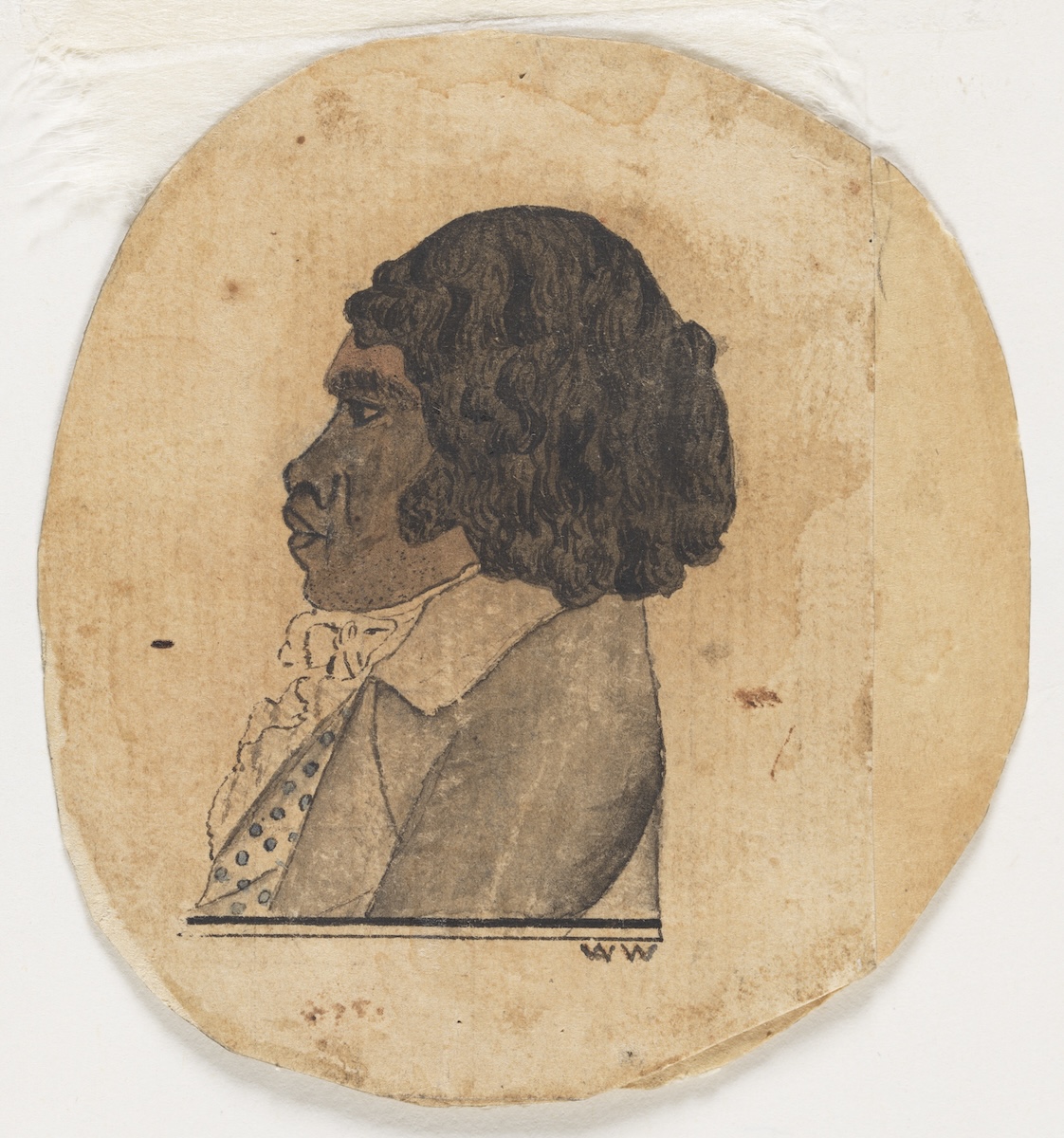
The contrast between Bennelong’s gentlemanly clothing and the martial imagery surrounding him reflects the tensions of his own life as he moved between Sydney and London. An Eora man from the Wangal clan, Bennelong became an intermediary between his community and the British colonists at Sydney Cove before traveling to London in 1792 as a representative of the new colony and returning to Sydney three years later. His movements across the empire were shaped by diplomacy, coercion, curiosity, and the unequal conditions of colonial encounter. After being kidnapped by the British, Bennelong mediated between Arthur Phillip (1738–1814), the first governor of New South Wales, and the Eora during the early years of the colony. Yet Bennelong’s portraits reveal something broader than the beginnings of British Australia. They expose the visual networks of an eighteenth-century empire whose cultural traffic flowed in multiple directions.
Both portraits are striking for what they omit. Bennelong is detached from Country and set against a featureless background. Rather than portraying an Aboriginal leader within his community or on Country, as in paintings by the Port Jackson Painter, the drawing and print transform him into a collectible imperial figure, a visual souvenir from the newest British Pacific possession.[4] Yet the circulation of Bennelong’s portraits complicates this reading. Bennelong was not merely represented by the empire; he moved through this network under radically unequal conditions: British colonists kidnapped him in Sydney, while colonial administrators described his voyage to England as “voluntarily and cheerfully” undertaken.[5] Like the Ra‘iatean voyager Mai (known in Britain as Omai) two decades earlier, Bennelong traversed the globe. He went by way of Rio de Janeiro to London in 1792, spending almost three years away from Sydney as an intermediary between metropolitan audiences and Indigenous worlds.[6] His journey suggests that empire functioned less as a one-way pipeline from London to the colonies than as an archipelago of interconnected places, each contributing people, objects, and knowledge to the imperial center.
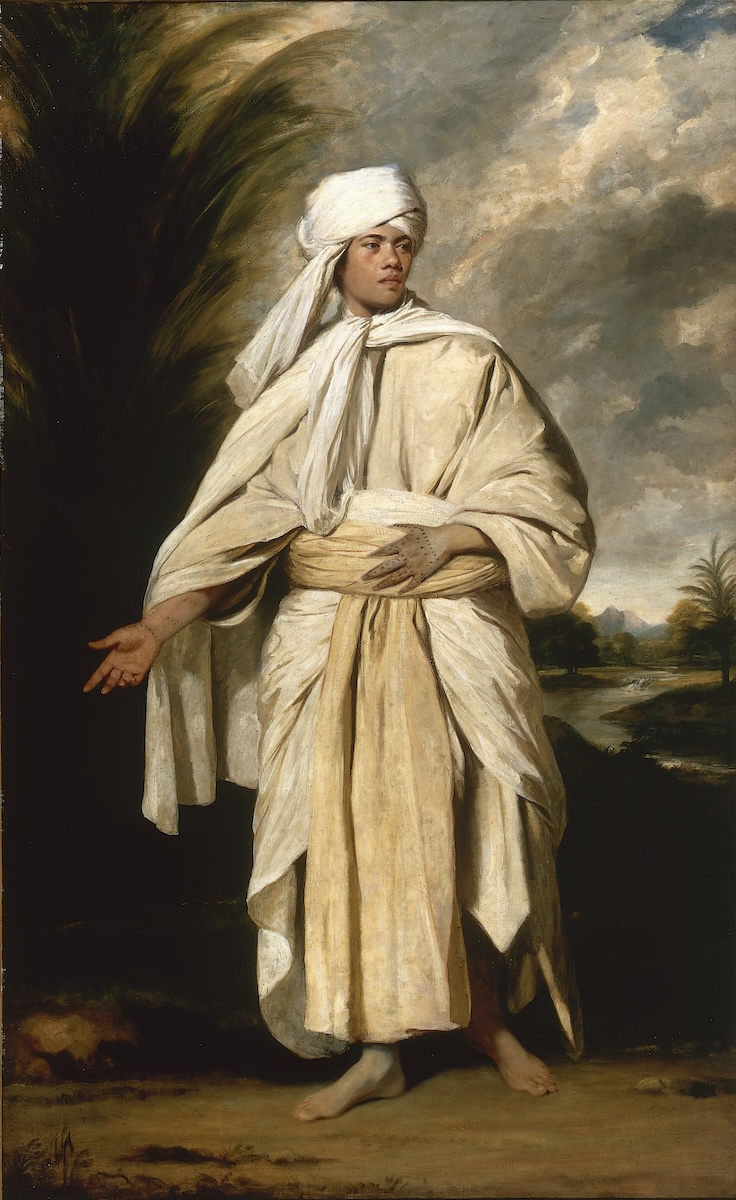
Contemporaries immediately recognized the comparison. Marine officer Watkin Tench admitted that he had imagined “Baneelon [sic], whom imagination had fondly pictured, like a second Omai, the gaze of a court, and the scrutiny of the curious.”[7] Mai had become a celebrity in Georgian London during the 1770s, painted by Joshua Reynolds, entertained by the elite, and celebrated in poetry and theater (Fig. 2). In Reynolds’s portrait, Mai’s flowing white robes and turban-like headdress drew upon the conventions of early orientalist portraiture, translating his Pacific origins into a more familiar Georgian visual language of exoticism and idealized alterity. Bennelong appeared destined to follow the same path. As Kate Fullagar has shown, however, Bennelong’s arrival in London attracted remarkably little attention.[8] Although he visited many of the same landmarks as Mai, including St Paul’s Cathedral, Parliament, and Covent Garden, he neither met the King nor became the fashionable curiosity later histories imagined.[9] The political climate helps explain why.
Bennelong arrived in London amid mounting revolutionary anxieties across the Channel, with the loss of the American colonies still casting a long shadow and the Haitian Revolution newly underway. On May 21, 1793, the day he reached Britain with his Eora companion Yemmerrawanne (ca. 1775–1794), The Sun advertised George Pidcock’s model of the French guillotine alongside kangaroos from Botany Bay in his Grand Menagerie.[10] Revolutionary violence and Australian novelty occupied the same exhibitionary space. Newspapers likewise drew political analogies. One London paper sarcastically declared that Australia had finally produced the egalitarian society sought by the French Jacobins: “[The Jacobins] are the natives of New South Wales.”[11] Bennelong was thus cast less as a second Mai than as a symbolic Robespierre of the Antipodes, an association reinforced by reports of violence during the earliest encounters between British colonists and the Eora. Bennelong’s portraits therefore carried the image of an Aboriginal man together with metropolitan anxieties about revolution, empire, and the changing position of Britain in a rapidly expanding world.
Seen in this light, the portraits visualize an empire constituted through the movement of people, ideas, commodities, and images. Bennelong occupied the center of these exchanges: an intermediary between Governor Phillip and the Eora, between Sydney and London, and between Indigenous and European systems of knowledge. His likeness complicates the familiar narrative of imperial power flowing outward from Britain.
These portraits therefore deserve to be considered alongside the famous images of Mai rather than solely within Australian colonial history. Together they reveal an eighteenth-century imperial archipelago in which visual culture in London depended upon encounters at its farthest edges. Indigenous Australian people, objects, and images contributed to the production of metropolitan culture. Bennelong’s image reminds us that the British Empire was never a one-way street; people and images arriving from places cast as imperial peripheries continually reshaped the metropolitan center.
Agnieszka Anna Ficek is an independent art historian specializing in early modern representations and constructions of “otherness” and the “exotic”
[1] The portrait is inscribed on the back “Banalong [sic] one of two Natives the first brought from New South Wales by Gov.r [John] Hunter and Cap.n Waterhouse.”
[2] Thomas Bankes, A New and Authentic System of Universal Geography (C. Cooke, 1788).
[3] Thomas Bankes, A Modern, Authentic And Complete System Of Universal Geography: Including All The Late Important Discoveries Made By The English, And Other Celebrated Navigators Of Various Nations, In The Different Hemisphere… (C. Cooke, 1797), 259.
[4] The Aboriginal portraits by convict painters Thomas Watling (1762–1797) and George Raper (1769–1797), currently in the Natural History Museum in London, offer comparative examples.
[5] “With the Governor there embarked, voluntarily and cheerfully, two natives of this country, Bennillong and Yem-mer-ra-wan-nie, two men who were much attached to his person; and who withstood at the moment of their departure the united distress of their wives, and the dismal lamentations of their friends, to accompany him to England, a place that they well knew was at a great distance from them.” David Collins, An Account of the English Colony of New South Wales (T. Cadell Jun. and W. Davies, 1798), 251.
[6] Coll Thrush, Indigenous London: Native Travelers at the Heart of Empire (Yale University Press, 2016), 231.
[7] Watkin Tench, quoted in L. R. Hiatt, “Bennelong and Omai,” Australian Aboriginal Studies 2004, no. 2: 87.
[8] Kate Fullagar, “‘Savages That Are Come Among Us’: Mai, Bennelong, and British Imperial Culture, 1774–1795,” The Eighteenth Century 49, no. 3 (Fall 2008): 225.
[9] Fullagar, “‘Savages That Are Come Among Us,’” 211.
[10] Markman Ellis, “‘That Singular and Wonderful Quadruped’: The Kangaroo as Historical Intangible Natural Heritage in the Eighteenth Century,” in Intangible Natural Heritage, ed. Eric Dorfman (Routledge, 2011), 73.
[11] As noted by The Times on June 6, 1793 (quoted in Hiatt, “Bennelong and Omai,” 89), “At last a discovery has been made of a race of men, who are covered and guided by those laws of Equality, with the regicides in France are endeavoring to establish. They are the natives of New South Wales. It is to such a state of nature, that the Jacobins want to bring the people of France.”
Cite this article as: Agnieszka Anna Ficek, “Bennelong’s Portraits and the Archipelago of Empire,” Journal18, Issue 22 Archipelago (Fall 2026), https://www.journal18.org/8345.
License: CC BY-NC
Journal18 is published under a Creative Commons CC BY-NC International 4.0 license. Use of any content published in Journal18 must be for non-commercial purposes and appropriate credit must be given to the author of the content. Details for appropriate citation appear above.
