
Bridget Garza Griffin
In 1775, Charleston cabinetmaker Thomas Elfe (fl. 1747–1775) drafted his will. Among the assets he bequeathed to his son, Thomas Jr., were cabinetmaking tools, planks of mahogany, and three enslaved men: Joe, Jack, and Paul. Elfe described the three enslaved men as having been “brought up in [his] business.”[1] This phrasing was often embedded in the legal language of inheritance. In addition to wills, advertisements by white southerners often drew on such slave-market terminology, or common market language, to signal the perceived skills and value of enslaved people.[2] The skills and value invoked by this language rested on years of craft knowledge accumulated by enslaved individuals. Recent scholarship increasingly seeks to recover the lives of both enslaved and free Black craftsmen in Charleston, demonstrating the centrality of Black artisans to the city’s furniture trade.[3] For example, William A. Strollo demonstrates Elfe’s extensive reliance on enslaved furniture makers; Elfe’s records document men trained in sawing, carpentry, cabinetmaking, furniture assembly, and painting. At least one learned the trade through a formal apprenticeship.[4] That Elfe paired tools, mahogany planks, and enslaved craftsmen in a single bequest lays bare how integral enslaved labor was to the furniture economy of Charleston.
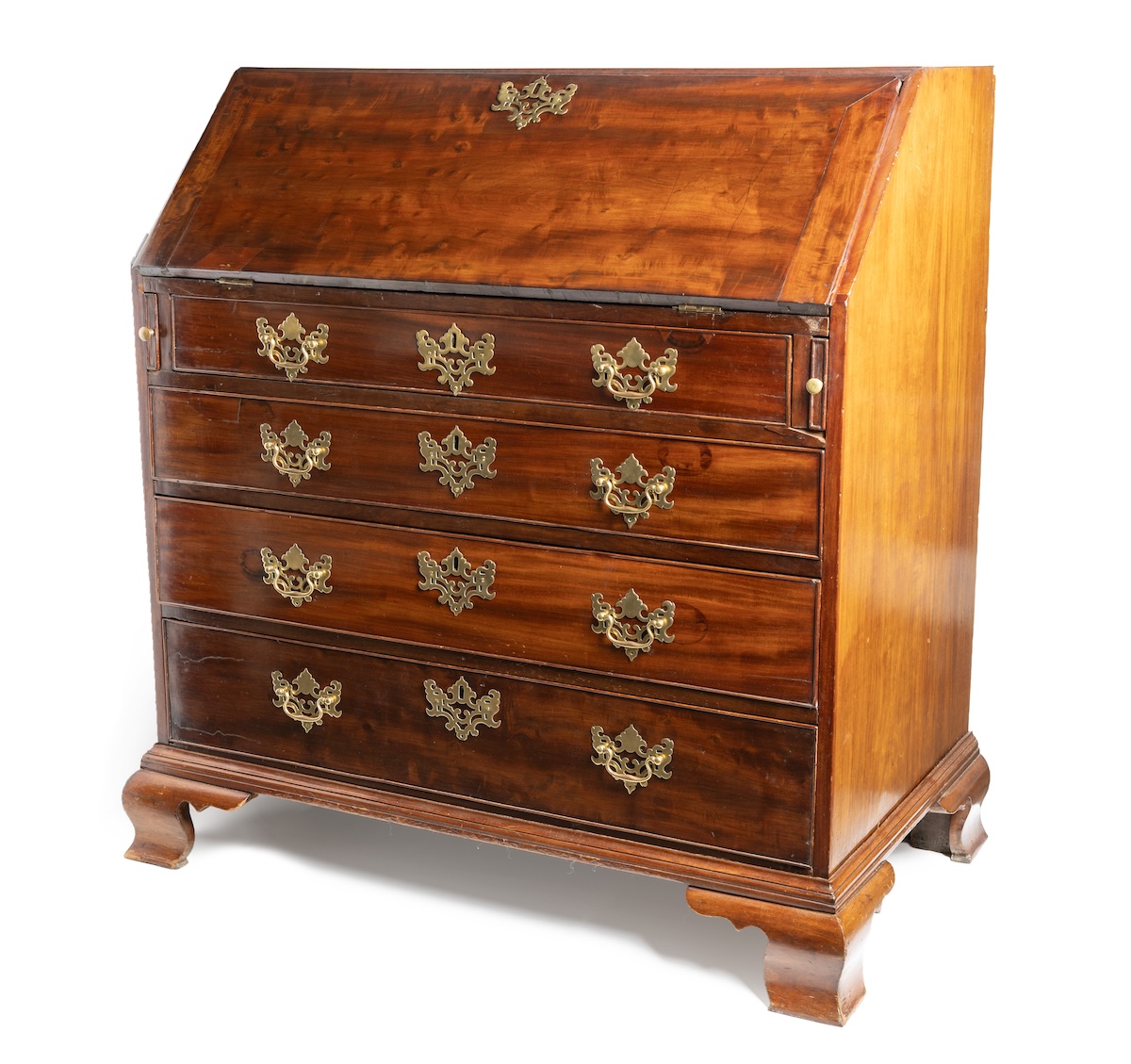
A slant-front desk attributed to Thomas Elfe (now in the Charleston Museum) (Fig. 1) offers a case through which to reconsider attribution to the workshop master within an archipelagic framework. Drawing on Édouard Glissant’s concept of Relation, we can understand Charleston furniture as shaped through processes of creolization, or continual cultural encounter and exchange within the Caribbean archipelago. While the people who actually constructed the desk cannot be identified, its attribution to Elfe alone obscures the workshop’s true nature as a coerced collective that included enslaved craftsmen on whose labor his extensive production depended.[5] The slant-front desk features mahogany as its primary wood, possibly imported from the Bay of Honduras or [New] Providence (Bahamas), with Lowcountry cypress used as the secondary wood in the interior. Provenance records indicate the desk (ca. 1760–1775) was once owned by the Lynes family of Foxbank Plantation in South Carolina and produced during the time that Joe, Jack, and Paul were in Elfe’s workshop (Fig. 2).[6]
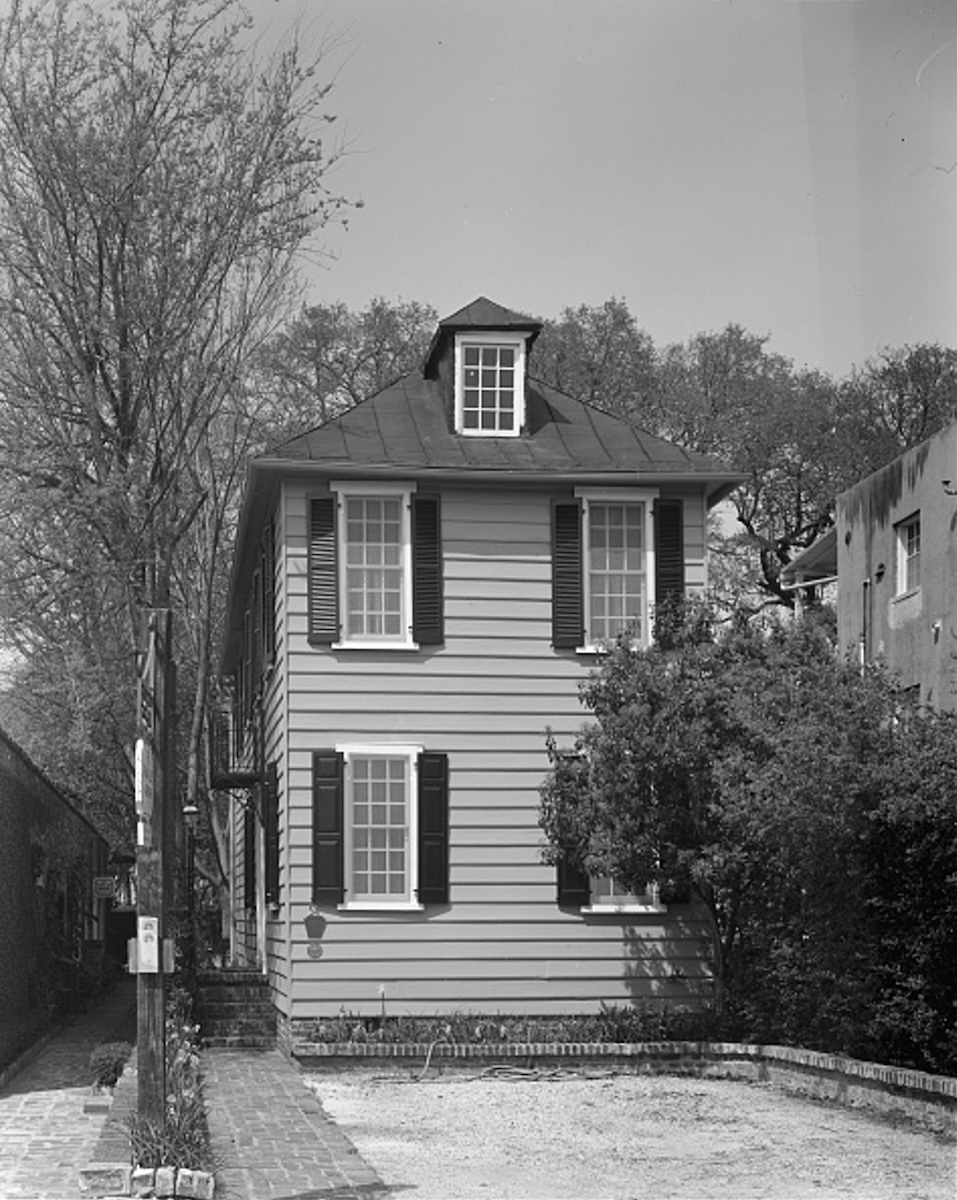
The Lynes family took ownership of the rice plantation and “all that plantation or tract of land called Fox Bank containing 430 acres” in 1819.[7] Who lived there when the desk was in situ is unknown. Its placement within a plantation household, however, invites consideration of the enslaved men, women, and children whose labor maintained this domestic environment. In her book, Portraits of Resistance: Activating Art During Slavery, Jennifer Van Horn emphasizes that Black viewership is a significant dimension of material culture. Thus, the desk made in Elfe’s workshop, potentially through the labor of enslaved craftspeople, may be understood not only as an object of elite ownership but also as one that existed within a visual environment experienced by people deprived of autonomy.[8] The desk was later purchased by William Henry Walling and his wife, Emma Elizabeth Walling, née Nettles, and entered the museum collection by 1952.[9]
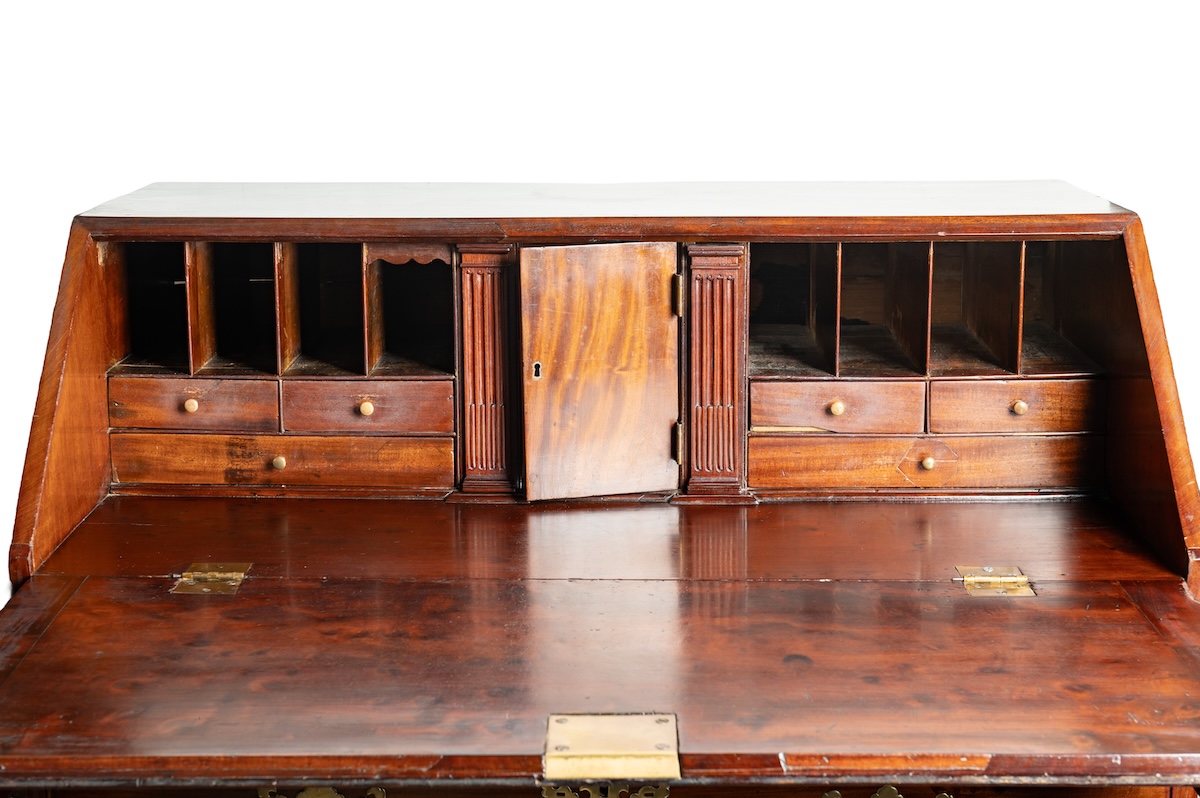
The desk displays distinct Charleston hallmarks: cypress construction and “U-dot” fluting, a decorative pattern of rounded grooves, and circular motifs on the letter drawers. The interior drawer fronts, fall front, and central compartment door are veneered in figured mahogany.[10] Its restrained form and interior reflect popular Lowcountry motifs. Interior features, including the arrangement of open compartments or pigeonholes and drawers, reveal a hybrid vocabulary influenced by English print sources such as Thomas Chippendale’s The Gentleman and Cabinet-Maker’s Director (1754; 3rd ed., 1762) and by Germanic design traditions circulating in Charleston and wider colonial America (Fig. 3).[11] However, as is typical in any cultural exchange, craftspeople adapted these designs to local materials and varied construction practices. Recent scholarship describes this as a “technological dialogue” or “inventive exchange,” in which objects became “mobile forms of knowledge.”[12] This adaptation depended both on printed designs and on embodied furniture-making skills, through which craftsmen translated visual models into material form. The migration of craftspeople, both voluntary and forced, contributed to the cross-cultural craft world from which Charleston furniture emerged.
The construction and interior design of the desk reflect a hybrid craft vocabulary shaped by migration. Reading its materials and makers through Kamau Brathwaite’s concept of tidalectics shifts the geography of the object outward from Charleston to the wider Caribbean and Atlantic world.[13] Between 1760 and 1775, Charleston merchants regularly advertised mahogany from [New] Providence, the Mosquito Shore, and the Bay of Honduras, imported through established colonial trade routes.[14] One 1768 notice in the South Carolina and American General Gazette offered “several thousand feet of Bay mahogany” available “very cheap for cash, or short credit.”[15] Consequently, imported mahogany connected Charleston cabinetmakers to Caribbean networks of extraction, commerce, and exchange.[16] Likewise, the supply chain, from mahogany felled in plantation forests and dedicated timber-cutting grounds through maritime shipping and merchant networks, transformed Caribbean ecological resources and enslaved labor into commodities.
In Elfe’s will, the listing of mahogany planks alongside his cabinetmaking tools and Joe, Jack, and Paul testifies that raw materials, skilled labor, and the means of production were legally and economically incorporated into the racial capitalist economy of Charleston.[17] Their transfer as part of the same bequest conflated inanimate materials and human life, rendering each a form of property through which the workshop’s productive value could be sustained across generations. The commercial networks that supplied Elfe’s workshop further extend the desk’s geography. Elfe’s former partner, the cabinetmaker and merchant John Fisher, advertised the arrival of Mosquito Shore mahogany in 1761 and Bay mahogany in 1768, illustrating the entanglement of the Charleston furniture trade with the maritime commerce that supplied its raw materials.[18]
Elfe’s will shows that timber was not the only form of property circulating through these commercial routes; enslaved sawyers, joiners, cabinetmakers, and other skilled craftspeople were also integral to these archipelagic networks as human property whose bodies and skills could be hired out, mortgaged, transferred, and leveraged as collateral within overlapping systems of credit and debt.[19] Their labor and legal commodification thus helped to sustain the Charleston furniture and decorative arts economy from which objects such as the slant-front desk emerged. Elfe’s own business records make these overlapping systems of production, property, and credit concrete.[20] Enslaved joiners and cabinetmakers appear repeatedly in his account books as “Handicraft Slaves” and as both skilled makers and forms of capital, mortgaged within networks of credit connecting Charleston’s craftsmen and planter elite.[21] The same entanglement appears in the dissolution of Elfe’s partnership with John Fisher, when enslaved workers, having been “brought up in the business,” were combined with those held by another cabinetmaker, plantation owner, and enslaver, Stephen Townsend.[22] Together, these records establish how the kind of craft knowledge used to produce the desk became interwoven with systems of property, credit, and commercial exchange.
Elfe’s slant-front desk condenses an archipelagic world into a single object, bringing together London-disseminated design sources, Caribbean mahogany, Lowcountry cypress, and the skill and coerced labor of enslaved furniture makers. As such, it consolidates materials, knowledge, and labor from multiple Atlantic geographies within a piece of furniture made for Charleston elites. The archival recovery of Joe, Jack, and Paul does not permit attribution of the desk to any one of them, but it does reveal the limits of singular attribution as a means of understanding its production. Read in this way, the desk demonstrates that eighteenth-century Charleston cannot be understood apart from the Caribbean and the wider Atlantic world: its materials, labor, and commercial networks situate the city within interconnected geographies linking Caribbean islands, the Lowcountry, metropolitan Britain, and West Africa through continual movement and exchange.
Bridget Garza Griffin is the Oliver Ford Curatorial Research Fellow for Furniture and Woodwork in the Performance, Furniture, Textiles and Fashion Department at the Victoria and Albert Museum, London
[1] Thomas Elfe, will, July 7, 1775, Wills, vol. 17 (1774–1779), 88, Charleston County Probate Court, Charleston, SC, accessed via South Carolina, U.S., Wills and Records, 1670–1980, Ancestry.com, image 522 of 793.
[2] Stephanie E. Jones-Rogers, They Were Her Property: White Women as Slave Owners in the American South (Yale University Press, 2019), 114–15. Jones-Rogers notes that sellers frequently described enslaved people using terms such as “likely,” “good,” “excellent,” and “superior,” and placed them within “saleable lots.” Such terminology not only advertised perceived skills and value but also reinforced racial categorization and the traits buyers sought in enslaved individuals.
[3] Grahame Long and Gary Albert, “John Gough, Free Black Cabinetmaker of Charleston, 1763–1791,” Journal of Early Southern Decorative Arts 41 (2020).
[4] William A. Strollo, “‘An Amazing Aptness for Learning Trades’: The Use of Enslaved Craftsmen in Charleston Cabinetmaking Shops,” Winterthur Portfolio 59, no. 4 (2025): 223.
[5] Strollo, “‘An Amazing Aptness for Learning Trades,’” 223.
[6] Samuel A. Humphrey, Thomas Elfe, Cabinetmaker (Wyrick & Company, 1995), 104–5; Elfe, will, July 7, 1775, 88.
[7] Register of Mesne Conveyance, Charleston County, SC, Book B-9, 335–36.
[8] Jennifer Van Horn, Portraits of Resistance: Activating Art During Slavery (Yale University Press, 2022).
[9] Humphrey, Thomas Elfe, 104–5.
[10] Humphrey, Thomas Elfe, 104–5.
[11] Elizabeth A. Flemming, “Staples for Genteel Living: The Importation of London Household Furnishings into Charleston during the 1780s,” American Furniture (1997): 335–58; J. Thomas Savage, “The Holmes-Edwards Library Bookcase and the Origins of the German School in Pre-Revolutionary Charleston,” American Furniture (1997): 106–26. Savage documents the German-born cabinetmaker Martin Pfeninger working for Elfe in 1772.
[12] Felicia Gottmann et al., “The Migration–Innovation Nexus in the Early Modern World,” Past & Present, March 19, 2026, 6.
[13] Kamau Brathwaite develops cyclical movements of Atlantic history and migration throughout The Arrivants: A New World Trilogy (Oxford University Press, 1973); for his formulation of “tidalectics,” see Brathwaite, conVERSations with Nathaniel Mackey (We Press, 1999), 34. On creolization and Relation, see Édouard Glissant, Poetics of Relation, trans. Betsy Wing (University of Michigan Press, 1997), 33–34.
[14] Provincial newspapers of the period regularly advertised mahogany arriving from [New] Providence (Bahamas), the Mosquito Shore, and the Bay of Honduras, reflecting established Caribbean timber routes documented across the eastern seaboard. Providence (Bahamas) mahogany, often called Madera, reached its peak at 400 percent of mahogany imports to Charleston in 1736. By 1760, Bradford L. Rauschenberg notes that this number dropped to 4.17 percent, and after this date, there were no further records of Madera being brought into Charleston. However, Providence (Madera) wood would likely still have been in circulation during the desk’s production date range. See Bradford L. Rauschenberg and John Bivins Jr., The Furniture of Charleston, 1680–1820 (Museum of Early Southern Decorative Arts, 2003).
[15] South Carolina and American General Gazette, January 19, 1768, 3. Fisher advertised freight space on the brigantine for goods bound for the West Indies, including several thousand feet of Bay mahogany, and noted its return to the port city in 1768. As Anderson notes, merchants along the eastern seaboard handled mahogany alongside other imported goods, purchasing whole logs and relying on local sawyers to cut them into planks. See Jennifer L. Anderson, Mahogany: The Costs of Luxury in Early America (Harvard University Press, 2012), 203.
[16] Anderson, Mahogany, 89–124.
[17] Elfe, will, July 7, 1775, 88.
[18] South Carolina Gazette and Country Journal, November 14, 1761, 3; South Carolina and American General Gazette, January 19, 1768, 3. Described as “master,” Fisher appears in a 1761 notice concerning a vessel “laden with mahogany” from the Mosquito Shore. By the mid-eighteenth century, merchants faced competition from cabinetmakers whose expertise in timber appraisal gave them a distinct commercial advantage; Anderson, Mahogany, 203–9.
[19] Trevor Burnard and Emma Hart, “Kingston, Jamaica, and Charleston, South Carolina: A New Look at Comparative Urbanization in Plantation Colonial British America,” Journal of Urban History 39, no. 2 (2013): 214–34. A cabinetmaker’s success depended on available capital, labor, timber supply, and access to local and Atlantic markets, conditions closely tied to the economic structures of plantation society. Anderson, Mahogany, 39–40.
[20] “The Thomas Elfe Account Book, 1765–1775,” South Carolina Historical and Genealogical Magazine, no. 35 (1934), no. 36 (1935), no. 37 (1936), no. 38 (1937), no. 39 (1938), no. 40 (1939), no. 41 (1940), no. 42 (1941).
[21] Thomas Elfe et al., “The Thomas Elfe Account Book, 1765–1775 (Continued),” South Carolina Historical and Genealogical Magazine 40, no. 1 (1939): 23, 26.
[22] South Carolina and American General Gazette, June 3, 1771, 3–4.
Cite this article as: Bridget Garza Griffin, “Mahogany and the Men Who Made It: Enslaved Craftsmanship and Archipelagic Networks in a Charleston Slant-Front Desk,” Journal18, Issue 22 Archipelago (Fall 2026), https://www.journal18.org/8344.
License: CC BY-NC
Journal18 is published under a Creative Commons CC BY-NC International 4.0 license. Use of any content published in Journal18 must be for non-commercial purposes and appropriate credit must be given to the author of the content. Details for appropriate citation appear above.
